

Follow this tag to curate your own personalized Activity Stream and email alerts.

David and Marina, the dynamic duo behind the Midnight Charette podcast, have hosted some big hitters in the architecture industry recently. We've particularly enjoyed their recent episodes featuring interviews with architects. Their informal style breaks the typically serious, academic format this... View full entry

Syracuse University is one step closer to selecting a world-class partner to conceptualize, design, and construct the new National Veterans Resource Complex (NVRC). The NVRC Selection Committee, made up of faculty, staff, students, and design professionals, recently reviewed the qualifications of 28 of the world’s foremost architecture firms. [...] has selected three finalists to advance to the final round of the competition. The finalists are: Adjaye Associates; SHoP; and Snohetta. — nvrc.syr.edu
"Notably, each of these firms is among the seven finalists currently vying for the opportunity to design the Obama Presidential Library in Chicago," the school's announcement goes on to say.More Syracuse Architecture news on Archinect:Deans List: Michael Speaks of Syracuse ArchitectureTwo Syracuse... View full entry

good architecture can survive budgetary rigors — at Hunters Point South, for instance, where a pair of hulking towers designed by SHoP and Ismael Levya Architects expresses de Blasio’s urgency even though it’s a holdover from the era of the allegedly Nero-like Michael Bloomberg. [...]
SHoP’s new towers are not world-beating architecture, but they’re more than good enough to plug into an evolving network of ferries, parks, schools, shops, all of which foster more investment.
— nymag.com
More on affordable housing in New York:New York's "poor doors" are no moreNYC's public-housing woesThe Chinese government is building affordable housing in BrooklynArchitecture vs. Housing: The Case of Sugar Hill View full entry

The tower would have only been 697 feet until the developers bought Steinway Hall — a deal that allowed for the building’s height to double, but also gave the Landmarks Preservation Commission the final say.
The approval was a no brainer, members said.
“It represents the best of both worlds of new construction and design and historic preservation,” Commission Chairman Robert Tierney said Tuesday.
Fellow commissioner Fred Bland called the combo “daring and smart.”
— nydailynews.com
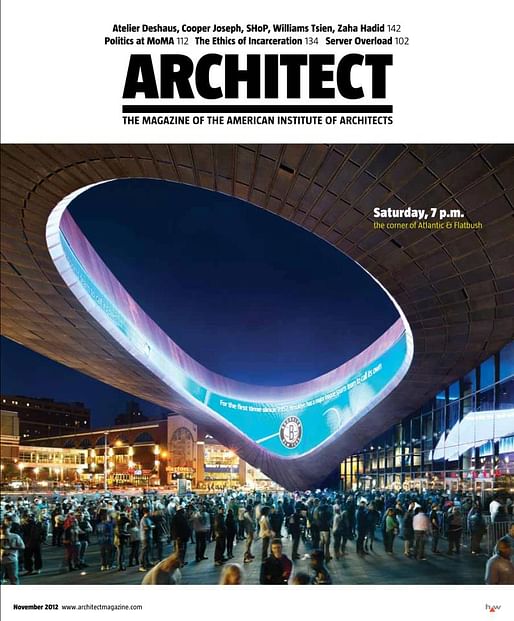
I recently received my November Issue of Architect and for the first time since the blogs caused us all to begin devouring images at warp speed and sent print media into a battle for survival, I actually "read" an architecture magazine. It was truly satisfying. From its inception, the idea behind... View full entry

Chakrabatri is proposing that the city basically double the width of the medians along 11 blocks of Park Avenue, between 46th and 57th streets, and run a 12- to 15-foot-wide pathway up the middle, thereby creating 2.24-acre promenade surrounded by the sort of lush gardens and sculptures that already occupy the medians. — capitalnewyork.com
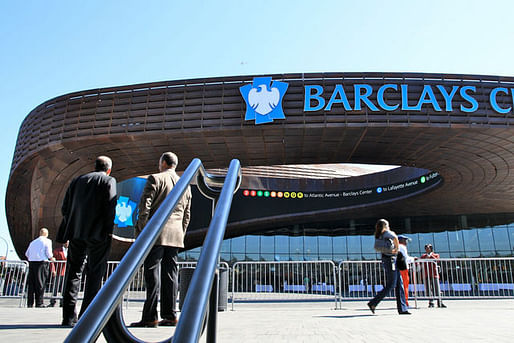
Brooklynites might consider themselves lucky. In Manhattan, Madison Square Garden’s owners are renovating, spending nearly $1 billion. Judging from results so far, it won’t be enough. The Barclays Center is no Garden disaster, just an extraordinarily expensive lost opportunity. — bloomberg.com

I do not think the arena’s architecture should relate better to the context. The immediate context is the developer Forest City Ratner’s two cheaply clad, faux-historicist malls across Atlantic Avenue. The larger context is the lowrise brownstone neighborhoods of Fort Greene and Prospect Heights. To relate to the first would be depressing; to relate to the second, impossible. The real building is an exact analogue to the renderings of this site, which... blur and dematerialize the neighbors. — newyorker.com

Ratner & Co. believe Brooklyn as a whole is already well on its way to super-premium status and will never go back. They believe Ratner has built exactly the sort of architectural showpiece and modern sports-and-entertainment megaplex that the newly gentrified Brooklynites want. — New York Magazine
Will Leitch asks now that the fighting is over and Bruce Ratner’s Barclays Center is almost completed, will the crowds come? Additionally, Aaron Plewke recently snapped some photos of the building under construction. View full entry

Mr. Chakrabarti said the firm is determined to shake things up in the world of architecture, development and planning. “Most master planning, you use pretty pastel drawings that rarely have anything to do with what gets built,” he said. “Planning has been static, it hasn’t been performative. Most of these plans, they get implemented over 20 or 30 years. Think of how much a city and the world changes in that span of time.” — New York Observer
The former city planner, developer and current chair of Columbia's real estate development program, the Center for Urban Real Estate, joins the hotshot New York firm. View full entry

Some of the names might already sound familiar to Houston design aficionados. Interloop principles Mark Wamble and Dawn Finley are professors at Rice. Denari received his undergraduate architecture degree from UH. Snøhetta is a finalist for the upcoming contemporary galleries at the Museum of Fine Arts, Houston and SHoP Architects are behind the current renovations for the Blaffer Art Museum. — houston.culturemap.com

“We have the tool kit to pull it off at the highest level in this pressure cooker of New York, and to export it to the rest of the world,” Pasquarelli says, punctuating the self-assessment with a cocky grin: I may be arrogant, but I’m right. — New York Magazine
Justin Davidson examines how SHoP Architects founded by a five friends, who met while at Columbia University in the 90s, are becoming masters of post-boom buildability. Primarily, through a focus on digital fabrication and modularity. Whether their B2 tower, which will rise at Atlantic Yards... View full entry

Those of you who were reading Archinect 6 years ago may remember Doug Johnston's school blog. If you're wondering what he's up to now check out his website and his online store, featuring his really beautiful sculptures/containers made from cotton sash cord and sewing thread. Really nice! View full entry

We know more than the developer, we know more the contractor, we know more than the inspector, we know more than the guy installing something. We know a lot about all the stuff. It’s the integrator and the communicator role that’s the most important thing: We don’t build buildings, we make instruction sets for buildings. — Gregg Pasquarelli, via observer.com

Ms. Dufault, 22, was killed when her hair became caught in the lathe, whose rotating axis is used to hold materials like wood or metal being shaped. — nytimes.com
As Aaron points out in the forum, please be safe in the shop! View full entry


