

Hi Archinect!
The sultry r&b is playing, and Saskia Sassen is in front of the gold curtain this Friday night for the keynote lecture of the conference, "Ethics of the Urban: the City and the Spaces of the Political." This is the third in a series of conferences organized by Dean Mostafavi, including Ecological Urbanism (2009) and In the Life of Cities (2011).
[View the talk at the GSD's YouTube Channel.]

[Photo: Brixton riots, London, April 1981. © Manchester Daily Express/Science and Society. From the GSD website.]

5:15: videos are playing. One from The Sopranos; a driving scene, going from Manhattan and New Jersey. The second video shows some kind of jookin-like dance performed by three young black men on a rainy street corner.
5:19: Mohsen makes introductions. The conference is organized "in the spirit of friends,' with many Harvard colleagues and special guests from out of town. He chose the videos to refer to scale. The first one, of The Sopranos, is a driving scene going from the city, and past toll-booth, which is a kind of threshold, through New Jersey and into the suburbs. The second video, of young men dancing, is a kind of ritual, and happens at the scale of one street corner. It becomes a "choreography of the making of that particular corner," addressing questions of dispute and disagreement.
5:23: These opening remarks are called "Agonistic Urbanism." A series of slides:

"One last word on the title of the conference," because the notion of "ethics" is there. "We're warned by philosophers that we shouldn't think just about politics. Žižek, for example, encourages us to temper this with a normative notion of ethics.
The conference is organized around a series of localities. "I'm very happy that the first event is this session on Cities and Citizenship, and we're very lucky to have both Saskia Sassen and Homi Bhabha here." [I'd note that although it wasn't officially part of the conference, the talk from Sassen's husband--Richard Sennett--formed the unofficial launch of this conference earlier this week.]

5:33: Saskia Sassen starts. Warns us that it's going to be a meandering trip but this is where we're going: "The question of membership is deeply troubled. ...I want to argue, a bit as a provocation, that beneath the ideological separation, which is actually happening is a structural approximating." The global security apparatus concentrates a vast number of sites, places, and organizational capabilities that are about surveying; it's a transversal geography. And who are we? We are supposed to be the ones who are protected, but we are under surveillance; and by fiat, we're all suspect.
"The citizen is an unstable subject. So is the immigrant, the irregular."
"Let me start with my decoding of citizenship. I think of it as an incompletely theorized contract between the state and the subject. In that incompleteness lies the longevity of the institution; the possibility for it to accommodate new formats. In that instability there are possibilities, both good and bad."
5:38: In the Roman Empire, citizenship was related to your geographic distance to the center.
If you take the neo-liberal movement for the past 30 years, a formal subject--the citizen--reveals herself to be subject to all kinds of transformations: we have lost rights as citizens. These losses have to do with the incompleteness of the notion of the citizen.
"Richard, a very nice person in my life, always complains that I work too hard, and that I need a hobby." She had no hobby. When Clinton passed his Immigration Reform act, rights were taken away from citizens. When that happened, she ran to Richard and said, "I have a hobby: I'm counting all the rights that citizens are losing." He said "that's not a hobby." But she's still counting.
There's no such citizen, like a Christmas tree with its baubles, such that we can see when one right (one bauble) goes missing. But we've lost several nonetheless.
Let's turn to the undocumented immigrant. Someone is an undocumented immigrant only when they intersect with the law. E.g. they go to court and are told that yes, they have a right to their wages. (Although this doesn't happen so much now, Sassen says. "The immigrant" is a very elusive subject. It doesn't exist except as an assemblage of elements.
These categories have to do with the idea of membership, made visible by the city through its conflict and accommodations. "No matter the hatred against the immigrant" in European cities throughout its cities, you can see the percentage of foreign birth. In France, 1/3 of people have a parent who is foreign born.

Let's consider remittances. We generally think of this as people who are working abroad, sending money home to poor countries. But let's look at the top 20 countries receiving remittances; France, Germany, and the United States are included. China and India are "bimodal" (both poor and rich).

5:55: There are people who are unauthorized under the law, but recognized by the community: Sassen gives the example of someone who has lived in a neighborhood for 20 years and who has worked, but who is undocumented. How do we categorize such a person?

Security agencies in the United States: the government employs many private agencies, who can employ either citizens or non-citizens. A series of slides are shown to suggest that "the government controls everything" through a vast network of agencies. "Who is the citizen here?" What is the meaning of the citizen under a regime of these practices?


Habeas corpus is gone. People can be put under permanent surveillance. 400 academics have signed off on a project related to the New York Police Department related to these kinds of issues. Immigration is now under the auspices of Homeland Security.
There is a thick and complex zone of security arrangements, meant to protect "us." And then there's "us." We are suspect in the name of our own protection. It's a history that Sassen argues is emerging right now, and "enormously important."


In 2009, the top 1% of earners in NYC received 44% of all income in NYC. And these people also generally have other sources of money that are not "income." We'll never get rid of inequality and that's not the point; but at what point do we say that this is something else entirely, something beyond mere inequality?
Graph of top 10% of earners. "The adorable Keynesian years" in the 50s and 60s, where the top 10% of earners earned under 35% of the income.
Graph of % growth in After-Tax income. Note that the bottom 50%--almost all citizens--earn almost nothing. (Further destabilizing the idea of citizenship.)
 Foreclosures: 15 million contracts for "subprime mortgages" were sold. From 2006 to 2010, 14.2 million foreclosures were made. "Short brutal histories." These are real people's stories. Many are in cheaper homes, or in homeless shelters, or "slab cities." These are vast numbers; each of these households can be one person or more. But once they've gone through foreclosure, "the system renders them invisible."
"I want to end with a rumination on the city. How do these trends instantiate in the space of the city?" How does a city have urban capabilities that arise out of the space and people? Is it a space where the question of membership gets messy, through interaction? Think of the embedded code of the center of the city during rush hour. It is crowded; people may step on each other's toes, or get pushed, but there is an unspoken code that you don't get upset about this. In a small town this kind of thing could incite violence. This is a kind of capability of the city (to absorb this kind of situation).
What is the structural approximation of this kind of situation?
"The United States could have dropped a bomb on any major Iraq city; but in a way, it couldn't." Or similarly, think about the occupation of Tahrir Square, or about the Occupy Movement here: it's a project of making urban capabilities, the capability to occupy a space.
"The 'outsider,' the 'immigrant,' the 'illegal': these are very unstable subjects. So is the 'citizen.'" The city becomes a place where these people can become visible, and these categories can be engaged.
Done, applause. Homi Bhabha takes to the podium.
"One of the great pleasures of growing older" is meeting the same people in new places. (Alluding to the fact that Sassen and Bhabha knew each other in Chicago.)
6:18: HB observes that the nation has often been a patriarchal notion, while there have been many female scholars of citizenship; it's been a matriarchal field. Their work has been diverse, but...these differences do not prevent the emergence of a shared project about the nature of citizenship, and a national and global redistributive politics.
We must be aware of the estranging conditions, out of which this work comes. [Run-down of these various scholars' projects. The interstitial, the alienated, the incomplete are mentioned.] Quoting Sassen: "Incompleteness brings to the fore the work of making. ...It is the outsider and the excluded who have been key members of this incompleteness by subjecting the institution to new claims across times and space."
Incompleteness is integral to the condition of being formalized; the tension between the formalized and the incomplete is the engine of change--change which may become lethal to the institution itself. "When I hear, however, that incompleteness can effect lethal change to the status quo, my mind turns to questions of state, citizenship, and the police in the Foucauldian sense" of state, population, civilization, security, and so on.
What is the role of police? What is the role of state violence, group violence, institutional violence in the struggle for claims and rights? This needs some filling-out. HB seeks a third mode, in addition to making and unmaking.
HB applauds Sassen's notion of incompleteness..."but I worry that incompleteness of this kind may as quickly lead to barbarism, as it opens up new forms of civility." Modes of violence are short and quick. The worst period of killing in Rwanda was 100 days. This catastrophic possibility requires us to reflect on violence, well-being, and the complex sense of securitas in the whole sense of a construction of a population.
"I have been more persuaded by Sassen's notion of de-nationalization, and less by the upbeat notion of the post-national." There's a complicity between the foreign and the national, for example in many poor countries, which leaves behind the vast majority of people (the poor) to the benefit of very few. The presence of foreign agribusiness in India has led to (hundreds) of suicides among farmers. A similar case exists with deforestation.
"Saskia moves us to sharpen our ethical and political visions." The sovereign nation state may have lost legitimacy after Auschwitz or Rwanda, or destabilized after the recent financial crisis.
"For the Kashmiris, the Palestinians, some First-Nation peoples, the nation is always a proleptic, a future promise" lost under a specter of patriotism. Nations make lives and also deaths. "The ghosts of sovereignty are fierce and are capable of reappearing in many forms." "Spectral sovereignty is created in the asymmetrical conditions of global capitalism, and it is necessary to put it together with attempts at globality to create consumer cosmpolitanism."
End. Applause. Sassen and Bhabha sit down at the table. Sassen playfully mentions that she is replying to Bhabha's reply to her talk.
SS: ..."Who is gaining rights? Corporate actors." How can citizens engage this question? You're right that this is a critical issue; I don't have an answer. ...In me also lies the activist and positive person who asks how formal systems of power come down? Typically it's not because there's a stronger power. In WWI the victor was the one with the bigger guns. (But not in most cases.)
SS: The state: for me, it's a category that no longer works. I see as a feature of this current period, with "the decline of the state," is the rise of the executive arm of government. It has one leg in the global world, where it is no stranger. It is also where we have the least standing. "The courts have greater use to us." HB: Depending on where you are. SS: Absolutely, but for the moment I'm thinking of the USA.
SS: "It is terrible from the perspective of spectacle, that I don't disagree with anything" that HB said. "You are dialogical [a reference to Richard Sennett's talk from a few days ago]."
HB: "It seemed to me that in the incompleteness model--I want to understand how it can flip over." And then, how to stabilize it, for the radical redistributive politics that you are suggesting?
HB is talking about Ian McEwan's novel Saturday, which takes place on a day when there are protests against the war in Iraq, and refers to this quote: "He's a docile citizen, watching Leviathan grow stronger while he creeps under its shadow for protection." HB is suggesting that there's a kind of passive bourgeois life that we need to spend some time thinking about, without judging, but thinking seriously.
...HB: "Reification is always a bourgeois performance."
Question from the audience: "You concentrated on the producer side, not the consumer side. We've traded producer sovereignty for consumer sovereignty." [Rant about how consumerism isn't good. No question, just a statement.]
SS: "In terms of consumerism, I admit it's a permanent weak point in my argument. I'm simply not good at addressing it, but it's not the direction I was going in."
Question from the audience: "What is the complete citizen by means of comparison? Is it a kind of slave, robot, machine, or corporation? Can you speak to that in reference to social media--Facebook or Wikipedia (etc.)?"
SS: Citizenship is always incomplete. If we get to the robot, it's over. It's one capturing of the kind of complex subject we want to be. We don't want to just be a robot, a slave, etc. But we might find other forms through which a complex satisfying membership can be found.
What happens when all of this goes digital (free-floating, etc.)? SS mentions that she's written a paper on this recently. Partial elements can constitute something. In some networks, I'm this part; in other networks, I'm another part. Interactive domains deliver their utility through ecologies that include the non-technical.
Question from the audience: "My question is if you could say more about the role of the city, not as a site but as an actor in creating new forms of nationalism."
SS: The city for me is both a space that has the capability to make apparent aspects which in other settings cannot be experienced. How does the city talk back to various conditions? When I talk about a long-term immigrant who is like a citizen, that is a capability of the city, to allow that to happen.
There are urban capabilities to enable those who are less powerful to obstruct the less powerful.
The event is still going on, but I gotta duck out! Thanks for reading!
Lian
View full entry
Hi Archinect, I'm at Harvard's Kennedy School of Government tonight for a talk with Samuel Klein, Trustee at Wikipedia. It's a small crowd, but we'll see how it goes. 6:43: How ironic, we're starting with some technical difficulties. 6:44: SK is asking who has started a Wikipedia entry that... View full entry
Hi Archinect! I'm a bit under the weather today, but this is one not to miss. Richard Sennett, the GSD's Senior Loeb Fellow for 2012 (and faculty member at New York University and the London School of Economics) is talking about the "Architecture of Cooperation": “The theme of the lecture... View full entry

Hi Archinect! Tonight's event is called “Design Technologies as Agents of Change,” with Thomas Bock (TU Munich), Paul Seletsky (ArcSphere New York), Rivka Oxman (Technion Haifa), and Ingeborg Rocker (GSD). Moderated by Martin Bechthold (GSD). Three Germans tonight! 6:32: It's still a... View full entry
Hi Archinect, We're back in full Piper, eagerly awaiting Philip Glass. I'm not sure what will happen. Our website says that "Mr. Glass will speak on the theme of collaboration and the creative process and, through brief performances, share selections from his oeuvre." [Photo by Fernando Aceves... View full entry

Hi Archinect! I'm at the Media Lab for a talk with Tom Stocky, Director of Product Management at Facebook. His presentation is called "Design, Hack, Ship: How we build products at Facebook," and it was billed as offering "a glimpse into what happened behind the scenes of the initial News Feed... View full entry
Hi Archinect! Patrik Schumacher, partner at Zaha Hadid Architects and founding director at the AA Design Research Lab, is in Piper tonight for a lecture on "Parametric Order: 21st century architectural order." [You can see the video online at the GSD's YouTube Channel.] 6:36pm: PSC takes the... View full entry
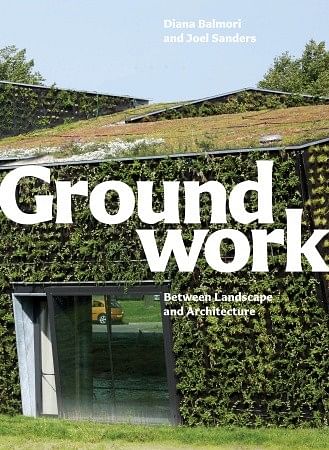
Hi Archinect! [Left to right: Charles Waldheim, Diana Balmori, Joel Sanders, Mohsen Mostafavi, Ben Prosky (facing away), and Chris Reed in Piper Auditorium before the lecture.] Balmori and Sanders are in Piper tonight, talking about their book Groundwork: Between Landscape and Architecture. I... View full entry

Hi Archinect! We're in "full Piper" with a full house for the GSD's first public event of 2012, called "Museum as Genealogy"--and it's all Scott. [Added note as of Jan 29]: For many of us as GSD architecture students, this kind of event is anticipated as a moment when some of the most important... View full entry
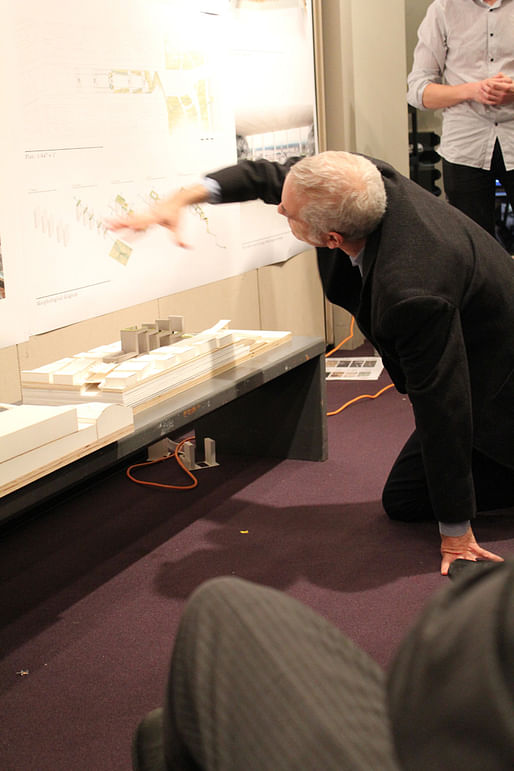
Oh hello there, Archinect! Finals were a blur and vacation was the best, and here we are back in the trays yet again. Oh, I have so many things to tell you. But first, my project from last semester! A twelve lane highway runs under the entire site. I was building on air-rights over this highway... View full entry

Hi Archinect! We have one week left before our final review and the plan is to finish my model today. Actually, the plan was to finish it yesterday, but this morning I realized that this was unrealistic. If I can finish the model today, then I'll have six days for drawings, which is still tight... View full entry

Hi Archinect! This is just a quick update as we head into our last few weeks before studio finals. Things are going well and I'm just buckling down to focus on representation techniques and the specifics of my design, so that things don't become a complete shit-show in December. I'm gonna hold... View full entry

Hi Archinect! It's Open House day at the GSD, so we're in "full Piper" (using the entire auditorium) for a lecture by Wang Shu from Amateur Architecture Studio. The video is now viewable at the GSD website and the GSD's YouTube channel. 4:05 pm: A long and laudatory introduction from Scott. He's... View full entry

Hi Archinect! We had our midterm last Wednesday and I am finally rousing myself out of my post-review sloth and pleasure-chasing (and yes, it was glorious) in order to post some images. I've already posted photos of our site. And you may have seen the video of my critics' public lecture at the... View full entry
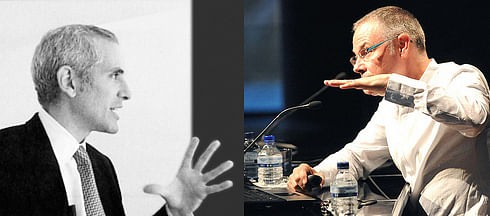
Hi Archinect! Stan Allen, Dean of Princeton University School of Architecture and Principal of SAA/Stan Allen Architect, is going at it tonight with Preston Scott Cohen, Chair of Architecture at Harvard GSD and Principal at Preston Scott Cohen Inc. The video is also posted at the GSD's YouTube... View full entry
Hi Archinect! William S. Saunders, Timothy Hyde, George P. Dodds, David Gissen, Simon Sadler, and Meredith TenHoor are in the house tonight in front of the golden curtain. The topic is theory and writing. [Update: you can now view the full video at the GSD's YouTube channel.] 6:40: William... View full entry
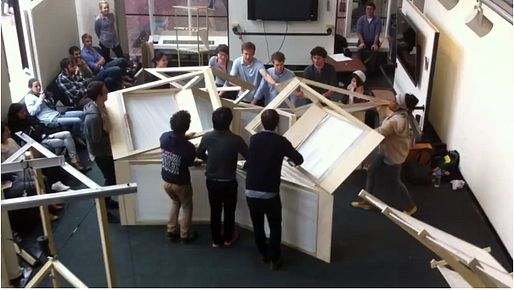
Hi Archinect! The kids did good. Here is the final project from a group of students in the first-year M.Arch.I. Materials and Construction course. They were working with fabric hinges and a geometry that allows for their full-scale mockup to be transformed and configured in a multitude of ways... View full entry
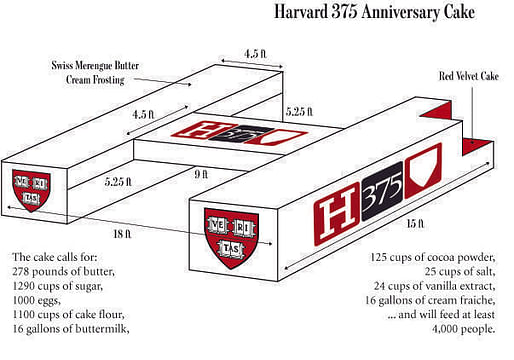
[Harvard's Birthday Cake. Graphic from The Harvard Crimson.] Hi Archinect! Well, this year the GSD turns 75 years old, and Harvard turns 375. Big parties all around, pecha kucha lectures from alumni and faculty, and lots of alumni in town for the weekend of events. Yo-Yo Ma performed in the yard... View full entry
Hello Archinect! My current studio critics, Marion Weiss and Michael Manfredi, are lecturing in front of the gold curtain tonight. You can also watch the whole thing on the GSD's YouTube channel. 6:36: Scott Cohen is making introductions. Lots of awards, great projects, Ivy League educations and... View full entry

Hi Archinect! My first semester studio critic and assistant professor of architecture, Danielle Etzler, has been building buildings for fifteen years, teaching architecture for a few, and thinking throughout about connections between these. Over the summer, I sat down with her to talk about the... View full entry

Hi Archinect! Okay, I've been sick all week, and I've missed so very many things. (Note: if you're ever told that it's OK to get a flu shot while you have a cold without a fever, don't believe it! Flu shots are powerful.) On Monday, Asia GSD invited Erwin Lui, a senior designer at Toyota... View full entry
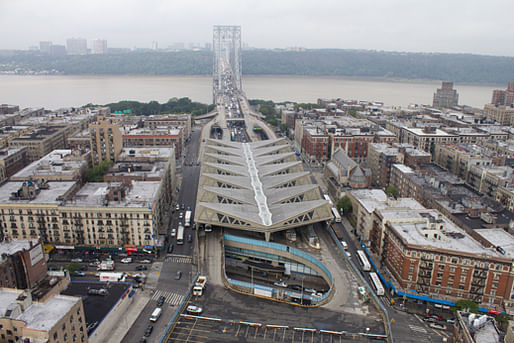
Hello Archinect! Last week our studio (led by Marion Weiss and Michael Manfredi) went to NYC to visit our site, which is the area around the "Bridge Towers" that are built directly over the I-95 highway in northern Manhattan. [This image from Weiss/Manfredi. All other images are mine.] Our site... View full entry
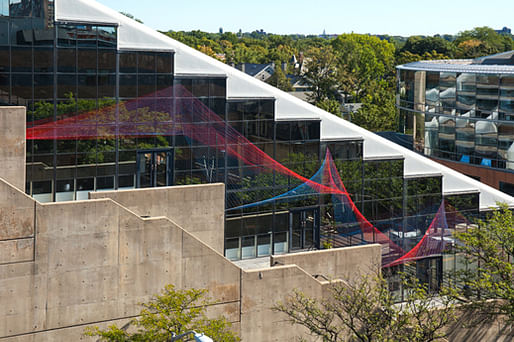
Hi Archinect! Like most schools of architecture, the GSD has a tradition of students installing projects in and around the building. Some of these last longer than others, and some are better thought-out and executed than others. Some are not installations at all, but just crumbling pieces of... View full entry
Hi Archinect, Just a quick note to say that my studio, led by Marion Weiss and Michael Manfredi, will be running a workshop on "Evolutionary Infrastructure: An Unfinished Utopia" at the BMW Guggenheim Lab this Friday, September 23, from 3 to 5 pm. If you're in New York and have a moment to stop... View full entry
Hi Archinect,Janette Sadik-Khan, the New York City Department of Transportation Commissioner, is speaking in Piper as part of the 'Roadmap to Sustainable Infrastructures & Green Cities Conference.' [Photo from Esquire.com] 6:38: It's a pretty full house in Piper tonight. Sadik-Khan is as... View full entry
Hi Archinect! Live-blogging tonight from Piper Auditorium, where we somewhat inexplicably (and to my endless fascination) have a new gold lamé curtain. Krzysztof Wodiczko, Erika Naginski, Mark Jarzombek, and Kirk Savage are talking in an event marking the 10th anniversary of 9/11. The... View full entry
Hi Archinect! This post is as advertised. "Site visit" on Saturday, September 3, 2011 to our site from last semester's studio project--Flushing Meadows. [I was crouched in the bushes like a pervert to take this photo. Tennis fans, you know that I know that you know who this is.] Now I'm back at my... View full entry
Hello Archinect! Just a quick note to say that it looks like the GSD's new website, which has been in the works for the past few years, is live! I haven't even looked through it yet, but you can check it out here. The site is designed by Lisa Strausfeld's team at Pentagram. Thanks for looking!... View full entry
Hello Archinect!!! I was very happy to wake up to this email from Dean Mostafavi this morning:Dear Students, Due to the overwhelmingly positive response to this semester’s Paris studio offering, we have made plans to continue the Study Abroad Program in Tokyo for the Spring 2012 term. Toyo... View full entry
Hello Archinect! Like everyone else who's heading back to school this fall, I'm not yet prepared to let go of summer. There are so many things I wanted to do but haven't yet done! I just need a bit more time. I'm not ready yet! Apparently, Gund Hall feels the same way: The GSD's 75th anniversary... View full entry
This blog was most active from 2009-2013. Writing about my experiences and life at Harvard GSD started out as a way for me to process my experiences as an M.Arch.I student, and evolved into a record of the intellectual and cultural life of the Cambridge architecture (and to a lesser extent, design/technology) community, through live-blogs. These days, I work as a data storyteller (and blogger at Littldata.com) in San Francisco, and still post here once in a while.