

Hi Archinect!
Drew Harry and I are here at MIT’s Media Lab for Futures Past: Design and the Machine, a conference organized by Duks Koschitz (Pratt/MIT), Olga Touloumi (Harvard GSD), and Theodora Vardouli (MIT). (Don’t worry, Kanye is not in the house though if you haven't been sated yet, you can read my reaction to the reaction to Kanye's reaction to being at the GSD here.)
From the conference website (where you can also view videos of the event):
Futures Past: Design and the Machine is a three-day conference on the institutional and intellectual history of research and visions for human-machine systems beginning in the second half of the 20th century, and its relationship to emerging roles of technology in design. The conference is structured around panel discussions with protagonists of early efforts to incorporate computers, information technologies, and communication engineering in the design process. The event includes paper sessions with junior scholars, researchers, and historians of these early visions. This is the second-to-last session, called “Mediating Interfaces.” Peter Galison (Harvard) is chairing, and we’ll hear talks from David Mindell (MIT), Molly Steenson (Wisconsin), and David Theodore (Harvard/McGill).

3:31 pm: Olga Touloumi opens the session with speaker bios.
3:35: David Mindell takes the podium. “Systems and Subjectivity in 20th Century Commercial Aviation.”

DM: That last session brought me back; my first job was at Xerox buying large architectural CAD systems in the 1980s--they wanted to design their buildings on the same machines they designed their copiers…

We’ll start our story in 2009, after the ‘Miracle on the Hudson,’ in which a pilot landed a plane after a dual engine failure--heroic work on the part of the pilot. This was complemented that same year by a crash with 50 dead as a result of pilot error with pilots compromised by lack of sleep and other factors. There was also an Airbus crash in which the plane handed control over to pilots when they weren’t expecting it and they failed to manage the plane correctly. Two pilots overflew Minneapolis and claimed that they missed the landing because they were distracted by their laptops, as they reviewed their company’s new schedule.

All of these instances raise questions about the role of automation and pilot skill in airplane cockpits. Each of these events raised public awareness and provoked debate about what pilots are doing in automated cockpits. Is there anything left for them to do? Are pilots becoming obsolete? The Hudson crash seemed to suggest that they are essential, but many other instances complicate that feeling.
Researchers have come around to a much more situated view of human interaction, even overlapping with the work in STS (Science, Technology, and Society) and the work of Latour and others.
There are two fundamental pieces missing from work on ‘human factors’:
1. They always take the system as a given--that there is a proper way to use an aircraft, instead of viewing the aircraft itself as evolving and contingent. The moments of agreement and stability on the airplane are fairly short-lived.
2. At the same time, the ‘human factors’ world misses an idea that is fundamental to the humanities: that human subjectivity is also evolving and changing, and that what it means to be human changes in different settings--as opposed to an abstracted view of the human operator as a universal and disembodied being.
This echoes related debates in factory and office work, as well as other domains. My thesis today is that the cockpit is a workspace that is shaped and occupied by people and technologies that have their own histories and cultural processes.

What did pilots really do? How much of flight was built into the aircraft by its engineers, versus the work of the pilot? The Wright Brothers favored unstable designs that required heroic work to keep them flying, whereas later engineers favored aircraft that essentially flew themselves and were fundamentally stable.

The identity of the pilot has always been at play. It can trace its lineage back to the romantic fighter ace in the first World War...through Charles Lindbergh, who said “We have made this flight across the ocean, not I or it.” All of these identities are highly gendered.
Wiley Post made the first solo flight around the world with an autopilot that allowed him to take naps during long periods of flight. David calls him “the first blue collar cyborg.”

The C-1 Auto Pilot poster shows the plane being flown by the hand of God.
Eventually women and African Americans started to pilot. This demographic broadening depended on evolution around simulation, training, technology, and the aircraft itself.
Image: Cybernetic view of the pilot as part of a feedback loop. This is part of the rise of the study of ‘human factors.’

Ross McFarland observed: “The pilot’s life is for the most part, a sedentary one, with only partial use of gross musculature.” This is very different from the earlier view of the heroic, macho pilot. As values of comfort and access became valuable for pilots, ideas about who good pilots were (i.e. white men) became reified the actual shape and layout of the cockpit itself. For example, Japanese pilots weren’t allowed to fly in the the occupation of Japan, until the 1950s, and when they returned to fly, their bodies were ill-suited to the American aircraft.
In the 1950s, the airline pilot stabilized as one of the world’s most recognizable professions. Was this job that of the “devilish barnstormer” or a calculating professional? Piloting has become mundane, with excitement around it only emerging in movies. The most common refrain about the work identity is this trajectory, from the lone eagle to systems managers as late-20th century office workers making high level intellectual decisions about how and when to use automation tools.

The layout of the cockpit controls literally reflects the division of its parts among various companies who produce it. This is still true today, although you also have various software companies programming the various bits, in addition to the hardware components.
We’ve gone from three pilots to two in the cockpit, which was a 40 year fight involving the FAA, labor unions and technologists. I suspect we’re about to see a fight about moving from 2 to 1.
This is a move from craft knowledge to professional knowledge: learning through apprenticeship and experience versus through training and procedure. There is a wealth of craft knowledge and apprenticeship even in these modern cockpits: the subtle and invisible workarounds to work with various aspects of automated systems; and the tacit knowledge in managing complex systems?

When this cockpit design was released, there was controversy about the addition of keyboards: Are these ‘masculine’ pilots being “reduced” to ‘feminine’ typists?
We need to move beyond the notion of Frankensteins or golems, but account instead for the changing rules and professional identities where pilots in these systems.
In my ongoing work, I try not to ask “are humans in control? is it automated? is it unmanned?” Instead, I ask “are there people? where are they? what do they do?”

3:58: Molly Steenson takes the podium. “Supreme Usability: The Architecture Machine Group and Information Spaces.”

MS comments on how great it is to be able to present her work on Negroponte, to Negroponte; and thanks everyone in the room (early technologists in the field) who did all the work that allows people like MS to come along later and study it.

Negroponte’s Architecture Machine Group has chronologically been a book, a minicomputer, a small curriculum, a series of minicomputers, and eventually a group.
Negroponte’s vision was for an intelligent responsive environment, including audio and video was necessary to create an all-encompassing environment. He believed that the interfaces of an architecture machine needed to be natural, as well as high fidelity.
These projects put the user inside the computer, which Negroponte called “being in the interface.” The conflation of the human interface with the built environment was described as “supreme usability.” ...Where does this put the user?
ArcMac’s media room focused on creating a sense of place that enveloped the user with different types of media content, as well as interfaces and sensors that brought the human inside the interface.

The center of the room featured an Eames chair, with touch screens within the user’s reach. These projects started around 1976, when their funding started. In Negroponte’s early “fancies,” this was a “computing place.” Ideally it will be quiet and separate, and there won’t be a door directly leading to it. Instead, you will pass into the machine itself through a passageway.

In the Aspen Movie Map, the user could drive down the streets of Aspen, Colorado where the main screen showed a view of the street, with the side screen showing top-down maps of the town to give the user a sense of spatial context.

Dataland provided a more abstract vision, where the side screen had a spatial layout of glyphs that the user could zoom into and select, from a regional scale down to individual landmarks. [i.e. Google Maps before Google Maps.]
Using the Eames chair rebuts the premise that system users must live in severe aesthetic settings; it situates its users as “heroic explorers rather than office professionals.”
Spatial organization was designed to make information identifiable and organizable. As one gets to know a space it starts to become an organized world of meaning, or a place.
The media room fused the human to the information space, offering visual and auditory cues that gave the human user cues about the organization of the media space. In the same way that we could navigate a pile of papers or a bookshelf of books, the memory of where something has been in the past guides future interactions.

The space that we perceive behind the surface of a mirror, or the auditory space that we reconstruct as we listen to a musical recording, could very well be a “mental space.” Like Sherlock Holmes’ flat, it could be a [mental tool] that helps us with recall and thought.

In a report on the Media Room, Negroponte writes: “as soon as each wall becomes a floor-to-ceiling display or a hemispherical display, the room falls away. It becomes a calm quiet, womb-like space in which to navigate information. Although the room was designed to be quiet, the content and experiences aimed to become a new reality.

It is important to note the shift of the funding structures going on at this time. This 1977 proposal is 600 pages, 6 weeks of work, a tour de force, and it was, shockingly, rejected by the NSF (National Science Foundation). So the Architecture Machine Group had to figure out other funding. At the time, Negroponte described this rejection in a newsletter as “the end of our relationship with NSF.”
At the same time, the paradigm was shifting in defense funding, shifting away from basic research to applied and tactical research, or military command and control. This research focused on two areas: 1. automation, and 2. integration. People were becoming, as Paul Edwards observed, [subject to routinization, like machines].
‘Supreme usability’ has to do with ergonomics on a large scale, but also with information streams and the built environment. It was a paradox, which Negroponte acknowledged in later proposals: On the one hand it was as complex and sophisticated a cockpit, but on the other, it was as easy to operate as a television. “We look upon this objective, ‘supreme usability,’ as one which requires intimacy and redundancy and immersive modes of media and interaction.”
“Architecture Machines would need to have bodies like our own.”
Warren Brody, in “Soft Architecture,” observed that automaton is not intelligence; it leads to hard-shelled machines that can control us. All the skill of human engineering is required to avoid the mistakenly flipped switch.” Does the total immersion of the media room offer a way out?

4:20 pm: David Theodore is up. “The First Failure of Man-Computer Symbiosis: The Hospital Computer Project, 1960-1968.″

In 1960, the company BBN collaborated with the Massachusetts General Hospital, on a “total information system,” which became known as the Hospital Computer Project.
It was envisioned as a temporary configuration of humans and machines, for editing and routing messages. It was intended to take over all forms of messaging in the hospital, from diagnosis to research and administration. When even the hospital’s computer staff called it “naïve” when the project was ended in 1968, it was considered a failure. But that is not the final assessment of the project.

 [Diagram of the hospital network on the left, original 4 node ARPA-net map on the right.]
Might symbiosis be the wrong way to conceive of human-machine relationships in the hospital?

There was a tendency of hospitals to suffer from inward vision, looking at their own internal success and failures, not outwards to other health care systems and industries.
Hospital reformers looked to rationalize the hospital system, transforming it from its origins in 19th century philanthropy, to civic infrastructure: a robust network of independent but interconnected institutions. Hospitals like Montreal’s General Hospital were obsolete on the day they were opened.

Computation and hospital life came together quickly. In computerized hospitals, nurses and other staff took on the role of [information workers].
The machine-oriented hospital was about labor.

 [Image from the Akron Hospital in Ohio: the nurse is envisioned as a machine, who takes in input from the doctor (at the top), and provides output, in patient care (at the bottom).]

This is parametric design, decades before this became popular in architecture. Image of an algorithmically designed hospital facade. Of this, it was said that the “designers did not interfere” with the algorithm.

The involvement of a prestigious research hospital (MGH) also convinced the National Institute of Health to fund the project, which had been looking for a way to advance biomedical computing research to help researchers deal with the complexity of biological problems. By 1964, there was 40 million dollars committed to medical computing research. ...Today’s HMOs are descendents of this thinking.
The main partners here were the AHA (American Hospital Association), BBN, MGH (Mass General Hospital), and NIH (National Institutes of Health).
It’s worth noting a few technological ideas that are now commonplace but that BBN struggled to make work in the hospital:

1. Time-sharing computer infrastructure (as in the above diagram).

2. The second idea was the realization that the user didn’t have to be in the same place as the computer. BBN demonstrated the use of computers accessed over telegraph lines.

3. Staff had to move from a material culture of flip-charts, to one of keyboards.

BBN hoped that the system would work like this diagram. If a message came in about blood tests, the machine could process that message and send it to the correct end user. But the system would also change in scale and kind, as it grew. The algorithmic decision making process meant that the machine would soon receive messages that it would or could not understand. So you needed a human--at the bottom of the diagram--who would act as an interpreter (at the bottom of the below diagram).


The prototypes worked, in the mid 1960s. In 1965, teletypes were placed on a ten bed floor of the hospital. But the system never met the basic threshold of operability.


This is a still from a motion study, trying to understand how much space nurses need. Nurses had little trouble differentiating between a bed, it’s position, and the patient in it, so “man and machine” in symbiosis was actually less efficient than nurses working alone.
Doctors especially didn’t like the idea of becoming typists. The terminals added noise to the ward, and they resented becoming “typists.”


The hospital had established protocols for providing 24 hour care, but no protocol for managing the machines on this round the clock basis.

BBN acknowledged some of these failures, but they were on the wrong track. Here’s an image from Machines and Medicine, which had decidedly non-mechanical therapeutic machines.

Why couldn’t health care be delivered with the same efficiencies as modern, assembly-line built products? Hospitals were built on this notion, changing the way that materials moved through the hospital, and how clean and dirty supplies moved through the space.

Symbiosis has long been considered [forward-thinking], but from the point of view of the hospital, it was a failure. Is symbiosis always doomed to fail? It is perhaps not just an historical event, but a more fundamental barrier about any attempts to couple man and computer.

4:39: Peter Galison jumps up on the podium.
PG: An interesting pairing begins with DM and MS’s papers, but also includes DTs, and this has to do with “finding the right persona for the job,” rather than finding the “right tool.”
DM tracks a passage from hero to system administrator to game player, in terms of what the right persona has been for a pilot. This is a change that has consequences for what the machines should do and how they should be handled by the pilot. DM talks about this through an echo of other dialogues--professional work, factory work, secretarial work--in fashioning the pilot’s persona.
This becomes a theme of the battle between a Taylorized pilot and one who maintains primary control over the plane, which is similar to the battle between unions and aircraft plants. Airbus’ philosophy is to minimize the pilot’s control. One therefore can’t credit Sullenberger, the Hudson pilot, too much.
My first question for DM would be: When you say that the story of the historicity of the pilot-machine interaction echoes the other dialogues, is that an account that is explanatory? Is labor history the right way to explain this? If not, then what is?

PG: In the case of Molly Steenston’s paper, the question is: What is the right persona for the Media Lab? Sorry, I mean the Media Room. [Laughter.] I’m interested in hearing both from the participants here who were involved in designing this, and from MS. What is the right metaphor for who the person is in the cockpit, the person in the media room, or the person in the hospital? In a way these are three papers, with six players, in search of this metaphor.
My question to MS is: What is the role of the military metaphor of the cockpit? Is it a metaphor? It seems to drive most of the argument until towards the end of the paper to open up to a dual model, on the one side the battlefield cockpit, on the other side the living room. The right person for the Media Room seems to be somewhere between a military pilot and a couch pilot.
DT’s account comes at this from a very different way. If DT were constructing a paper that was directly parallel to the first two papers, he would say “I want to trace what doctors are saying when these systems are inserted.” What would they say about these intrusions on their routines, and their relationships with nurses? We know that doctors don’t like to have their procedures disrupted.
But that’s not exactly the approach that DT takes. His perspective is through BBN, which gives us a different picture. From BBN’s perspective, the doctors are recalcitrant and stubborn, nurses resent doing things twice, and the entire hospital is an obstacle to its rationalization via this computer network.
Astronauts do not comprise an ancient profession, so if you’re designing a new kind of astronaut and a new kind of cockpit, you don’t have to reckon with a 2500 year old astronaut ethos--whereas the doctors DO think that they have a millennial profession to defend. So there are symmetries here. One thing you might guess in advance, was that for BBN to apply a new model to a hospital was that it was going to be harder than creating the astronaut role.
This is a machinic view--not the view driven by the hospital administrators. BBN isn’t primarily motivated by saving money for the hospital administration. They’re interested in bringing the hospital into the computer worldview. One thing that would be fascinating, for example, is whether there were analogues in how the instrument designers saw what the pilots do?
All three of you have fascinating things to say about the persona of the operator, and I ask you to reflect on these wider questions about these professions as we begin our discussion.
4:51: How hard is it, in your domain, to alter the persona of the operator?
DM: The persona of the aviator has been altering the whole time. That’s one of the reasons that things are contested--they don’t have the security that doctors have, and whether they become white collar or blue collar is at stake, at any given moment. Pilots are funny as laborers, like baseball players--they make a lot of money but also form unions. They have a bitter history from a labor point of view. We don’t see it much now, but in the 1960s through the 1980s, it was common to see pilots on the picket line.
PG: Part of that is because pilots often come out of the military, which is neither white nor blue collar.
DM: And that varies from country to country. When I interview them it’s hard to generalize why people become pilots: some are tech-y, some are looking for a good job, but they carry with them a sort of eagle-like modernity. They have a special relationship to the heavens from before air travel became mundane and awful. So they carry that with them more strongly than other kinds of workers (eg coal miners, office workers, etc.)
DT: As usual, Peter, it’s a simple question but it goes all the way to the heart of things. And I’m sure you already have a couple of good answers for it. [Can we tell that PG is DT’s PhD advisor?] One thing is that symbiosis takes time--five or six years isn’t enough. Another is that you need education. Do you add another year to the doctors’ training where you learn to use the computer? Another is the attempt to educate the architects. Without changing that cockpit, these changes were impossible, so since then we’ve seen hospitals become more like a cockpit.
PG: So Molly, I know my question may sound as if it doesn’t intersect. In a sense, there is not a long term history of hyper-media operators. But there is a contested, complicated and changing relationship of what it means to interact with and program computers. It shifts technically, economically, and demographically.
When the Media Room is being formulated, what is the thing that they were trying to change? Is it the nature of programming? Or cartography? Or computer use? What is the object that this is coming into existence out of?
MS: I think it was about changing operator experience. On one hand, interfaces became a proof of concept that you could be inside, as opposed to the microworld in which you operated from the outside in. From there, it becomes a general conception of convergent media. There is also a question of who the operator is. Taking Aspen, it’s a great place to go--it’s a lovely place, obviously. But the funders were interested in military applications.
PG: One of the things that strikes me is that not having a direct door between the machine room and the operator room, which parallels a deep theme between the history of cars; you were originally expected to do your own mechanical work on the automobile. But eventually this separation became important, and we now isolate the user environment from the machines behind the curtain.

Comment from audience: The persona is a God, an immaterial person on their throne/chair. The computer room at the back is the laws of physics, making the world work.
Comment from audience: I’m working in healthcare now, and want to say that the battle has been won. Everything is computerized now. The rooms are bigger to make room for cables and machines. But the battle is still being fought in terms of the role of the physician. But now we are concerned with to what extent the physician is the decision-maker in the caregiving process as opposed to a passive cog in a larger rational system.
Edith Ackerman: The patients are out too.
Question from audience: Can you talk more about the machine and the space of its operation? With drones and autonomous flight in aviation, and the increasing role of telepresence in aviation. And we’re in a media room now, because everywhere we go, our spaces are shot through with media. It’s interesting to think of the disembodiment of the persona, of the operator in the media room. Is there a line connecting the periods you’re looking at with this contested present?
DM: The one thing I would take issue with is the notion that there is some linear progress of separation. The systems that are present, systems that are autonomous, and systems that are remote, and. There is a notion that one of the past, one is the present, and one is the future. I don’t think that’s right. When you built an autonomous aircraft, if changes what it means to be a pilot. So I don’t think it’s just about disembodiment, as humans haven’t gotten automated out, even if they get pushed around.
When does it matter where your body is? That matters in warfare, and in health care. I look at David’s medical story and think of the simplistic slide I showed about the 1950s feedback loop: one machine and one human in one loop. But these days it’s about multiple machines and multiple interactions.
The failure of the BBN system also had to do with the computer doctor at the hospital who had the computer science lab. David, what do you think of that?
DT: Well you said it already, there’s a smaller answer where they worked on modules rather than the total system. But to add on a little to this question of separation, there’s always this notion of separate but connected. Not a feedback loop, but we move in a network rather than being more and more separated.
MS: In some ways, the media room was all about embodiment. We need to have bodies like our own to have sensory engagement. That’s one of the loci of architecture, the interfaces and the sensory qualities and the human-ness become part of the room. They become inseparable.
Question from the audience: How do we come from these man-machine interactions...to high level conception of war and peace?
PG: Is your question about how when bodies are removed from warfare, how that changes the nature of war? ...
MS: The reason behind the Aspen movie map was behind the hijacking of an Israeli jet in Uganda. The impetus of the project was that if you could do good simulation of a place, you could be more successful in preparing for military operations. There’s all sorts of history around these rooms that leads up to drones. But for me the more immediate point has to do with peace-keeping and command and control.
Nicholas Negroponte: Just for the record, the reason why we took military funding was that there was no peer review. Peer review was what screwed us up with the NSF, and I said, forget that. I haven’t reviewed or submitted with the NSF since then. Today I’d have a little more trouble using military money than I did then.
And the media map did have to do with military money, but Aspen came before Uganda. The spatial data management system predates the media map by a few years. The movie map used that interface, but wasn’t designed for it originally.
MS: ...Thank you, Nicholas. I really appreciate it.
PG: Another theme that seems to come out from all three papers: They’re all attentive to technological issues, but in all three cases you’re saying there’s something more than the technological which is decisive. DT ends with the technical issues, imposing the BBN way of working in the hospital, but there were also fundamental issues around practice that defied the model. I couldn’t tell if that was conceptual about the time period and the model then, or about the very nature of human/machine interaction.
DT: It’s the latter. Yesterday there was a question in one of the panels about what to do with the history of this stuff. The critiques of the system were completely coherent and elaborate at the time. There’s little historical work to go back and figure out what went wrong. We haven’t yet figured out how to work with these systems. It hasn’t changed fundamentally, it happens through evolution of the technology.

Comment from audience: Going back to Nicholas’ comment, it’s a question of global concern, how research gets funded. We have to be careful of this today. Is it just an autonomous machine handing out research grants, or is there some process promoting creativity?
Comment from the audience: I wonder whether the success criteria were defined for BBN’s project. But knowing what we know now, we know there were a lot of errors in the prescription. Even with the technologies then, I would expect there could be some benefits for the doctor or someone who could read the doctor’s writing to put that in typed form. Who is supposed to benefit from the system--the doctors? The administrators? The patients? Or in aviation, do we define the beneficiary as the pilot, or the passengers, or…?
DT: In 1960, it was supposed to be worth the cost. By 1970, it wasn’t necessarily worth the cost, but [computerization] had simply become necessary. And that’s still something that health care struggles with today.
PG: Sometimes there's an expectation that black boxing things is a simplification, and sometimes that is true, but sometimes it's not. Photoshop and movie editing spawned a huge amount of complexity at a higher level. If you said, is it more complex for someone to edit a movie today than it was to write machine code in the past? You'd be hard-pressed to judge. Airbus made black box inside of black box in their programming, and that wasn't understood--certainly not by pilots descending through the clouds. And that's resulted in some accidents.
End. Applause.
Thanks for reading!
Drew and Lian
View full entry
Hi Archinect, Over the past few days there have been over 30,000 views of this blog's Archinect post on Kanye, and many times that number of reposts and articles about the event at other media outlets (including Rolling Stone, The Atlantic, Vanity Fair, USA Today, and Buzzfeed). It seems as if... View full entry
Hi Archinect, Yeezy surprised students tonight with a short visit to Harvard GSD's design studio. I REALLY like Kanye--Late Registration, My Beautiful Dark Twisted Fantasy, and Watch the Throne basically got me through studio, from first year to thesis--so I'm bummed that I wasn't there. He... View full entry
Kanye speaks with architecture students at Harvard Graduate School of Design (Video by and courtesy of Flavio Sciaraffia.)

Hi Archinect! Co-live-blogging tonight with Drew Harry from MIT Media Lab. Full house in (half) Piper! From the GSD website: Mohsen Mostafavi, architect and educator, is the dean and the Alexander and Victoria Wiley Professor of Design at the Harvard GSD. His work focuses on modes and... View full entry

Hi Archinect! I'm co-live-blogging tonight with Allison Green, a first-year student in the GSD's Master of Urban Planning program who is also starting to blog at Archinect. From the GSD website: Theaster Gates, an artist trained as an urban planner and sculptor, has developed a practice that... View full entry

Hi Archinect! Full-ish house in Piper tonight. From the GSD's website: Robert Wilson is among the world's foremost theater and visual artists, acclaimed for stage works that integrate dance, movement, lighting, sculpture, music, and text in striking, emotionally charged images. His productions... View full entry

Hi Archinect! I'm at the Boston Society of Architect's BSA Space for a lecture from Craig Edward Dykers, Founding Partner at Snøhetta. It's the opening event for the Association of Architecture Organizations' conference "Making and Measuring IMPACT: The Value of Architecture and... View full entry

Hi Archinect! I'm back at the GSD for a panel moderated by Shantel Blakely of Harvard GSD Public Programs called "Frontiers of Design Criticism." From the GSD website: Today the feedback, spin, and other acts of interpretation that were once the preserve of historians and other experts are... View full entry

Hi Archinect, Fair warning: this one isn't architecture. I'm at a Harvard Alumni event--author and marketing, branding, and business strategy expert Dorie Clark is talking about "reinventing yourself." Clark is an alumnus of Harvard's Divinity School. Clark opens with an anecdote about Joanne... View full entry

The SOM Prize is an annual $50 000 fellowship allowing a recent graduate of an accredited American undergraduate or graduate program in architecture, urban design, or related fields to conduct research and travel for a project of their choice. The SOM Foundation recently announced James Leng, who... View full entry

Hi Archinect! I'm in Los Angeles (yeah!) for an ACSA board meeting and we thought we'd take in Sylvia Lavin and Eric Owen Moss at SCI-Arc. SL: ...There are all of the different things that architects make and that we recognize as architecture in some way. And then, what are the different... View full entry

Hi Archinect! We graduated! Although I'll continue to blog and live blog when I can, this is my last post as a GSD M.Arch.I student. Graduation was hot and sweaty, with lots of waiting--but also incredibly exciting and gratifying to enjoy this final day with classmates, friends, and family... View full entry

Hi Archinect! I was in New Haven today, to interview Michelle Addington. I haven't been here since I was a prospective student, so it is somehow fitting to be back now that my M.Arch.I degree is done. It was also great to spend some time with Michelle, as her work is so interesting and her move... View full entry

Hi Archinect, Last session of the day. John Todd, advised by Toshiko Mori. 4:30: JT: "We live in a post-utopian world...Meaning is not created from a transcendent source but emerges from around us [through an immanence]... The idea of individual vs. collective is a false dialectic. We are not... View full entry

Hi Archinect, Just a few scenes from the GSD this afternoon, our last day as M.Arch.I students... Thanks for looking! Lian View full entry

Hi Archinect, 1:10: Ceri Edmunds is presenting. "This project places the shopping mall into anatagonism with the suburban residential. This project seeks consolidation..." At the bottom level are loading docks and parking; the loading docks service the three voids. Above this are the... View full entry
Hi Archinect,Okay, we're only an hour behind schedule.12:00: Trey Kirk begins, describing Mies' seminal courtroom design, with a cell off of each courtroom; and a typology of courtrooms since then. In the internal programming for courtrooms, double-height courtrooms and single height judges'... View full entry

Hi Archinect, 10:44: Drew begins. The focus here moves from the adaptation of self to the adjustment of nature...For centuries, architects have attempted to [cure] the self through what I'll term 'environmental modification.' In contrast there is biological modification, as in the film... View full entry

Hi Archinect! Second day of M.Arch.I thesis reviews at the GSD. 9:30 am: Fareez Giga begins presenting "Nonsense." Advisor: P. Scott Cohen. "This all began with Lewis Carroll's Alice's Adventures in Wonderland." ...Reality is a construct, a fiction. To confront the real is to...understand this... View full entry

Hi Archinect! Studio reviews are over at the GSD. I'm finishing up a few papers--my last school assignments ever--and helping some friends with thesis. I'm also excited for tonight's lecture, from the editor-in-chief at Architectural Record, Cathleen McGuigan. From the GSD website: "Cathleen... View full entry

Hi Archinect, At long last, Jose Ignacio Ábalos Vazquez has been announced as the incoming chair of architecture at the GSD. This has been widely rumored for over a year around school, but only now has been made official and public. The announcement was low-key and almost content-free... View full entry

Hi Archinect, We're in full Piper tonight for a historic event, the Walter Gropius Lecture, delivered by our Chair of Architecture, Preston Scott Cohen. [I'll add a link to the video when it's posted; this blog post is just the low-budget teaser for a must-watch blockbuster film.] [Photo op with... View full entry
[Scott's roast - Fareez Giga, James Martin, and others.]

Hi Archinect, I'm in Stubbins (a small room at the GSD) for James Carpenter and Michael Mulhern, a founding partner at TriPyramid Structures. Martin Bechthold made the introductions. JC: "Michael just informed me that we've completed over 60 projects together." MM: We build widgets, at the end of... View full entry

Hi Archinect! Tonight's event is one that I've been (peripherally) involved in, as this project is one that we've been discussing in the context of an urban planning and design seminar that I'm taking led by Rahul Mehrotra, called "Kinetic City." (Full video available at here.) From the website... View full entry
Hi Archinect, You might have seen that Denise Scott Brown has asked to be recognized by the Pritzker committee. As Dezeen reports, "At the time the prize was awarded, Scott Brown had been a partner at the couple's practice Venturi Scott Brown and Associates for 22 years and had co-authored with... View full entry

Hi Archinect, I love emoji faces. I love to send them, I love to receive them, and I love to make little scenes with them. So does my boyfriend, Drew Harry. So much so that we've been working on a little side project called me-moji.com. It's a website where you can browse people's attempts at... View full entry
Hi Archinect, Did you see this? Until March 29, you can submit a 2-minute video audition for a chance to be a co-host of "ARCHITECT Live" at the 2013 AIA National Convention in Denver at the end of June. The AIA flies you to Denver, puts you up, and pays you $75 a day (hey, it's still... View full entry

Hi Archinect, You can watch the full video of this event at the GSD's YouTube Channel. 6:29: Zaha's in the house tonight. There was a huge line in the lobby--she's obviously one of the few architects who attracts such large non-architect audiences. The lecture is apparently untitled. It's already... View full entry
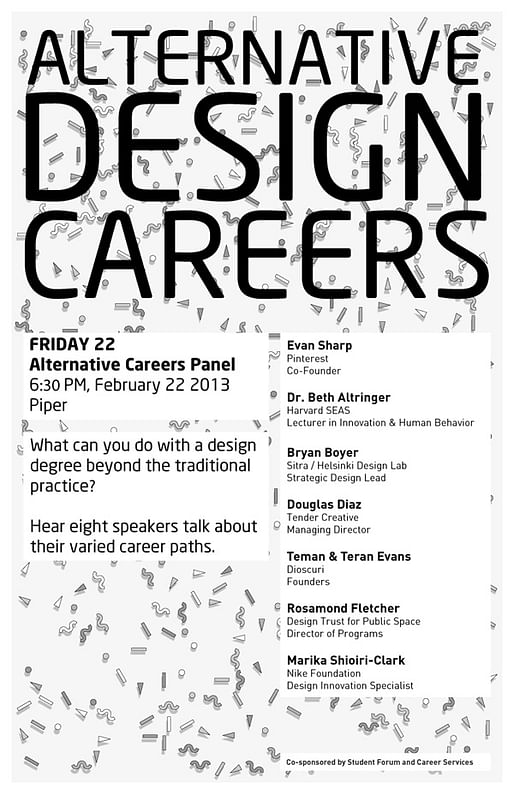
Hi Archinect! 6:35 pm. Judy Sue Fulton and Lauren Kim, two M.Arch.I students in my class, are hosting a panel on alternative design careers. There will be short introductions and then some conversation with individual panelists around tables. Bryan Boyer: says he's a "confused" professional. "I'm... View full entry

Hello Archinect! So...I finished my thesis but still have a few classes to wrap up this semester. I'm taking a statistics class with Michael Hooper, an independent study research project with Jay Wickersham (as a professional practice elective), and a seminar with Rahul Mehrotra on the "Kinetic... View full entry
This blog was most active from 2009-2013. Writing about my experiences and life at Harvard GSD started out as a way for me to process my experiences as an M.Arch.I student, and evolved into a record of the intellectual and cultural life of the Cambridge architecture (and to a lesser extent, design/technology) community, through live-blogs. These days, I work as a data storyteller (and blogger at Littldata.com) in San Francisco, and still post here once in a while.