

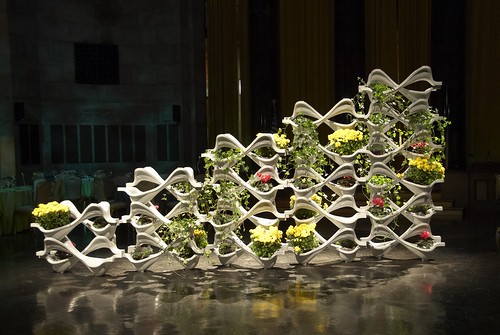
We are looking for a permanent home for our Amphorae concrete installation and we are hoping that you can help us find a spot! We have found a home for one of our projects which will permanently be on display at the AIA Center for Architecture in New York and we are hoping that other local institutions would be interested in our other work.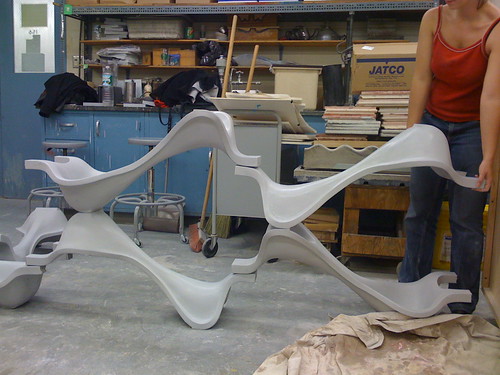
The project has been presented throughout North America and now we do not have space to store our vertical wall system. We have decided to donate it to any institution that would display it publicly and we can also help with planting the wall fro the summer season.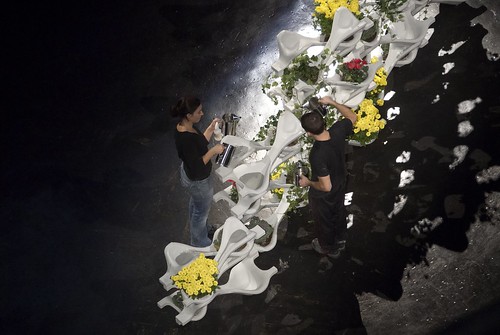
We currently have 32 bricks available and we can deliver them anywhere within close proximity to New York City. The blocks are reconfigurable and can fill a variety of spaces depending on the layout.
You can find more information about the project here: http://amphorae.wordpress.com/
E-mail me directly at Mark5136@gmail.com if you have any questions.
Thanks,
Mark
View full entry
My class has finished the first week in their five week cycle of XS, S, M, L, XL and they have posted their vase scripts on our class blog. You can find our site here. Each of the vases were designed to fit in a standard 3D printer. Each of the students have also posted their code, so you can... View full entry
Hello Everyone, Tonight will be the first night of my class Parametric Realizations that I will be teaching at Columbia. Here is some information on the class. Overview Parametric modelers are commonly used in the development of digital architectural models, but they are rarely taken to the point... View full entry
Alumni Keynote: ECOGRAM: The Sustainability Question Wednesday, October 22, 2008, 6:30 pm -8:30 pm Wood Auditorium, Avery Hall Daniel Wood (M.Arch 1992) and Amale Andraos WORK Architecture Company, New York Organized in collaboration with the Office of Development and Alumni in conjuction with... View full entry
As the world of architecture slowly becomes engaged in the discussion of Ecology. Columbia University has devoted the entire week to look at the problems that have led us to the situation that we are currently experiencing. 6:35 - There is a very large and diverse turnout in Wood Auditorium... View full entry
Hello Everyone, The Ecogram conference starts next week on Monday at 6:30 at Columbia University. Here is some information on Monday evening: MONDAY, OCTOBER 20 PANEL: ECO-CRAFT: Design, Context + Innovation Wood Auditorium, Avery Hall 6:30 PM Michelle Addington >> - Professor, Yale School... View full entry
Hello Everyone, Here is our first wall installation for the Solid States Concrete Conference. Special thanks to LaFarge and Columbia University for all of your help! To see more of our work please visit: http://amphorae.wordpress.com/ The wall was 6' tall and 12' wide. Each unit is 1" thick. The... View full entry
Hello Everyone, We have been hard at work casting concrete and we have two types in finished production mode. We have finished models of the Tabletop Planter and the Torso Block. We are also putting the finishing touches on the mold for a block that we call The Wave. We will post pictures as soon... View full entry
We have been working hard on our current casting project. You can chart our progress on our blog here: http://amphorae.wordpress.com/ With the engineer Peter Calcetas arriving in a week we have set up a series of smaller quick molds that we can use to test Ductal. This unit will be used as a... View full entry
For my final semester I placed music videos on hold and devoted my time to physically testing digital models. Dora Kelle, Adam Mercier and I worked together to develop the Brise Block. Our Rhino model was deliberately kept simple so that we could focus on the fabrication process of the block. Of... View full entry
I apologize for my lack of updates over the last semester. To catch you up to speed on things I finished my studio with nArchitects and I really appreciated the devotion that Eric, Mimi and Billy brought to the studio. Our trip to Brazil was amazing and the discussions helped all of us mold our... View full entry
Watch more cool animation and creative cartoons at aniBoom Hello Everyone, I have entered my Francois Roche Robotic Tower animation in the Radiohead music video competition, here is the brief: The band is now asking fans to create their first music video for the album in a contest utilizing online... View full entry
This presentation represents my attempt to rationalize the mesh by allowing it to grow based on specific programmatic and aesthetic inputs. The review took place on February 25th and it was then determined that I should leave the mesh behind and find a stronger way of rationalizing the program by... View full entry
http://www.evolo-arch.com The following is my entry for the eVolo Skyscraper Competition: robotic tower the tower is a commentary on man’s self destructive ways. rather than let humans design architecture, protocol will be used to design the ideal space for each inhabitant. the protocol will... View full entry
china-lab.org The following is our submittal for the China Lab Charette that took place a few weeks ago. MEGA-BLOCK = HYPER-MESH Mark Bearak - MArch Dora Kelle - March Seth Ruggiero - Urban Planning Dana Fantauzzo - Real Estate To reinvent the mega-block we proposed raising the residential and... View full entry
Adam and my final proposal was to marry the concept that smart economic growth strategies and eco-friendly trade practices. This would be expressed both philosophically and quite literally. The annexes would be redesigned to mix public/private work/leisure indoor/outdoor and the lost continues... View full entry
Week 2/3 - Brazilian Ministry Annex study Our next assignment was a two week project (we will have final presentations on Friday) For this we chose a compare and contrast of two ministries, my partner and I chose to look at the Ministry of Foreign Commerce and the Ministry of Environment. From... View full entry
Hello Everyone, Amazingly, speedily, inconceivably two weeks have already gone by. Mimi, Eric and Billy are a total powerhouse. All three of them, three days a week, and we've already wrapped up two pin-ups. Week 1 - Building structure analysis Our first assignment was to pull references from... View full entry
... for the very last time I woke up yesterday and realized that it would be my final studio lottery at Columbia and I was bowled over with sadness. I can't believe that three years have gone by so quickly. The many highs (Roche, Andrasek, Keller) and the many lows (effect to affect, Building... View full entry
I received a lot of interesting comments during my pin-up last Friday. The main source of discussion was about how the agents work in terms of free will or prescribed trajectories. The second major issue was the floor plates; the comments were that they were too generic and didn't really add to... View full entry
Video courtesy of John Cerone The Francois Roche Studio Final Pin-Up starts at 1:00 in room 114 on Friday, December 7th. Be there or be square. Here is the jury list: Alissa Andrasek (Biothing) Ammar Eloueini (AEDS) Benoit Durandin Hernan Diaz Alonzo (Xefirotarch) Neri Oxman (materialecology)... View full entry
For those of you who saw my previous animation (I was too embarrased to leave it posted) I took your advice seriously and I generated a new robot. In this scenario there are 180 robotic agents working together to generate the tower. I appreciate your input and it has definitely helped to improve... View full entry
http://ncertainties.wordpress.com/explicit-protocols/071119_mbearak_cohesive-pods-and-structure/ View full entry
Sure it weaves, but is it sexy? View full entry
Here is my final project from Hernan Diaz Alonso's studio from Spring 2007. The assignment was to prepare a stadium based on the anatomy of a bug. I focused on bugs behavior and I presented the project without a narrative. The idea was to present a cinematic experience, the first video was my... View full entry
Music: Minus the Bear - Knights Over the week-end I spent time rethinking the motion of a mesh, specifically woven fibers. From there I focused on the relationship between a woven system and the robot that would create it. My aspirations are to generate a building that has a legible embedded... View full entry
Hello Everyone, Here is a video from my midterm: Here are some images from my midterm: I would post my jurors feedback, but I wouldn't want it to sway your opinions View full entry
Roche Studio Mid-Term Review Time : 2pm Location : The Ware Lounge (6th floor Avery building) Jury: Alissa Andrasek (Biothing), Peter Macapia (DORA), Roland Snooks (Kokkugia), Kyle Steinfeld, Ken Tracy (Associated Fabrication), Simon Kim (MIT), and too many Robots to count... View full entry
Hello Everyone, Today is the first day of the Engineering Transparency conference at the GSAPP. It is a 3 day festival with hundreds of speakers and guests. Definitely sneak into as many lectures as possible if you get a chance to stop by. Here is the brief: After the last century’s call to... View full entry
The (n)certainties studio AKA Francois Roche + Marc Fornes + Columbia University now has a blog that you can find here. Image by Kirk Tracy View full entry