

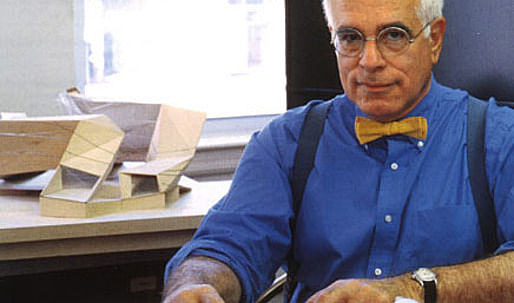
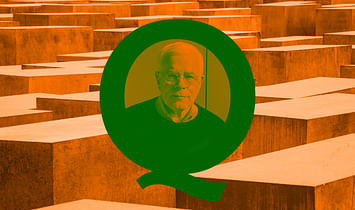
Peter Eisenman, 70, is one of the founding theorists of postmodern architecture and a distinguished practicing architect who will probably be best remembered for his Monument to the Murdered Jews of Europe (view images from the Archinect gallery) currently under construction in Berlin. Thus it was very surprising to hear what he had to say about the failures of contemporary architecture one morning at his firm's offices in an industrial loft in Manhattan's wholesale antiques district.
Although he is usually classed with postmodernists and deconstructivists who consider themselves cultural radicals with an agenda of revolution, Eisenman turns out upon closer examination to be a very different thinker, who is surprisingly blunt about the failures of modern architecture, the uselessness of the cultural left, and the obsolescence of the avant-garde. He is a cantankerously honest thinker in a field rife with glib ideologues and trendy posers.
An Interview by Robert Locke
Would you care to elaborate a little on the connection you see between politics and architecture?
Well, I think architecture is a form of politics. I believe that architecture does make political statements. There is no doubt. I mean, I was just in Naples recently, and three of the great buildings that I saw in Naples, in the most beautiful shape, were built by Mussolini. But that doesn't mean I agree with Mussolini's politics.
I have just written a book, which I've spent 40 years of my life on, on one of the most important Italian fascist architects (Giuseppe Terragni: Transformations, Decompositions, Critiques), who was a party member: he built the House of the Fascists in Como. Why would I be doing that if I'm such a lunatic on the left?
Well, I didn't say that. But people assume it.
Right. They assume that, but here's proof that I'm not. You know, I can tell you this: most of my clients are Republicans, most of them are right-leaning. In fact, my client in Spain for the cultural center at Santiago de Campostela is the last Francoist minister. And I have the most rapport with right-leaning political views, because first of all, liberal views have never built anything of any value, because they can't get their act together.
I find this public process about what monument we should build in downtown at the WTC site an aberrant one, because since when does the public choose? I would think that what you just said to me would lead one to believe that we ought to listen to the voice of the people as to what we should build, and I'm not convinced that you're not the liberal in the room and I'm not the conservative.
I would say that the voice of the people is one voice to be listened to, if only because the public has no choice but to look at buildings once they're built, unlike paintings or poems. But most people, insofar as there is a cultural right in this country, tend to assume that anyone who advocates and practices the kind of architecture you do has to be someone like Bernard Tschumi ' architecture in the service of Marxist revolution or whatever kind of revolution they've moved on to now.
Right - exactly.
So you're at the other end of the spectrum?
Yes and no.
I don't mean you're a fascist like your pal in Spain.
He's not a fascist.
Well, a former fascist, if you classify Franco as a fascist, which I realize is controversial.
The people who support me in Arizona are all Republicans. The support I had in the state of Ohio was from the head of the Republican Party in Ohio. They supported my work at the Venice Biennale. They supported my buildings. Rudolph Giuliani supported a cultural museum I was doing in Staten Island. Republican Borough President Guy Molinari was my big supporter in this city, who helped me in this city, who couldn't be more conservative, right? My appeal to Governor Pataki at the time of the World Trade Center was from a conservative point of view - I believe our project was the most conservative of all of the projects proposed.
World Trade Center Proposal
You mean the tic-tac-toe building
Yes. I think it was a very conservative icon compared to what's being done. So therefore, I find it very difficult to see myself to see myself as a wildly - I mean, I'm very happy your magazine is choosing to write an article about my views because I think my views are not too far from The New Criterion and Hilton Kramer and those people.
That's why a lot of my students see me on the other side of the fence: they see Leon Krier and me both as troglodytes. I am attacked more readily by the left than I am by the right. You know, this is what's interesting: If you take the left-leaning critics, I am one of their big enemies, because I stand for something that threatens them, because it appears to be radical, but for them it isn't radical, so for them it's very threatening. They don't worry about Leon Krier, because he's obviously off the charts for them. The people, like myself or Rem Koolhaas, that they worry about, are the people who appear to be radical but that they believe to be conservative. That's a fair assessment of where the young radical left in architecture is.
So if you describe yourself as an architect as being on the right, but not conservative like, say, a Robert A.M. Stern or a Demetri Porphyrios, wouldn't that be like how some people would describe Italian fascism, as in futurism and Marinetti and all those nutty guys?
I wouldn't call it nutty. In fact, I'm writing a piece...
He wanted to blow up Rome.
I'm writing a piece now for an Italian exhibition on metaphysics. On de Chirico, Corac, all of these so-called crazy guys, the Italian crazies. I've been working on this: what was the nature of the disciplinary specificity of architecture that was what I consider autonomous? My whole position is that architecture participates in what I call the continual unfolding of existence, that architecture, like any other discipline, has the capacity to do that, and that there is what I would consider to be a disciplinary specificity to architecture, so that even though the deconstructionists say that everything is one, and there's an intertextuality, and that there is no subject, I believe there is a subject, I believe there is a disciplinary specificity to all disciplines and what I believe one is looking to do - in addition to anything else - is find what that disciplinary specificity is in architecture.
You see, my work basically says that while I may have my own personal political leanings, or I may have affinities to conservative politics, when it comes to architecture, ultimately its politics is autonomy. That's why I can look, as Leon Krier does at Albert Speer, even though he was what he was - and I'm best friends with his son - I have no problem with that. I don't have to be an ideologue; I'm not a flag-waver. I believe that the architecture that the fascist regime was doing was a very important moment in time.
This can't help provoke a question about the building you yourself have said is the one you are mostly likely to be remembered for, the Holocaust memorial in Berlin. I'm not sure what to ask you about it: it reminded me of a sea of gravestones in a military cemetery.
What I was thinking was something quite different. I'm very much against the Holocaust industry. I'm against the nostalgia that is brought up about the Holocaust. I am against kitchifying the Holocaust.
I think it was something that defies representation; I think you cannot represent it. And what I've tried to do is say if you go to Auschwitz, if you go there, it's horrific: you're reminded of all these images et cetera. But you can re-assimilate your internal mechanisms to say, OK, that was then and here we are now.
What I tried to do in Berlin was to do something that couldn't necessarily be as easily re-assimilated. It has no imagery. In other words, it was not about imagery, it was not about marking, it was not about a cemetery. The fact that it could look like a cemetery is possible. It could also look like a field of corn. I was thinking about a field of corn I was lost in in Iowa when I did it. I was trying to do something that had no center, had no edge, had no meaning, that was dumb: D-U-M-B. And there's nothing in the city that's dumb. And therefore it was silent, it didn't speak.
I believe that when you walk into this place, it's not going to matter whether you are a Jew or a non-Jew, a German or a victim: you're going to feel something. And what I'm interested in is that experience of feeling something. Not necessarily anything to do with the Holocaust, but to feel something different than everyday experience. That was what I was trying to do. It's not about guilt, it's not about paying back, it's not about identification, it's not about any of those things; it's about being. And I'm interested, in a sense, in the question of being and how we open up being to very different experiences.
I've got to tell you the biggest supporter of that project was Helmut Kohl, the conservative prime minister of Germany. When the liberal Gerhard Schroeder came in, he almost killed it. My first project in Berlin was when Richard Von Weisacker was mayor and I did this field at Checkpoint Charlie, and VW came to me after I won the competition and he said to me,
"You know, Peter, my problem with your project is this: the left wing hates it because they think it's right wing and the right wing hates it because they think it's left. Nobody can make an assessment. You have created something that is, in a sense, problematic for everybody, because they can't label it. And if they can't label it, then they can't tell whether they like it or dislike it."
That's what I've tried to do in Berlin. That's what I've tried to do with myself, with my work. I don't want a label. I don't want to be either good or bad, right or wrong, left or right,
I am one of the most outsider of all the insiders. I mean, a lot of people say, you teach at Princeton, you teach at Yale, but I never had tenure at those institutions. I never wanted tenure at those institutions. But I'm not yet a maverick. I don't dress like a maverick. My dress is either Brooks Brothers or J. Press.
I believe that art and life are two different discourses, and how I want to live is different from how I want to practice architecture. I love living in an old New England house; my in-laws have a small sea-side house in Connecticut. I had this 1740s farmhouse in Connecticut where I used to live. What I do not want to do is to recreate a 1740s farmhouse; I want the original thing, with the original boards, because you can't get those kinds of wide boards any more, the kind of nails that were made.
But doesn't saying that art and life are two different things mean alienating our culture from the people it's supposed to be the culture of and lead to a kind of hothouse aestheticism that has nothing to do with real life?
Well, I'm very interested in real life, but that depends on your definition of 'real life." Who represents real life? I don't have any idea who, really. My clients that come to me, they're not coerced into coming to me, I don't have that many, and there's not any worry that Peter Eisenman is going to destroy real life. Just like there's no worry that Webern or Bartok are going to destroy pop music, right?
I wasn't talking about you so much as the idea that you suggested.
The idea that I suggested is very important to keep alive in the culture. I would think that both Demetri Porphyrios and Leon Krier would think that not having me in the culture would not be a good thing. It helps them to point to what the problems are. I represent certain problems. Just like I think would be very much less of a culture not to have them around, because it helps me to point out what some of the problems are.
I don't believe in the homogeneity of culture or the hierarchy of culture. I don't believe in one system, one - gestures - et cetera. I'm interested in fundamentals. I'm interested in fundamental research. But I am not a fundamentalist. Nor am I a Marxist. Nor am I a modernist. If the world were all deconstructionist buildings, I'd go nuts. I am interested in what the discipline has to show us about architecture as it relates to the culture.
As I said, I taught gothic. It's to do with the nature of the work. I believe that the history of architecture. I mean, Bob Stern, I have his lecture, his commencement speech. He made a strong critique of modernism. And I might make a similar critique of modernism. What I might say is Bob Stern, unfortunately, has to deal with the so-called marketplace, and his students don't want to hear about classical architecture.
You know, people say architects are not supposed to like sports, but I'm an avid sports fan. Doing a stadium for me is like doing a cathedral. I'm doing two other stadiums right now in addition to that (points at rendering on wall) stadium for the Arizona Cardinals . It's a very conservative area, Arizona, and they're so excited about the stadium. I think it's a classical stadium: look at it; it has a classical aura about it, but it doesn't have the trappings, classical ordination, but it seems classical, and what I'd like to think, if you saw see my Wexner Center at Ohio State University, you'd say it has a classical feeling to it. And I'm not against that.
And that's what I've been trying to touch: that moment in space and time that doesn't brand you as a conservative, doesn't brand you a fundamentalist et cetera. I'm against fundamentalism, because fundamentalism as preached by regimes in the Middle East is against secularism (which doesn't mean you're against God) and against progress, and I believe in both.
But what I'm talking about is not progress in the historicizing sense of the word as in ultimate progression to a better future. I believe that progress is something which opens up the present, not gets better. I don't think things get better; I don't believe in idealism; I don't believe in an ontological view of the world. I believe in the here-and-now, as in making this here-and-now better than it has been.
But I don't think it can be done: while I aspire to that, I don't think I make the world any better. And that's not my role: it's opening it up to the possibility of that.
Do you have any thoughts on the oft-made accusation that there's too much theory in modern architecture, particularly in teaching?
I don't think you can understand history unless you understand its theory. Alberti said in his Della Pittura in 1500 that what painting needs is to invent a history for itself. That's a theoretical proposition, not an historical one. To understand why he said that, why art and architecture need a history, that's a theoretical proposition.
All of the developments in architecture, the developments that we hold dear, have come about through theoretical pronouncements that then become history. So I can never distance theory from history. When I teach history to the freshmen at Yale, I start with Piero della Francesca, then Montaigne, then late gothic painting, then early Renaissance painting, and then we get to Brunelleschi. Hardly radicals, in one sense of the word - then Bramante, Palladio, Borromini, and Schinkel, right down to the present day.
For example: to understand what Brunelleschi was doing with perspective, he was interested in instantiating the subject in architecture as the subject hadn't existed in the Gothic world, and in the Renaissance it was now the subject that was the center of the universe, and so he said the only way the subject can be involved in architecture is to set up the subject's eye as the way of understanding space.
What do you make of the argument, which has been floating around for some years now, that the so-called avant-garde isn't avant-garde any more, has been getting long in the tooth, is a bunch of clich's from the 1920s and frankly, we all ought to be laughing at its pretensions?
I agree. I agree. (laughs) No, I agree. The avant-garde cannot exist in the way it did in the 20s, to repeat the 20s is no longer avant-garde, and I am myself not an avant-gardist.
When you get to be 70 years old, to try and pretend that you're a young Turk, doesn't wear very well. To dress like a teeny-bopper is really problematic, and to behave like one is equally so. When you get to be 70, you have a role in the world that's important to act your age.
(The interview is briefly interrupted as Prof. Eisenman takes a phone call from a member of the conservative Catholic organization Opus Dei who wants to know if he would mind being nominated for an architectural prize of theirs in connection with his cultural center in Santiago de Campostela in Spain. He does not, and the interview resumes.)
Looking at your convention center in Columbus, what it says to me is you've taken the very banal big-box suburban type architecture that gets ground out all over this country and you've said, - if this is the reality of contemporary America then let's do something clever with it that will actually be nice to look at...
Yeah - But I am very much against the idea of "aestheticizing" anything. I would like to think that just as I'm against the politics of fascism - that used thought to aestheticize their politics - I would like to think that what I'm talking about is not aestheticizing anything.
While we were stuck with this dumb box, OK, I would like to think that what we did - and this is where we may disagree - I would like to think that what we tried to do was, that we tried to find an alternative way: we cut the dumb box up into strips, right? And I don't call that aestheticizing. I call it reconfiguring or transforming the dumb box.
The Greater Columbus Convention Center, Columbus
I just mean making it pretty as opposed to ugly.
I don't know if I would say it's "pretty."
I liked it, and I don't mean "pretty" as an insult.
OK. Let's say, making it something that people take notice of, that causes them to say, I like it or I don't like it.
That improves the built environment...
Yes. OK.
That's all my questions. Anything else you'd like to add?
Don't confuse me with Bernard Tschumi. You know, when he was dean of the architecture school at Columbia, I could never get a job there. I may seem like a person that's far out to you and Bob Stern and Demetri Porphyrios, which is fine, but to the students, whom Bob and I both have to deal with, Bob and I are both seen as conservatives, and they want stuff that's more relevant to what they believe is relevant. It's a very difficult moment because Bob has to hire me to placate the students and he has to hire people like Gregg Lynn to, in a sense, show the students who are constantly demanding, "where is the world today?" And I think part of the reason why Yale hires somebody like a Richard Meier to do the arts building is because they believe they have to in fact keep up with what's happening in the world of architecture, like many other universities.
Robert Locke - robert_locke_journalist@yahoo.com - is a freelance journalist residing in New York City



43 Comments
Did you know that Peter and Richard Meier are cousins?
And born in Newark, NJ?
well, the comment on politics is an old can of worms. eisenman already spent lots of ink by having several arch writers respond to diane ghirardo in a famous p/a debate in nov 94 & feb 95.
i'd be more interested in knowing how eisenman responds to current trends in formalism. given he's in the middle of a long trajectory [wittkower, rowe, eisenman, lynn, diaz-alonso ?]... has there really been an evolution in the stance of formalism or has it only been lead by software development?
isn't it contradictory that he is careful to point out that he is not trying to be avant-gardist at 70, but he still insists on his outsider status [those princeton, yale, not tenured commnents...]? i mean, i see the difference between being in the avant garde and being an outsider, but i'd like to know why he feels like one..
and if we are going to go into politics, i'd like to know why he thinks acceptance for his projects has usually come from the "conservative right"... maybe it has something to do with his formal studies of classical buildings? is the message here that he has distilled, proportion, harmony and recondensed it in new purified form...? i can see that in very few of his projects... the formalist play is most often a reference to itself, not a mathematics of the ideal villa game.
it just seems to me the answers are so vague and general... i'd like to read more about where his current interests lie, and less about his 'i'm the kid left out of the game' routine. is the theoretical cosmos really so different from the academia cosmos?
"And I have the most rapport with right-leaning political views, because first of all, liberal views have never built anything of any value, because they can’t get their act together."
ahh the poetics of bullshit. the best of art and architecture is a response to the right-wing agenda.
Agreed... he finds the funding where those who grabbed it fairly or not... mostly not..that's his idea of having it together...
Eisenman proves again that he'll say or do anything to remain conroversial. This move is brilliant--now that he's been typecast for decades as a leftist intellectual radical, he "shocks" us all by switching sides and playing a football-fan Republican. Whatever he says it's all calculated so that he remains on the radar (you clicked the cover story, now didn't you?). He's about as faithful to liberalism as Philip Johnson is to modernism--i.e. so long as it suits his self-hyping agenda.
*sniff sniff*
I smell bullshit.
Peter Eisenman is a two bit hack with no talent.
I wouldn't let him design my outhouse
shit, he sounded like a schoolboy trying to impress an older girl and almost not getting away with it, if not the content of wat i said, just the way he said it...very disappointing.
I agree with STARK3D.
The reason that his support comes from the right is due to the fact that most republicans are idiots.
Aside from hearing a few of my acquintances were inpired by his lecture at Texas A&M some years ago, it appears to me that a right wing patron once had not asked him not to reason out a way to circumvent left wing thought to make it sound more right wing.
It's strange to read the answers of a (certainly) intelligent man that sound so superficial and dumb. I mean, he positions himself on the right (while saying hypocritically that he doesn't want to be labelled) because right-wing politicians have backed him up (is there more to it, or should we think that that's all you have to do to get Peter on your side, offer him cookies?)
Then the remark about liberals not getting anything done is obviously a straight attack, not against the left, but against democracy and the decision making process in most civilized countries today. He seems to have a fit of nostalgia towards Speer and Terragni and their environment, that let them do "pure design" for the sake of the ART of architecture. He doesn't see how the fussiness and contradictions of today are intertwined with human rights and the idea of equality.
And the way he says all this... Insinuatingly circling his subjects without sticking his neck out even once. Shame on you mr. Eisenman.
no comment, i mean not even worth.....
have you seen the ramp house that comes with wedge-shaped shoes?
sometimes i think guys like eisenman say this stuff just to stir things up. like his infamous comment that theory is dead.
liberals built this nation.
Some flowers in this manure, including this one:
"My whole position is that architecture participates in what I call the continual unfolding of existence, that architecture, like any other discipline, has the capacity to do that, and that there is what I would consider to be a disciplinary specificity to architecture, so that even though the deconstructionists say that everything is one, and there’s an intertextuality, and that there is no subject, I believe there is a subject, I believe there is a disciplinary specificity to all disciplines and what I believe one is looking to do – in addition to anything else – is find what that disciplinary specificity is in architecture."
What is architecture's specificity? I'll quote my old friend Aditya and say it's body and memory.
Body as in the physical material stuff that makes it, memory in being a reflection of culture - AKA the emotional stuff that makes it.
I think Eisenman is playing into the 'architects only build for the rich' image. read: My clients are rich/republican therefore I side with their politics as architects should do as their masters tell them.
Its interesting to note that 70% of principals at corporate design firms are also right leaning...
Slightly different topic but interesting nonetheless...
Architects donations to the 2004 campaign more right this year
Whats interesting about architects, money and politics is who is doing what : on the list of top 10 contributors there are at least 3 Bush 'Rangers'.
The head of Turner construction has raised $100,000 for Bush.
Also Hans Hertell is the chairman of American Builders Corporation, a general contractor in Puerto Rico. In addition to attaining Pioneer status as a Bush fundraiser ($100,000), Hertell made a total of $23,000 in GOP contributions during the 2000 election cycle. In 2001 Hans was appointed as Ambassador to the Dominican Republic.
FYI: Peter can't be that political as he has not contributed to any political campaign in the last year...
(FOG and Steven Holl gave to Kerry)
the thing with eisenman is that he loves stirring things up. but after a while it gets tiring... yes you are being 'controversial' by talking about right wing, but he ends mocking both left and right. that is all amusing and good, but it gets tiring. where is his commitment? if not in the political arena, then in architecture... if you mock positions but avoid taking one, you are left with no discourse.
so taking up a side angle: architecture and wealth have always had this love hate relationship. i guess that is what eisenman is mocking in the end, the idealist that needs to eat. but there are men that have bypassed this hurdle [sam mockbee, and i'm gonig to say architecture for humanity is doing a pretty good job also].
the mocking and double entendres are fun, but don't get us anywhere. eisenman has avoided any constructive discussion by limiting his discourse to innuendo.
The PJ comparison is right on. Werner Seligman use to tell great stories about Eisenman, from PE's cheerleader/frat boy days....
It's all about positioning himself, not necessarily a bad thing but just too obvious in this case.
And that business about "...because it appears to be radical, but for them it isn’t radical so for them......."
Ahhhhh...............what?
I do not understand why you see him as a nihilist. I personally think the man is anything but a nihilist...however he is quite clever in seperating journalistic accounts of himself...from what he himself writes. The article above is nothing more than an attempt on his part NOT to say anything (or too much)...and I would understand it coming from a decent writer (rare are those that build well and write well), if he has anything to say he would write it himself..in his way. The interview is boring, and Eisenman is a happy participant in actively making it boring. Anyways, I've always disliked him (his intellect has a stinky fishy smell about it) ...that bow tie is so '"pimpin' architecture". I think Philip Johnson, since he was brought in the discussion, is a much more interesting architect (as opposed to much more interesting architecture). Eisenman's logic is interesting though vulgar...no, not perverse, just vulgar. He also looks like an octogenarian gollum-nerd.
i am intertersed in Eisenman's reference to Della Pittura and the need for a subject to "invent a history for itself" as a theoretical rather than historical proposition. In many ways one could argue that this is exactly how the right has a leg up from the left. The right has its positions more clearly defined--and its history laid out--than the left. There is no need for position clarification with the today's right. History for the right is a set of binary oppositions (good/bad)coalescing into a linear historical narrative. The left, however, seems to always be defining and re-definfing its positions (sometimes according the right's coordinates). Politics on the left is constantly reinventing itself (as it should, as Alberti observed painting should) and writing its own history. This 'invention of history' as a theoretical proposition weakens the clarity of a the left's platform and a discernable (even predictable) stance on issues.
I think Eisenman enjoys the ambiguity of his position as being not dependent upon the language of right and left (inventing his own history as well) and therefore outside of that confining pendulum ... BUT an architect with so much resistance to 'the norm' cannot rightly associate himself or herself with predictability, structuralist, linear history OR theory. I think it safe to say that Peter is a third party member, the Peter Party.
that just brought memories of roland barthes's chapter on the right and the left in the mythologies book...
"I don’t think you can understand history unless you understand its theory. Alberti said in his Della Pittura in 1500 that what painting needs is to invent a history for itself. That’s a theoretical proposition, not an historical one. To understand why he said that, why art and architecture need a history, that’s a theoretical proposition."
" the need for a subject to "invent a history for itself" as a theoretical rather than historical proposition"
What is theoretical (in his sentence) is the Alberti proposition (in its interiority...in its exteriority, it is de facto a historical outcome) for that 'invention' and not the actual invention (or its subject..namely its own history) or your extracurricular 'need'. Eventually, the only thing he said was that a proposition is theoretical. Really? amazingly perceptive... You made it a bit clever by endowing the subject (for example, the painted mule in 15th century Italian paintings of Mary and Joseph) with its own need...an inherent kantian aesthetic in turmoil behind its own plasticity (an urgent aesthetic insurrection- a NEED for fuck's sake) ...rather than a sociological (and therefor necessarily historical) need. He gave you a little intellectual toy for you to decieve yourself with (it becomes more than a toy).
of course, this proposition belongs in a history of propositions. This eisenman rhetoric is not removed from much of his usual rhetoric that tries to escape history and meaning (through geometric absolutism or architectonic connotative exaggerations)..only to crashland on the neighbouring ground of monstrofied meanings..i.e postmodernism. This is largely why I find his intellect vulgar. It is an intellect of equivalences, of things that crash into each other.
Also, in your logic (which I find a tad simplistic) the left could also be said to have an equally binary opposition setup(the good (not right (i.e left)) and the bad(the right(i.e not left)). This is the natural effect of antagonistic co-dependency. As such, the 'left' is equally predictable/unporedictable as is the 'right'...the re-inventions are part of a constant formula that accomodate a possibility to react to the 'right'. And on par, the 'right' reacts to the 'left'. In america especially...this kitchifying of right and left has led to the simplistic seesaw nature of your logic (no personal offense intended ;-)
he still cant build a building that is not a piece of shit. And his memorial in Berlin, wasnt that done in the garden of Liebskind's museum a few years before???
Thinking about what architectures these day are really political, I wouldn't count Peter Eisenman's among them. What I would count are "the great wall of Israel", US military bases all over the globe, any secured border checkpoints, architectures like that. Was the USSR the last great political architecture of the 20th century? Could be. And how does Communist Chinese architecture stand up these days?
John Young's eyeball series at http://www.crytome.org is at the head of the class when it comes to scoping super-power architectures.
I like Eisenman for often letting me know what he does not know.
I think you meant this eyeball series
Gosh, John never tells me anything anymore!
a bit off subject, but just to folow through the above post earlier ... As for my argument that the left is constantly re-defining its position (sometimes to its detrement), hence rescripting its history, lets take the example of stem-cell research. The hard right needs not think about the issue at all. They hear that it involves toying with the origins of human life and immediately their position is sharply against it. The left, however, seeks a better understanding of the science to clarify the issue and then defines its position (therefore its history) on that contemporary understanding. The right seems to take a more historical position, while the left takes a more theoretical position. I know it is not necessarily as clear cut as just that, there are in-betweens and contradictions. But at their foundations, that is my impression.
well, the right (in the us at least) changed its opinion in an hour as soon as regan was diagnosed alzaymer...all of a sudden stem cell research was ok...you're making it sound like the only political side with a clear set of rules/morals/ideals. you can advocate that most of the times, in western countries, the right campaigns for the keeping of the status quo (while the left pushes for reform), or refers back to decades-old values, but that its mainly because the protests of the 70's destroyed those values, and those protests where almost completely leftist.
if we're talking about extremes, then its probably the left which tends to have more historical positions on big issues concerning morals, possibly connected to the fact that the left's political philosophy is much better codiified than the one of the right...my two cents.
"(through geometric absolutism or architectonic connotative exaggerations).." <= I said that...so I meant he meant something. He meant something, so I meant he couldnt be a nihilist.Well...a nihilist as you use it. Nihilism actually demands an assiduous,affirmative and imaginative stance. Its lineage is a history of such stances...from anti-tsarist autocratism through a novelistic tradition ( Dostoevsky and Tugenev) to a tittilated ethos (Nietzsche-is it better to be swaying at the top of the reed at the mercy of the wind, or down below..safe,out of harm's way ..and near blind) and the theatres of beckett,pirandello,ionesco and the like (when nihilism is finally freed from a need to always be allegorical (art emphasizing, mimicking, the pains of life) to become acutely aware of its own artificiality....nihilism becomes a desperate attempt to prolong life through art).
Eisenman is hardly that. He is,utterly, a positivist. As I said upstairs, his logic is that of equivalences.He might not profess a belonging to either camp (and some silly people here might see him so idiosynchratic as to be one of a kind...no one is one of a kind. This manner of thinking, or not thinking, demands puerile reverence (not for Eisenman himself but for the notion of individuality. Individuality is an artifice that be believed as much as it is disbelieved in)) but an argument can be construed that he does THINK like a conservative and his tone is that of the conservative right (a smug self assured self dependent absolutism). Another slightly more bullshitty argument can also be made regarding his geometric absolutism that only houses the needs and comforts of the individuals through the rules and regulations of the 'democracy' he lives in. It would be interesting to see what Eisenman would do in a rabidly facist system given the chance (I still wont deem the U.S that facist..though u nevvvvver know). This is why Eisenman is seen to be so idiosynchratic..he is a fusion of the avant garde (previously seen as anti-autocratic) and the autocratic. He is the vulgarized corruption of the intellectual who is pissed off at the 'rubbish' that has run amock following people-choice.
Eisenman: "I believe that art and life are two different discourses, and how I want to live is different from how I want to practice architecture. I love living in an old New England house; my in-laws have a small sea-side house in Connecticut. I had this 1740s farmhouse in Connecticut where I used to live. What I do not want to do is to recreate a 1740s farmhouse; I want the original thing, with the original boards, because you can’t get those kinds of wide boards any more, the kind of nails that were made."
Q: "But doesn’t saying that art and life are two different things mean alienating our culture from the people it’s supposed to be the culture of and lead to a kind of hothouse aestheticism that has nothing to do with real life?"
Eisenman: "Well, I’m very interested in real life, but that depends on your definition of “real life.†Who represents real life? I don’t have any idea who, really. My clients that come to me, they’re not coerced into coming to me, I don’t have that many, and there’s not any worry that Peter Eisenman is going to destroy real life. Just like there’s no worry that Webern or Bartok are going to destroy pop music, right?"
*****
We need to separate his work from his "life".
Eisenman is a conceptual artist whose medium can sometimes be a functional building. While Eisenman's clients and supporters may be republicans, that is about his life, and less about how he sees his work. As with his Holocaust Memorial in Berlin, he sees his work as having no moral agenda other than to introduce the subject to new conceptions of space.
About his work, Eisenman states "I am looking for ways of conceptualizing space that will place the subject in a displaced relationship because they will have no iconographic reference to traditional forms of organization. That is what I have always been trying to do, to displace the subject, to oblige the subject to reconceptualize architecture."
But his intention of reconceptualizing space and revealing to the subject new possibilities in architecture is not about "changing the world"... He doesn't think that his work is "dangerous", or revolutionary... He doesn't have any kind of moralist agenda to "transform the world" or make the world a better place through his architecture, but simply to expose it to something new.
this is a terrible interview.
eisenman has much more to offer than answers to these silly questions and even worse - built work!
boring
and with one word, satan halts the thousands and thousands of words pouring down upon the indifferent shoulders of peter eisenman.
very impressive.
i, for the most part, enjoy pete's work; however, as an architecture student at the university of cincinnati, i have to go to one of his buildings everyday...the DAAP building. anyway, i was walking out the door of that building one day talking to some friends. my head was turned so i didn't see...and i whacked my scull into the corner of a drywall cube that stuck out from the wall...apparently pete thought it was a good idea to have a sharp corner sticking out of his wall at exactly 6 feet off the ground. might want to consider those of us over 5'11 next time pete. at least that corner is no longer dangerous...seeing how i rounded it off pretty well with my head.
It seems many of you were hoping that P.E. would say something that you would agree with. Does that mean you are still looking for a leader you can join in lockstep? Abandon such hope. Caress the dragon.
He's not even right-wing, he's just an egomaniac. It's like being at a party when you're 17, and you want to rile feathers and sound cool, so you lean against the wall and you look up at the ceiling, and you say, yeah, I want to be eaten by wolves... or some shit like that, and it's just a joke, but you think you sound profound. You think you sound tough and interesting, but everyone's already moving on the next person. Rather than dick around bobbing and weaving and saying nothing of substance - does this interview actually have any content? - why doesn't he calm down? Get over it. He's a conservative. Who cares? Now say something in an articulate manner, for god's sake. He's like a fat person obsessed with being fat, when no else gives a shit if you're fat or not. So what if you're fucking fat? You're not the only person in the universe.
Peter Eisenman is the Kirstie Alley of architecture.
fault the intreviewee, poorly done, IMO. Petey is doin the world a service. This conversation is proof of that. If you make someone vomit, you've reached them...
Peter Eisenman will be speaking at the Center for Architecture this Thursday (February 12) at 6:30pm. The premiere screening of the film "Peter Eisenman: University of Phoenix Stadium for the Arizona Cardinals" (Tom Piper, 2008, 30 min) will be followed by a conversation with the architect. This would be a great opportunity to hear Mr. Eisenman discuss these (and other) issues in person, and for you to ask him your questions and get his answers directly.
Tickets are $25, with a $10 discount ($15 price) for AIANY members. They can be purchased here: http://www.acteva.com/booking.cfm?bevaid=175924
For more information: http://aiany.org/calendar/event.php?id=1014381
Pete is looking 10 years younger....
The comment thread is an excellent source of entertainment on the bus home. Lol.
I would first encourage you all to read up on all the names and references he has mentioned in this interview. Without understanding them, you will not understant where Peter is coming from.
To throw dirt on his name without complete knowledge on who Eisenman is, is quite disrespectful. He's accomplished a lot in his life and he has reached the milestone of maintaining his health well into his later years. To me he is an interesting individual who lives and creates architecture to his own perogative.
He is sophisticated in his approach, and simply rejects ideals he doesn't believe in. What's wrong with that? You all do it in some form or the other. In such a subjective discipline, such as architecture why do people feel their own desires and beliefs need to be pandered to all the time?
I definitely don't know everything he is talking about nor necessarily side myself with everything he is saying however this doesn't mean I am going to go ahead and slander his name. Anyways..
Peace and love.
Note: this article is 16 years old
its nice to read it again though. I wonder how he would respond to those questions now that the right is really closer to Terragni than ever. Some of the commentators are also interesting to see in hindsight. Good to be reminded the internet never dies.
Block this user
Are you sure you want to block this user and hide all related comments throughout the site?
Archinect
This is your first comment on Archinect. Your comment will be visible once approved.