
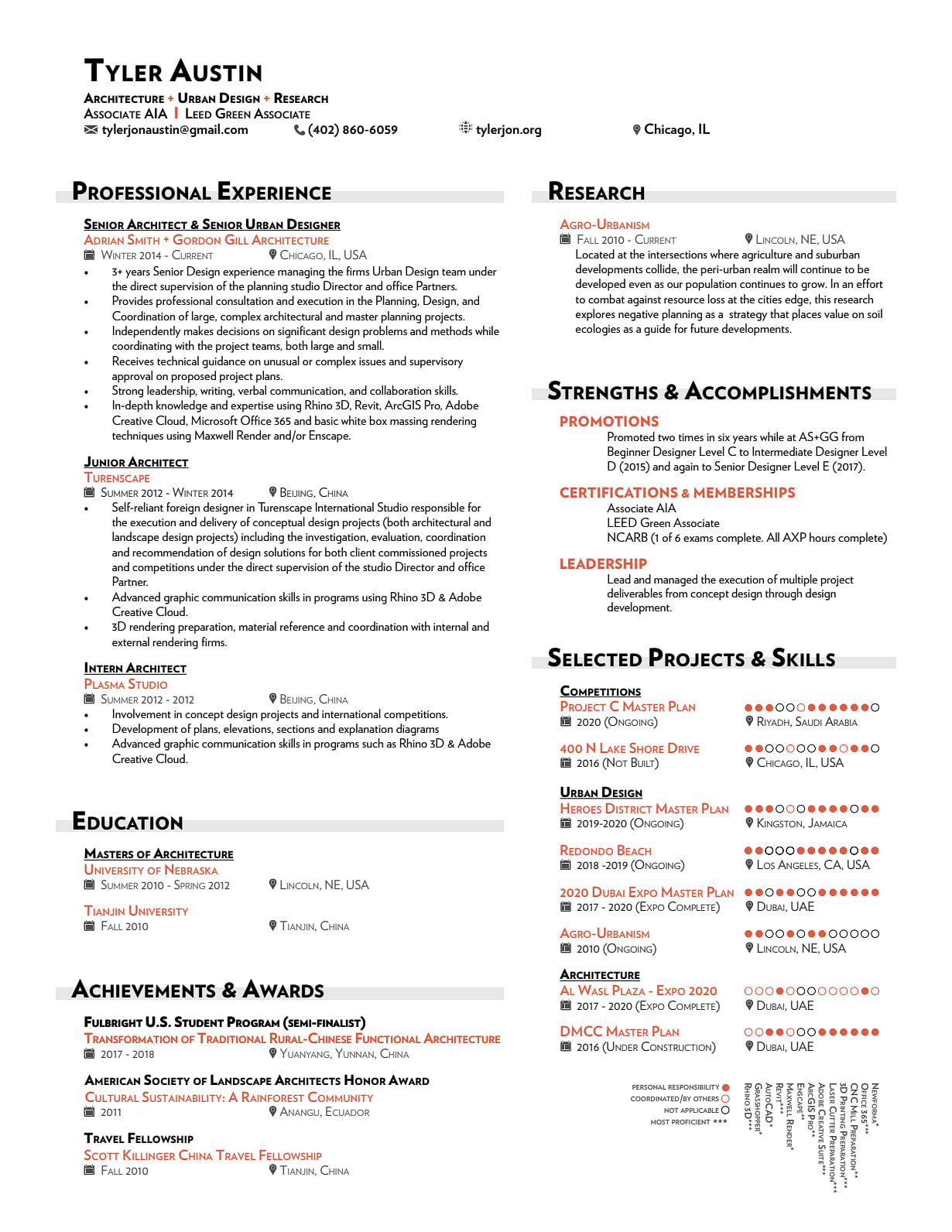
Tyler Austin, Associate AIA, LEED GA, has 8 years of experience working on both public and private sector projects around the world to envision, master plan, design and execute some of the most thoughtfully developed, award-winning city attractions and iconic buildings throughout the United States, Middle East, China, and Ecuador. Through this journey he has shared the privilege of working with the worlds most top leading design professionals and academic institutions working as both Architectural Designer and Urban Designer in two of the top highest ranking design offices in the world.
Adrian Smith + Gordon Gill Architecture, Chicago, IL, US, Architect & Urban Designer
3+ years Senior Design experience managing the firms Urban Design team under the direct supervision of the planning studio Director and office Partners.
3+ years Architectural Designer experience working on large-scale design problems.
Provides professional consultation and execution in the Planning, Design, and Coordination of large, complex projects.
Independently makes decisions on significant architectural design problems and methods while coordinating with the project teams, both large and small.
Receives technical guidance on unusual or complex issues and supervisory approval on proposed project plans.
Strong leadership, writing, verbal communication, and collaboration skills.
In-depth knowledge and expertise using Rhino 3D, Revit, ArcGIS Pro, Adobe Creative Cloud, Microsoft Office 365 and basic white box massing rendering techniques with simple entourage using Maxwell Render and Enscape.
Turenscape, Beijing, CN, Junior Architect
Self-reliant foreign designer in Turenscape International Studio responsible for
the execution and delivery of conceptual design projects (both architectural and
landscape design projects) including the investigation, evaluation, coordination
and recommendation of design solutions for both client commissioned projects
and competitions under the direct supervision of the studio Director and office
Partner.
Advanced graphic communication skills in programs such as Rhino 3D & Adobe
Creative Cloud.
3D rendering preparation, material reference and coordination with internal and
external rendering firms.
Plasma Studio, Beijing, CN, Architectural Intern
Involvement in concept design projects and international competitions.
Development of plans, elevations, sections and explanation diagrams
Advanced graphic communication skills in programs such as Rhino 3D & Adobe Creative Cloud.
2011 ASLA Award Recipient-Community Service, Award
This project dealt with the challenge of preserving the fragile culture and environment of an indigenous Ecuadorian community while simultaneously developing sustainable growth. Community participation and the collaborative process were the most vital components to the success of the master plan and schematic designs developed. Students of Architecture, Landscape Architecture, and Planning worked together to protect the local culture, environment, and economy by designing sustainable development as a model for the region.
2010 China Abroad - Scott Killinger Fellowship, Award
Fall 2010 China Abroad at Tianjin University, Tianjin, China