

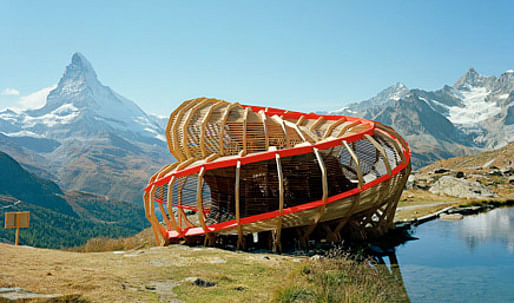
Evolver is an architectural artefact intervening on the panorama surrounding Zermatt. It was designed and executed by a team of 2nd year students from the ALICE Studio at Ecole Polytechnique Fédérale de Lausanne (EPFL) , Switzerland. In an effort to take full advantage of the site's extensive and astounding views, the project sits strategically next to the lake Stelli at an altitude of 2,536 m (8,320 feet).
Evolver's structure mainly consists of a succession of 24 rotating frames supporting an enclosed space that visitors are encouraged to enter. As he or she progresses through the space, a concealed but uninterrupted 720° movement is unraveling along a transformed panorama.
This transformation occurs while inside a person is moving along a selective string of openings only to be caught peeling off a sequence of unexpected views from the original landscape.
Wobbling below and above a distant horizon, ground and sky have been reorchestrated into an orbiting panorama by a journey that has already culminated to where it started: A loophole on the skyline.
Sound Performance
During the Zermatt Festival in September '09, Evolver hosted the sound project Deviation: Alpaufzug . Creating a new electronic device inspired by the legendary Swiss Alphorn, the Deviation collective from Lausanne installed 6 sound sources. Deviation plays improvised music on devices every time different, created for the occasion, on the basis of sound equipment in close connection with the place or context of the performance.
↑ Click image to enlarge
Photo: Joël Tettamanti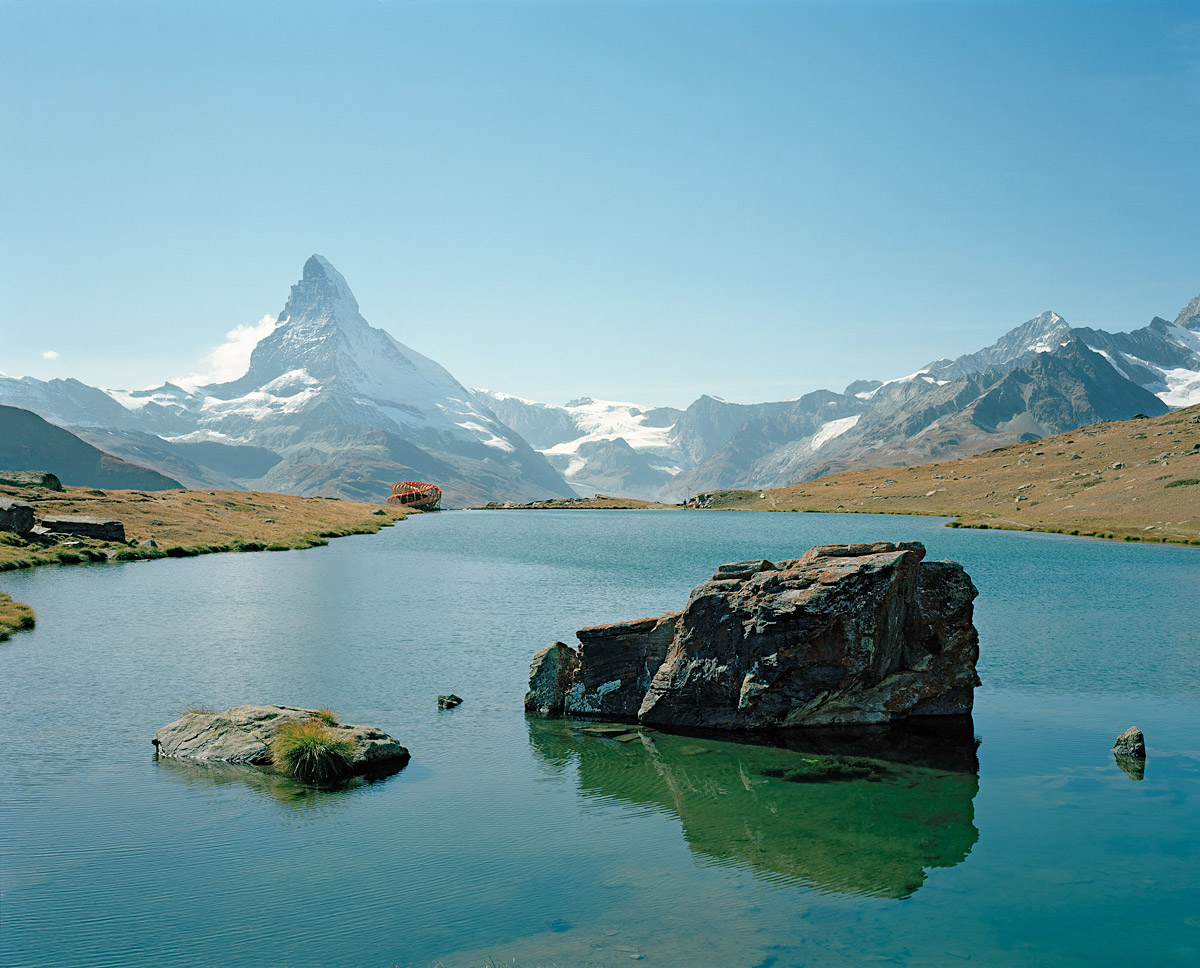
↑ Click image to enlarge
Photo: Joël Tettamanti
↑ Click image to enlarge
Photo: Joël Tettamanti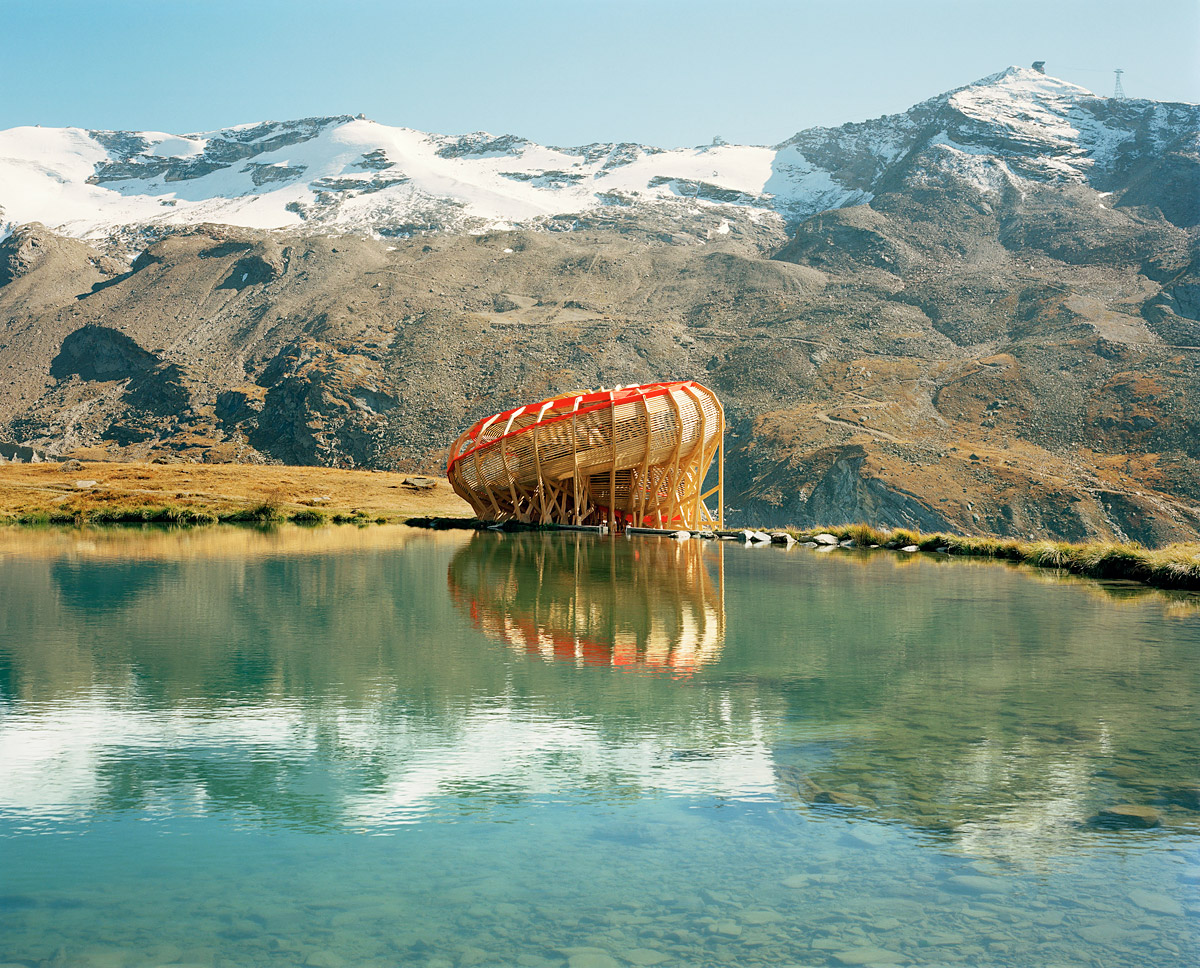
↑ Click image to enlarge
Photo: Joël Tettamanti
↑ Click image to enlarge
Photo: Joël Tettamanti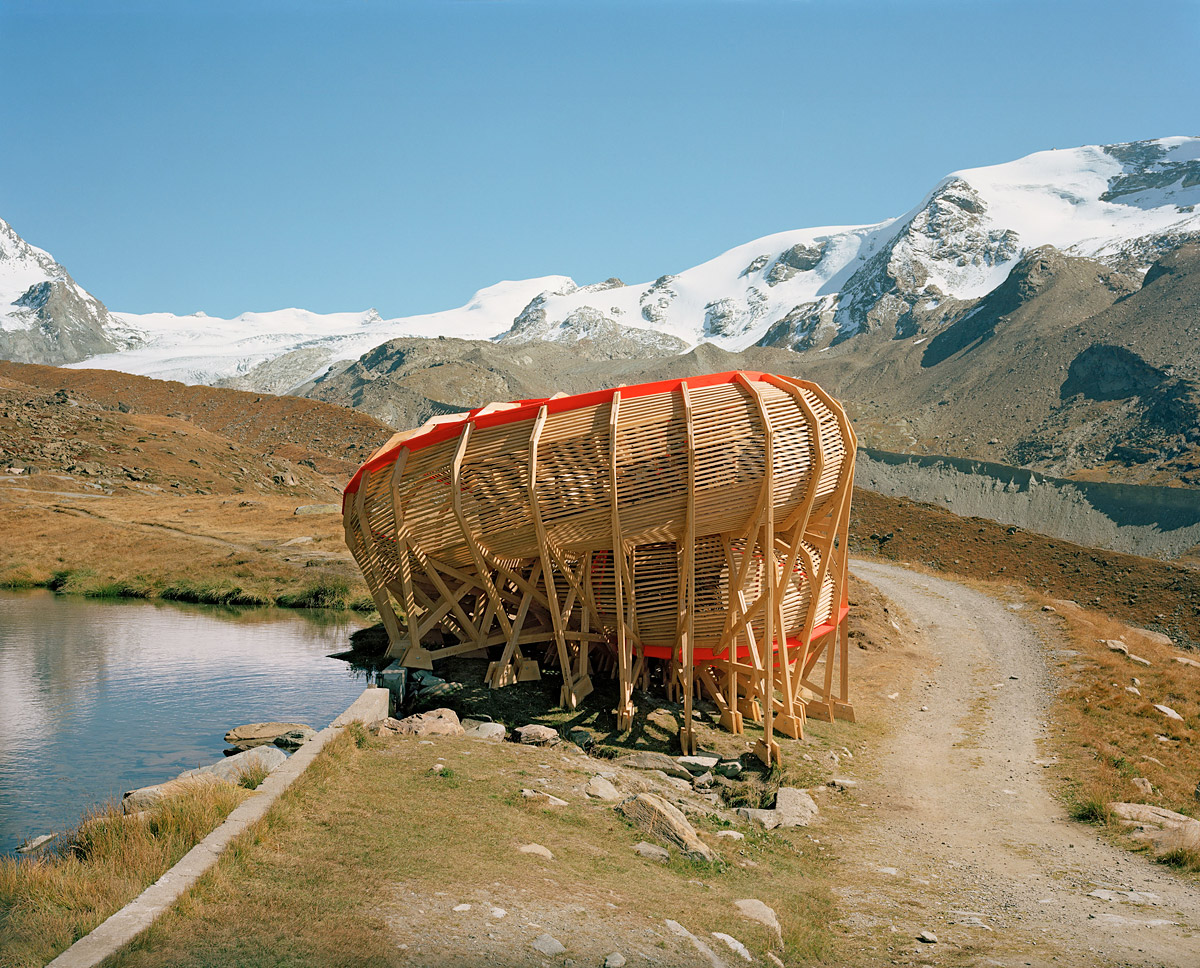
↑ Click image to enlarge
Photo: Joël Tettamanti
↑ Click image to enlarge
Photo: Joël Tettamanti
↑ Click image to enlarge
Photo: Joël Tettamanti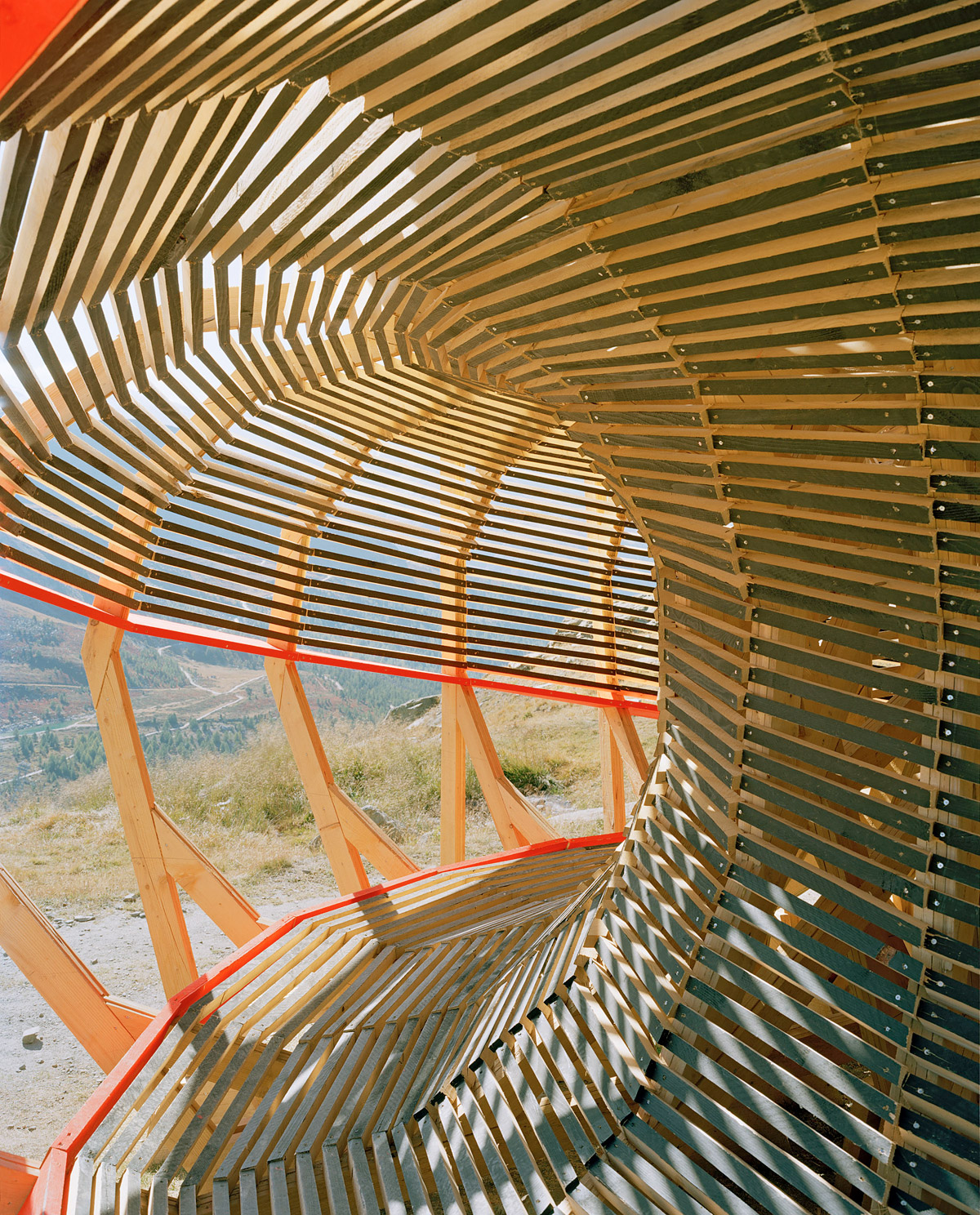
↑ Click image to enlarge
Photo: Joël Tettamanti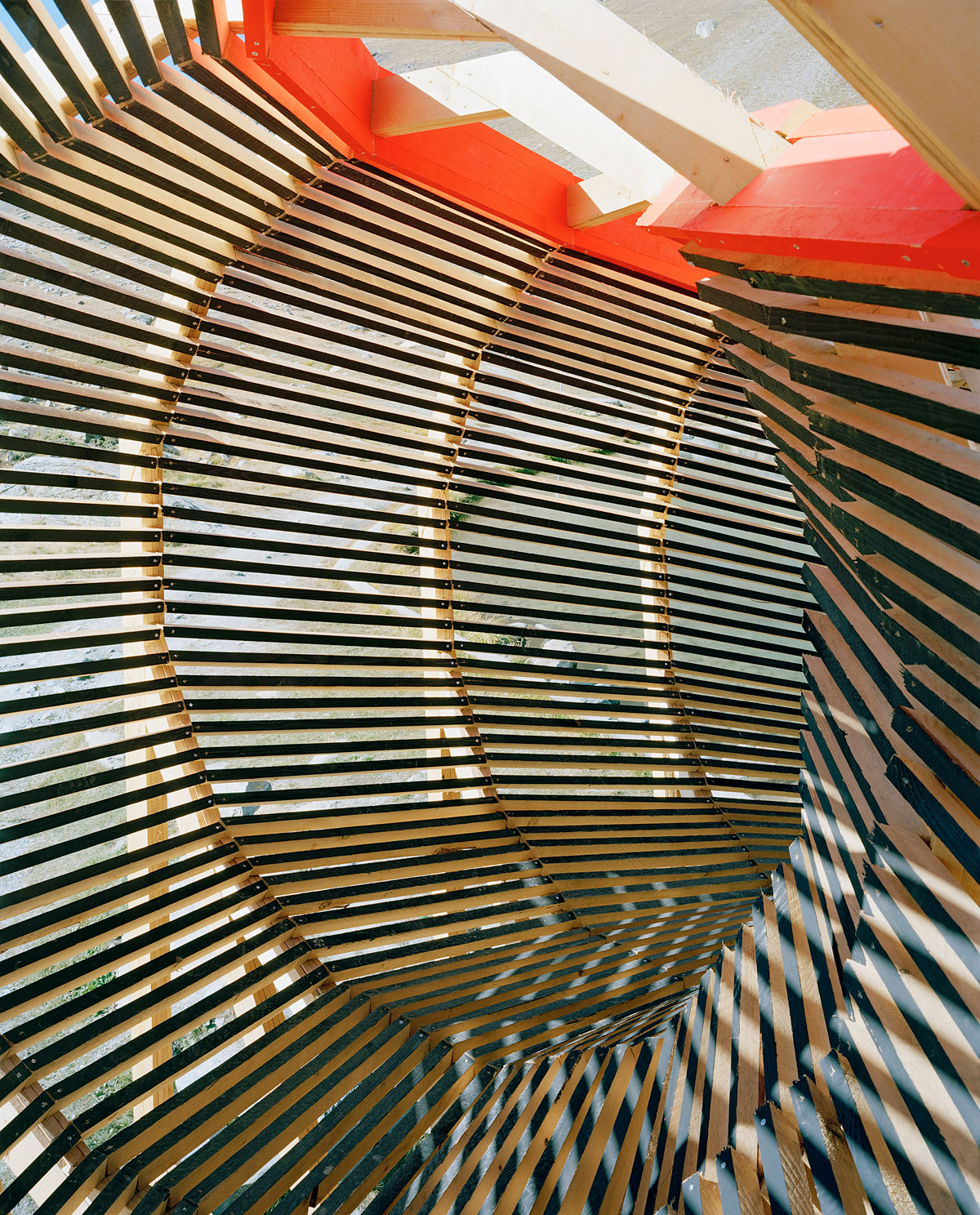
↑ Click image to enlarge
Photo: Joël Tettamanti
↑ Click image to enlarge
During Construction
Photo: Nicolas Feihl and Adrian Meredith Llewelyn
↑ Click image to enlarge
During Construction
Photo: Nicolas Feihl and Adrian Meredith Llewelyn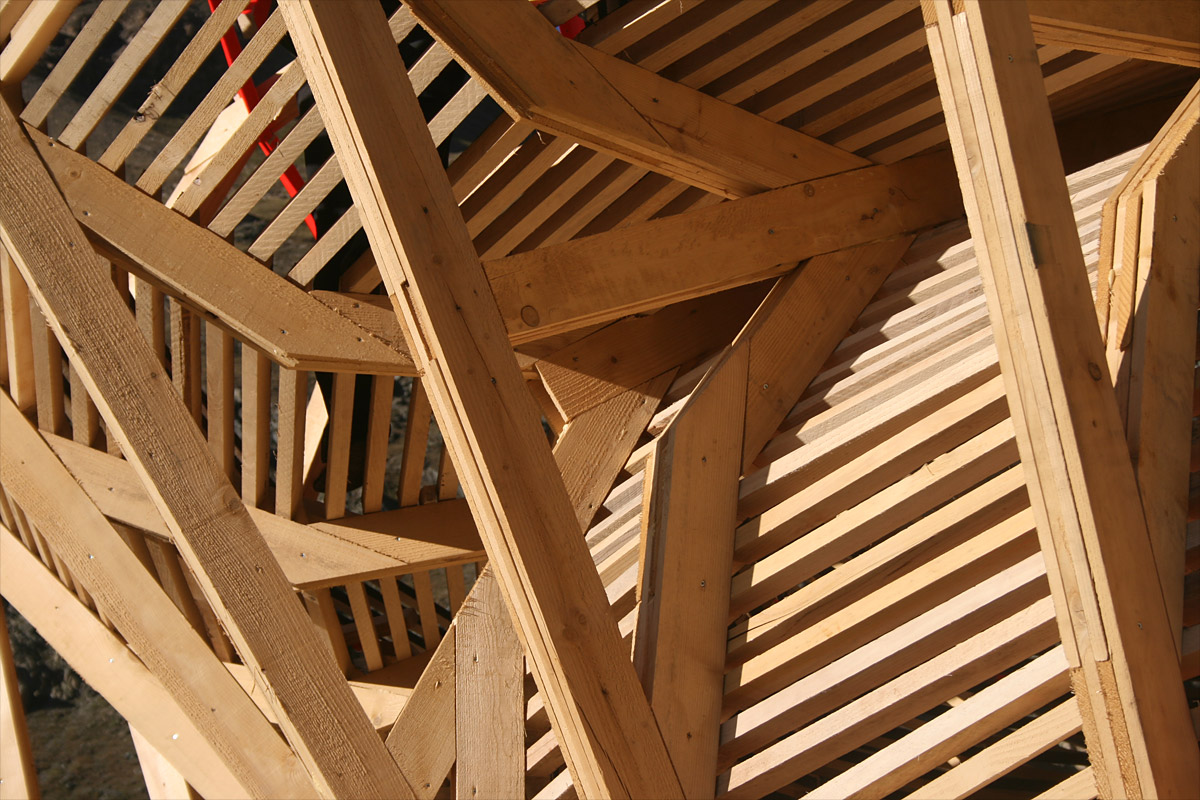
↑ Click image to enlarge
During Construction
Photo: Nicolas Feihl and Adrian Meredith Llewelyn
↑ Click image to enlarge
During Construction
Photo: Nicolas Feihl and Adrian Meredith Llewelyn
↑ Click video to play
Evolver - The "Making of" Video
↑ Click image to enlarge
Physical Model 1:10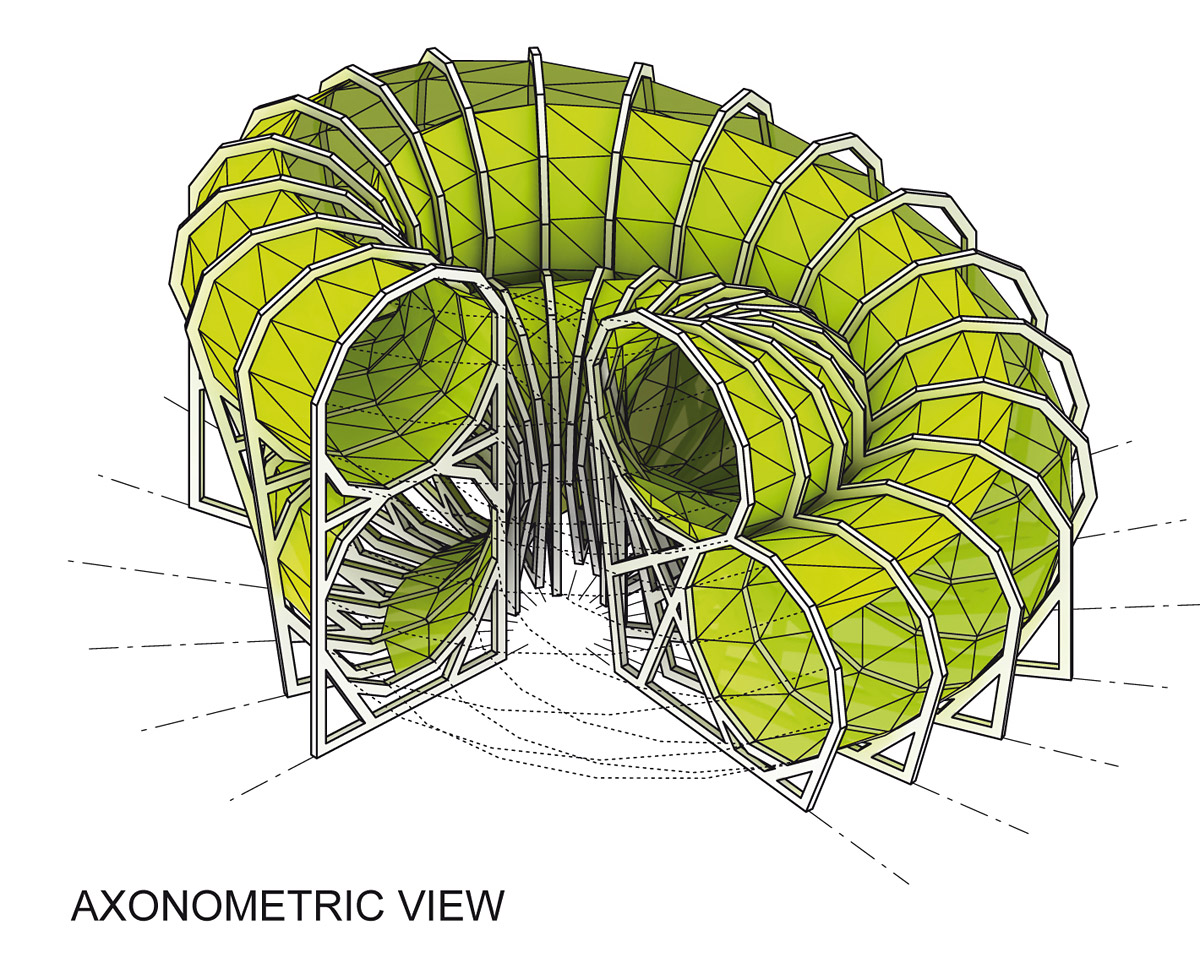
↑ Click image to enlarge
Axonometric View
↑ Click image to enlarge
Front View
↑ Click image to enlarge
Section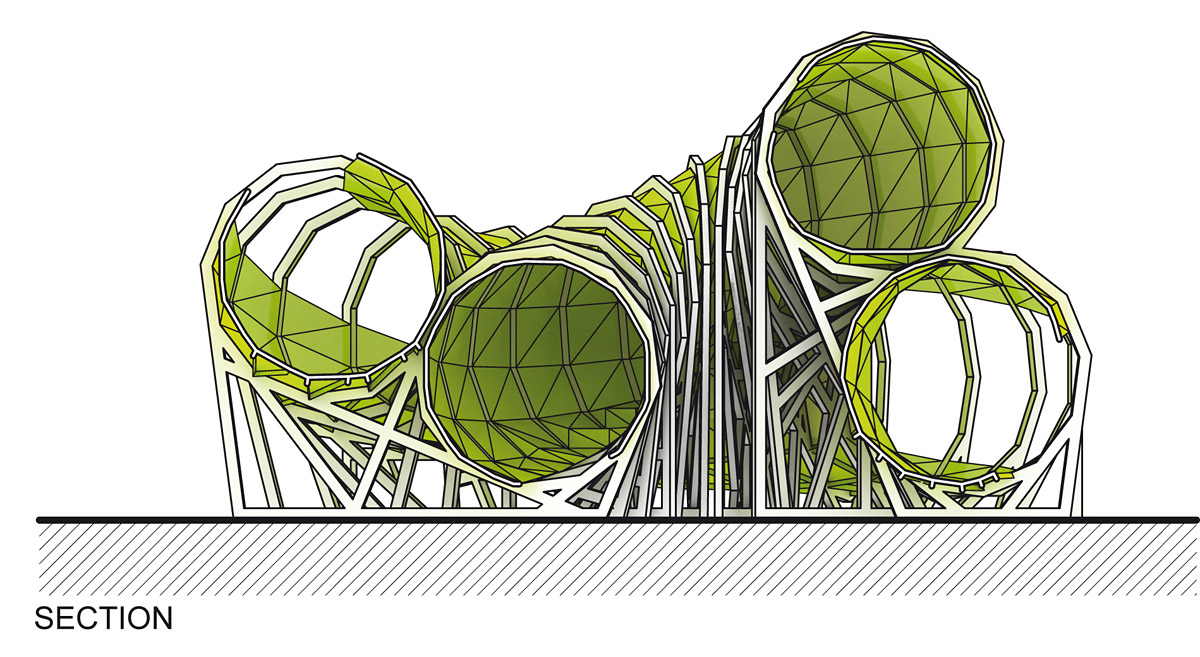
↑ Click image to enlarge
Section
↑ Click image to enlarge
Plan
ALICE is a laboratory at the school of architecture (ENAC/SAR/IA) at the Swiss Federal Institute of Technology in Lausanne, Switzerland. It was founded in October 2006 and offers an experimental approach to teaching design in architecture. The team consists of a group of architects and researchers from across Europe and Switzerland. All members of the team have built up their own practices in different European Cities, including London, Berlin, Zurich, Copenhagen and Lausanne. ALICE benefits from this international background at a day to day level, most members commuting between those cities and Lausanne.
One of the key ideas underlying ALICE's approach to teaching design is a constant discourse between a conceptual framework of an architectural idea and its translation into an actual project. While projects are usually developed with typical architectural drawings and models to represent a given proposal, we are presently exploring the potential of expanding the project scale into a one-to-one condition. The intention is that the structural constraints present at this scale as well as the potential physical and spatial impact will encourage synthetic thinking and a holistic approach to design issues.

35 Comments
this is awesome.
agreed.
Agreed.
... something a little off about that red, though, doesn't play well with the colors of the site. But yeah, totally awesome.
my second year curriculum may have just been trumped. (I've never had materials delivered to the site via helicopter)
really really nice. i like the model a lot too.
Another object in a landscape. Like a tumor; this structure makes for a sad prognosis of an unspoiled site....a wetland.
Emergent geometries is formulaic. Avant-garde? Look at Tatlin's Tower. http://en.wikipedia.org/wiki/Tatlin%27s_Tower
do be an idiot Corbuuu
This has little or nothing to do with what Tatlin's project was doing and failing to do as compelling as his tower is as an image and concept. And it is not emergent geometries. You do not understand what that word means.
This is beautiful work...I think it is maybe closer in intent to Olafur Eliasson's Serpentine Pavilion if we have to talk about other spiral references?
it is more of an experiential prosthesis than an object in a landscape
One of the best fabrication projects of the year from a school of architecture for me! : )
Love the video
*dont
barca7
No reason to get personal, especially when your reason for this project "it is more of an experiential prosthesis than an object in a landscape" means obsoletely nothing. Why not say pavilion? Viewing Platform? Fabrication vs building? Please.
The question for an architect is how and why do you build here ? What style it is means nothing. Whatever you call it, it is old news. Enjoy history it may humble you. Less is more.
i love my history. i am fascinated with some of the old russian eccentrics like Tatlin or Shukhov. actually thats why i bothered to object to your bizarre attempt use of Tatlin to somehow invalidate this.
i didn't mention style, nor did anyone else except for you...but i agree with you- questions of style miss the point. and while i'm just a recent architecture graduate and maybe my opinion doesn't matter much... this is strong work
i have been involved in some digital fabrication - and i know enough to know that what they did here is major. i am impressed by the clarity required to pull something like this off in a seminar setting
it is a fabrication project not a building. i did say pavillion.
what i meant by experiential prosthesis is that it functions to change the relation of your body to the landscape and the views that you get while your body is in movement. the slats filter and restrict the view while the open areas expose it. what i enjoy is the continuous variation of movement and perspective tied to the path of moving through the project rather than just framing single views.
also your psuedo environmental critique is ridiculous: this is NOT a wetland.
if you look at the way it meets the ground it is entirely reversible/deconstructible. you could even bring up james cutler to talk about not spoiling the ground.
WOW! What a stain on the landscape. It is such an internally focused, self referential object. It has nothing to do with the site besides to diminish it.
i'd like to shoot that signpost of the evolver with my revolver.;.)
kids would love something like this in a playground. the 'orbiting panorama' is a good idea acting as a regulator continuously going back and forth. like being framed by another frame(?) the mobius strip of evolver works like an up and down runway. i like the structural configuration. elevation drawings are designed for a flat ground and it gets a little crowded with the adjustable 'shoes,' trying to adopt it to variable topography. but that is a small glitch, considering other accomplishments.. great second year project. wow, even an helicopter involved.
things did change a bit since my generation's rombic days..
photos have cunning scale. i thought the structure was much bigger at first. it is really a better proportion as is.
yeah what a site! i'd like to see eccentric things like that when walking in nature.
i am not a purist. maybe they painted red to mark it is done in swiss territory to let their italian counterparts know..? of course not.
the matterhorn in the background... +,- 500 mountaineers died trying to climb it! crazy...
Orhan
I would disagree respectfully on the beauty of the structure (not the object)
The structure is essentially a flexible duct spiraling in an armature of bolted wood pieces. Instead of any economy (which in structure I find beautiful) you have circles made from faceted wood. (all that cutting and waste of material to simulate a circle out of plywood?) Doesn't anyone in the Alps have a pipe bender ?
I think you are assuming waste.
The remnants of mitered pieces could have been inverted and used as the next piece for all we know. If I recall correctly there is a lot of Swiss pine in the area - not so sure about local supply of pipe.
Interesting you should base your critique on economy in a second year project - postponing any preconception of 'reality' outside of school may not be a bad thing.
i did a slight editing with my comment above. basically it says the same thing but i enjoyed adding few more words.;.)
corbuu, i think most other ways of fabricating 'it' would be okay by me if they could. with mobius, you already have the form so it is a matter of game plan of building with your means possible. the site for this project is well used. kind of a life saver way. students use playwood simulations a lot. it is like a foam, cast concrete or cardboard material they use for physical models, draw-cut-slap together-install. these are kind of transitionary 1 to 1 scale and increased weight models. the fragile, temporary installations use the wood mesh method, it allows you to build all kinds of profiles.
they build a stair at sci arc from pipes last year. if thats what you mean. oyler wu is the name of the office. there is also others like ball-nogues studio & this and some point back there, is this exquisite piece by neil denari with beautifuly configured metal fabricated by crafts people with a bigger budget.
you can adjust the dosage and timing but form and construction what architecture students do and study. it is a form based education and this is a good project at second year to design-build something with simple means to understand how the space will have different structural considerations when 1 to 1 human scale and occupied and plus dealing with site and logistics.
do you know per corell? it might sound like an old song here but this project definitely reminds me his 3dh drawings of profiled space and construction, arguably.
Orphan
Why simulate material in a full scale construction? What lesson is learned? That material has no nature ? Plastic is stainless, is steel, is stone? Material science tells us differently. And haptic sense can not be simulated by a material pallet on a 3D program. This should be learned early by an architect the way a painter learns color.
This and other studios (they have been going on since the 90's) are using structure as a "symbol" (why I made the Tatlin reference). Design symbols (like the mobius and the string) and their poor literal translations have spread like a virus through the magazines and schools.
This idea and use of symbol should be taught in a theory seminar or upper year studio and not a construction class.
On a lighter idea of Fabricating Circles:
http://www.youtube.com/watch?v=Ng3XHPdexNM
awkeytect
I hear this "fear of reality" from academics allot?
What other professional training tells it's students to divorce from reality?
I think that economy is a very understandable and design worthy idea that is rooted in the humanistic work of many modernists (like Neutra and Aalto). An approach that 2nd year students do understand.
these are more like structure and form exercises. symbols are much more political, difficult and complex in their manifested meaning. ie; as you mentioned, tatlin's monument to the third international and bruno taut's glass pavilion to add another one.
very interesting work from second year students. beautifully executed too. the fluid flowing mature os the structure only adds to the beauty of the place. bravo to both the students and teachers involved in the exercise.
I still think I would enjoy the site more by just standing in one place and rotating in a circle. It looks like a fun object, but the best part of hikes are feeling the air and ground, and of course the unobstructed views at the peak of a mountain or hill. Nice structure, however.
This is beautiful student work that explores the bodies relationship to both land and architecture. It is an impressive project that teaches team work, technical skills and invigorates the imagination.
These students will not likely have an opportunity to create something like this again. I think the "object" beautiful and is inviting as it is temporal.
The orange/ red paint looks great as a formal device to accentuate movement.
While the helicopter delivery seems excessive, I would also say that American college sport teams that jet around be put under similar scrutiny.
Wow. Cool folly. Hmmm... I also think I'd appreciate that particular piece of landscape even more if it didn't have the play pin on it though. But props to those students for figuring out all those compound miters. It really is a stunning structure.
corbuu,
you mention that your reason for bringing up tatlin was the use of structure as symbol.
i hadn't gathered that from your earlier comments.
i agree that this is the case. and it is fascinating because of the use of dynamism and industrial technique to try to represent political ideals.
it rather fails in a way that this project does not because it only addressed a representation of the logic of metal construction but did not actually involve engineers and was not buildable(it was proposed in iron i believe? while gustav eiffel was much more successful turning this ferrovitreous construction logic into a symbol).
i think i maybe agree more with orhan that this is more about form than symbolism. i think that what you are criticizing as inefficiency is because the structure is being used as an armature for a surface as much as it is being used to just support weight.
this polymorphism of function is what i find beautiful about this structure. it is being asked to perform multiple things. it is different from modernism in architecture which was about separating functions discretely so that a thing did one thing only. clear and distinct.
it is a different type of evaluative criteria
what this generation is bringing to the table to support this is more complex performance evaluation/analysis packages which can bring rigor and efficiency
without having to reduce things to the lowest common denominator of
mass standardization
ie ecotect for environmental analysis
also these two are doing really interesting work:
http://proxyarch.com/
there are structural analysis packages as well of course
out of curiousity corbuu, how would you situate gaudi's structures which might be said to be symbolic of nature, but are achieved via more rigorous form finding? i am not trying to attack at this point, but to have a conversation
*symbolic of the type of mathematics in nature maybe?
Lordy how long winded these arguments are.
Can't we just appreciate the structure for what is?
Architecture can be both art and artisan and discussing it to death does not remove the functional core of it which is --- we design and build things that living, mobile things use; however nominally (however un-usefully, as half the people here commented). Now if it surrenders to taste, budget and critique, that is of course a matter of personal opinion.
Your pissing contest is rather entertaining though (corbu and barca) :). Sort of arguing with your books in front of you as reference. I would like to know if someone wins or if it will end in a draw.
twinshinky
I enjoyed barca7's (and Orphan's) comments and replies. It was a stimulating discourse in a day filled with difficult work details. Not a pissing match but an exchange.
Questions of design and ecology are important to bring forward.
If you are an pluralist... good for you (but bad for design)
All is not "good" in your DIY world.
agreed...
this was a project done in a school, not a service oriented office, and it is asking questions about how architects work, and how a project is conceptualized and then realized. it is speculative rather than normative construction
the function is in part an academic/didactic/research experiment for the the professors and students involved
and it is part a theoretical projection that is part of a broader conversation in architecture right now
on top of that it is a folly in the landscape
it is interesting if some people object to it, and i am curious about these objections, because i am from this generation, and i don't see things that way
i am interested in the talk about tatlin, and if structure is being used as symbol, or if it is taking on other roles
the conversation brought mark burry's discussion of his work on the sagrada familia to mind, but maybe this is a sidetrack from what the project itself is talking about structurally
Several comments on the lovely notes above,
Correct me if i am wrong, but isn't having a pluralist train of thought being an acceptance of several 'true' proponents to one being? How can it ever be bad for design, then? That threw me for a loop... a really bewildered one. A structure has more faces, design and functions as one fluid entity so it would be best to see all the sides of them--- hmm.
Also, i might be remiss in my labelling, apologies for that but i do call it as it i see, and i see two people trying to pound into one another (or discuss difficult work details with, as stated) that one way of looking at things is better than the other, particularly in corbuu's case. Very wordy, but entertaining.
And I did say it was entertaining, didn't I?
Lastly, Mr. Corbuu, you could never ask to hope for what I've seen yet, please do not assume that I live in a DIY world. From first world to third world, those are my truths, and what inspires other questions. Not just what is encased in shrink wrap from school. No doubt that the questions you raised are important, and that you do know something of them, I just don't find it seemly to bare all that is in my head in a public forum.
To Mr. Barca, I applaud what you are trying to say, keep at it--- just remember that other opinions, thoughts and ideas are no less important just because they aren't yours. Between school and work, who is to say that architecture's purpose has changed? Design for the sake of design belongs to an artist; that of which we are only half. The rest is a service to humanity. We never claimed to be a selfish career (though we do have many selfish pricks in the bunch, much like everyone else).
Plus, can someone tell me what is it with men designers, the continuous design concepts of towers (ie. tatlin's tower, eiffel tower, the chrysler) as a celebration of glory, and the endless fascination with them? Almost like the conventional notion of supplementing something lacking. The evolver, while disrupting landscape is still a much better execution of eye candy, in my point of view.
Again, gentlemen (i assume), have fun arguing, and tell me who wins please :).
not as interested in the phallic aspect...
jean nouvel and foster are your boys for that though
tatlin's tower and eiffel are interesting from being inside them...the spatial experience of inhabiting the open framework
like what the parisians used to say about the best part of paris was the inside of the eiffel tower because you couldn't see it (though nobody minds it from the outside either now)
but tatlin's tower tried to embody dynamism in the structure rather than reinforce a feeling of stability
evolver is a more dynamic structure, which i enjoy, and i agree that this is better than a tower
but i think the best designers are extremely opinionated...doesn't have to mean arrogant in their opinions, though often this is the case
but i'm not sure function is the best core idea anymore
i think these days its better to ask how it performs
functionalism is a pretty disputed thing, not just in architecture
but for this kind of project, there is a long history that goes waaaay back of
interventions in the landscape that are not strictly functional
for example
the roman garden pavilion that people are calling a nymphaeum near termini station in rome, which are really formal ideas, not functional ones
they still get used even if they are not created with function as a goal
or tschumis follies more recently maybe, and la villete works really really well, but it is highly "postfunctional" in the language of that time
i gain more respect for the thinkers like eisenmen that broke conceptual ground for this sort of digital architecture, the more i learn about them and architecture, initially i was quite turned off
Gods Tschumi--- you brought to mind a friend of mine from school i lost in touch with a long time ago--- that was his boy. He used to be able to completely wax poetic from la villette to constantin until everyone's (including our professors) eyes glazed over.
While i can completely accept that the idea of deconstruction is foregone conclusion considering the wealth of certain areas, and the main fact that it is human to appreciate what would seem illogical in a practical world, it is not a concept i like to embrace... appreciate yes, create in the ideology of, no...
I would very much prefer to polish an actual task or function by way of idea and construction until it shines and seems completely detached from the original action (much like the perfection of a japanese tea ceremony). Utopian and idealistic it is, but when you see so much suffering in the name of 'beautiful' architecture (ie. the very ugly contrast ryugyong hotel vs the hovels about 95% of the population of N. Korea; or jsut the general surroundings where i live- Manila); you lose taste for design in the joy of. The late Miguel Fisac would be an example i think, of beauty in polished function, or perhaps Miera and Aalto. Outdated, but they still work! :) Concrete fluidity broken by wood.
Anyway, yes it is true, the best designers are very opinionated. I used to laugh at the verbal volley back then too ;). Sure beats tele-novelas anyday.
the migel fisac work is very nice, thank you for the reference
can you link me anything for miera?
you don't have to talk to be opinionated as an architect (mies?)
i am not a deconstructionist,
but when i visited la villete, i thought it was working way better than i expected it would, and it backed up a lot of Tschumi's rhetoric for me.
obviously this is not the same ideas, those were all very urban
but i enjoyed how the programming came after the fact of the choreography
i do not think you have to start from the point of designating a function for
something to be seductive to people in a way where they will appropriate it.
it is maybe about making something seductive and the way that something like evolver could make you aware of your body in space that i really love about it. and i think in this case it would be less beautiful if it had a reason.
but to me your example of the tea ceremony, where the function is so polished that it becomes detached is also very lovely. it is a different way to get to something very reduced and focused.
an objection to function is not to the way such masters use it, when it becomes poetry even.
but to when it is too clumsy it can kill anything aesthetic that might be happening, and also be a kind of lie
and i certainly i don't want architecture to be useless. but they could have very easily turned this into something banal and stupid, if they had picked an unintelligent 'reason' for this.
ridiculous reasons are nice though, like a francois roche story.
but maybe this is just a jungle gym, for its reason
i do not think that this project is making anyone suffer for its beauty. ostentation can be ugly. this to me is not that though. it is a different context from manila or north korea and would not be appropriate there.
good ideas never die, they always come back- thank you for the fisac.
the migel fisac work is very nice, thank you for the reference
can you link me anything for miera?
you don't have to talk to be opinionated as an architect (mies?)
i am not a deconstructionist,
but when i visited la villete, i thought it was working way better than i expected it would, and it backed up a lot of Tschumi's rhetoric for me.
obviously this is not the same ideas, those were all very urban
but i enjoyed how the programming came after the fact of the choreography
i do not think you have to start from the point of designating a function for
something to be seductive to people in a way where they will appropriate it.
it is maybe about making something seductive and the way that something like evolver could make you aware of your body in space that i really love about it. and i think in this case it would be less beautiful if it had a reason.
but to me your example of the tea ceremony, where the function is so polished that it becomes detached is also very lovely. it is a different way to get to something very reduced and focused.
an objection to function is not to the way such masters use it, when it becomes poetry even.
but to when it is too clumsy it can kill anything aesthetic that might be happening, and also be a kind of lie
and i certainly i don't want architecture to be useless. but they could have very easily turned this into something banal and stupid, if they had picked an unintelligent 'reason' for this.
ridiculous reasons are nice though, like a francois roche story.
but maybe this is just a jungle gym, for its reason
i do not think that this project is making anyone suffer for its beauty. ostentation can be ugly. this to me is not that though. it is a different context from manila or north korea and would not be appropriate there.
good ideas never die, they always come back- thank you for the fisac.
the migel fisac work is very nice, thank you for the reference
can you link me anything for miera?
you don't have to talk to be opinionated as an architect (mies?)
i am not a deconstructionist,
but when i visited la villete, i thought it was working way better than i expected it would, and it backed up a lot of Tschumi's rhetoric for me.
obviously this is not the same ideas, those were all very urban
but i enjoyed how the programming came after the fact of the choreography
i do not think you have to start from the point of designating a function for
something to be seductive to people in a way where they will appropriate it.
it is maybe about making something seductive and the way that something like evolver could make you aware of your body in space that i really love about it. and i think in this case it would be less beautiful if it had a reason.
but to me your example of the tea ceremony, where the function is so polished that it becomes detached is also very lovely. it is a different way to get to something very reduced and focused.
an objection to function is not to the way such masters use it, when it becomes poetry even.
but to when it is too clumsy it can kill anything aesthetic that might be happening, and also be a kind of lie
and i certainly i don't want architecture to be useless. but they could have very easily turned this into something banal and stupid, if they had picked an unintelligent 'reason' for this.
ridiculous reasons are nice though, like a francois roche story.
but maybe this is just a jungle gym, for its reason
i do not think that this project is making anyone suffer for its beauty. ostentation can be ugly. this to me is not that though. it is a different context from manila or north korea and would not be appropriate there.
good ideas never die, they always come back- thank you for the fisac.
oh gods sorry for all those posts, can i delete the duplicates?
Welcome regarding the fisac reference, and --- EEEk my apologies, i mistyped, and really badly. I meant Alvaro Siza Vieira --- not Miera--- the portuguese architect. I suspect I was distracted at the time i wrote!
And correct, the evolver is a different context from Manila or N. Kor, but when you aren't free of excamples like that it tends to affect the way design flows. I can honestly say that there is very few original ideas that sprung here; and most of them a vain attempt to secure their roles in the design food ladder/corruption bandwagon--- ie. copy from abroad. Tch. Little patience with that kind of thinking too.
Lastly an answer to seductivity of forms--- http://www.youtube.com/watch?v=XliOko5xrr0&feature=related -- Kodama & Takrno's protude & flow project. While its not a building, its another way redefining function from dreams...
Function does not have to be clumsy, or of our dimension, i think. Too often i think this can limit designers in the quest of a new form or cause them to do something completly 'formy' without giving a thought to what the usage is beforehand, leading to lack of planning for evolution.
That's it for now... :)
Ps. i don't think we can erase comments... unless we appeal to the web-maintenance.
Block this user
Are you sure you want to block this user and hide all related comments throughout the site?
Archinect
This is your first comment on Archinect. Your comment will be visible once approved.