

ShowCase is an on-going feature series on Archinect, presenting exciting new work from designers representing all creative fields and all geographies.
We are always accepting nominations for upcoming ShowCase features - if you would like to suggest a project, please send us a message.
Maison NW is located near Paris, in the city of Saint-Ouen, neighboring the northern quarters of the capital. It is on an attractive plot in a rather typical neighborhood. On the western side, the whole area is filled with small, low-cost apartment buildings and on the east, a small industrial zone. It spreads along a cemetery, a large park with century-old chestnut trees. From the upper floor terrace, one can see the branches and leaves. On the southern side, one can see a small block one and two-story brick houses.
The project takes place in the headquarters of a former printing house, dating back to the 1950s. The space has been transformed into 9 artists’ workshops. The house-workshop covers 1,937 sf (+ a terrace of 861 sf), on three levels.
↑ Click image to enlarge
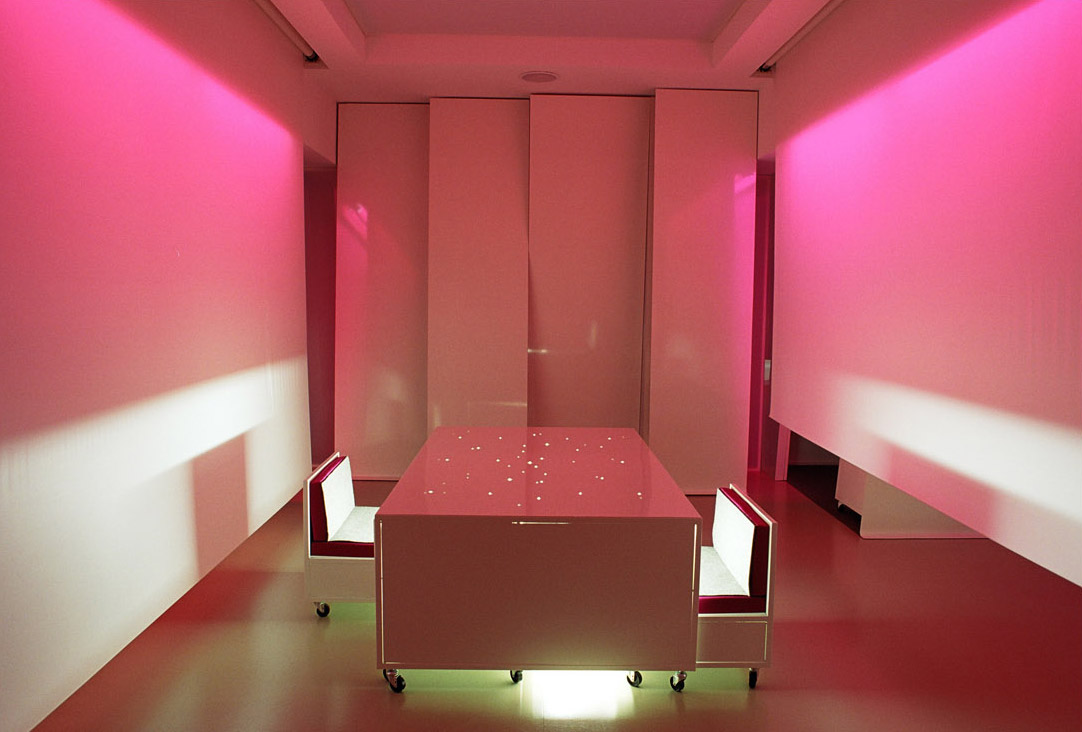
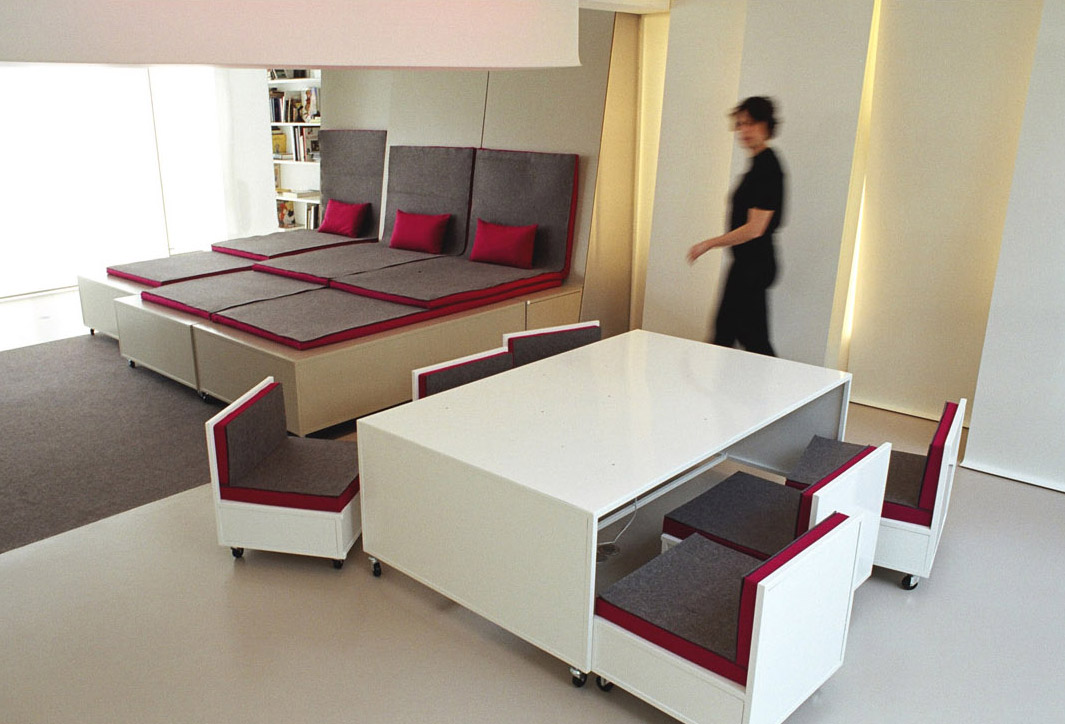
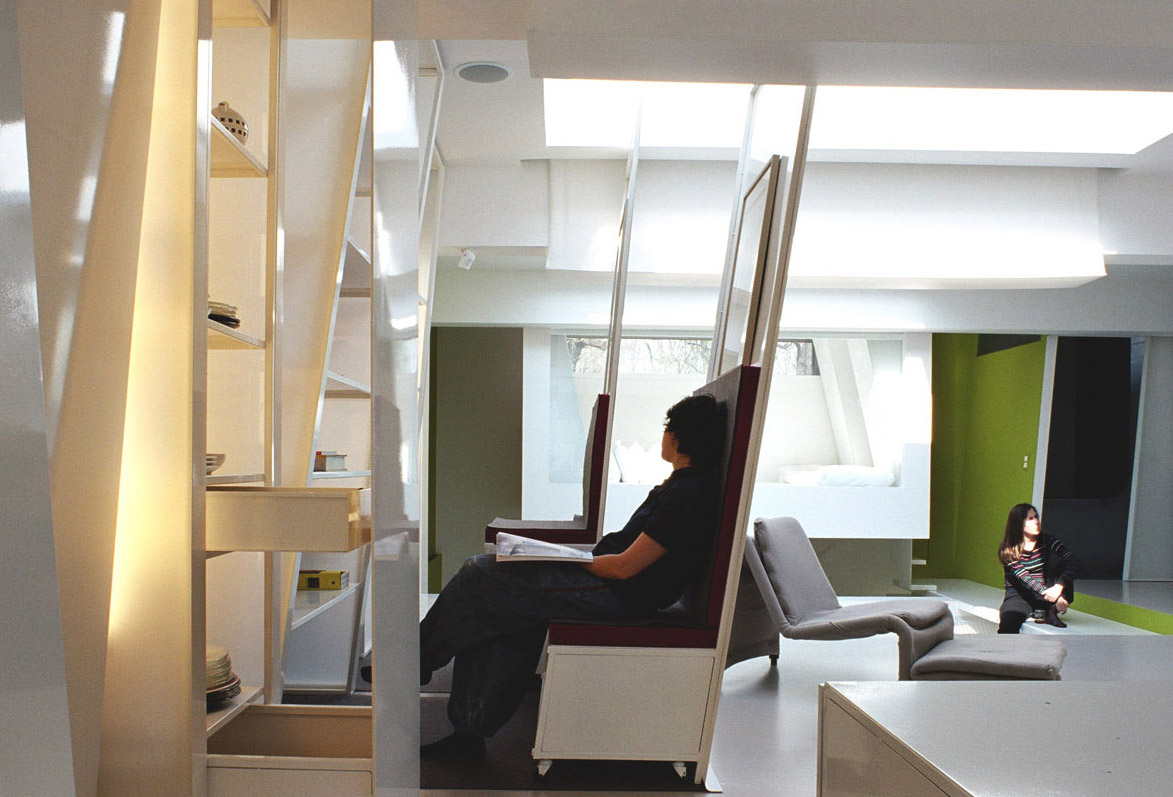
The 'Furniture Room' (Click on this and all of the images to get a detailed view)
A tailored architecture.
Maison NW, the home and work studio of architect Nathalie Wolberg, is treated as a laboratory to test out new devices and new environments on a daily basis.
Taking into account the individual from the conception of the project allows a different approach on the topology of domestic space. The concept consists of crossing individual personalities with daily actions in order to create a coherent framework that takes on:
↑ Click image to enlarge
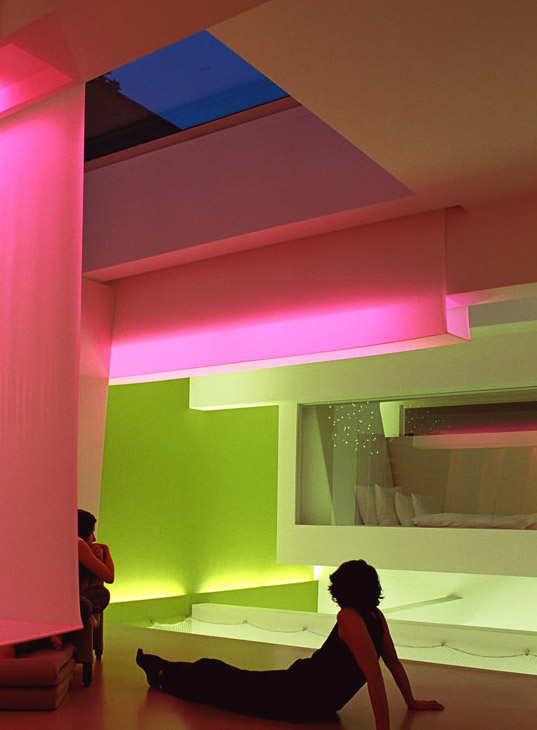
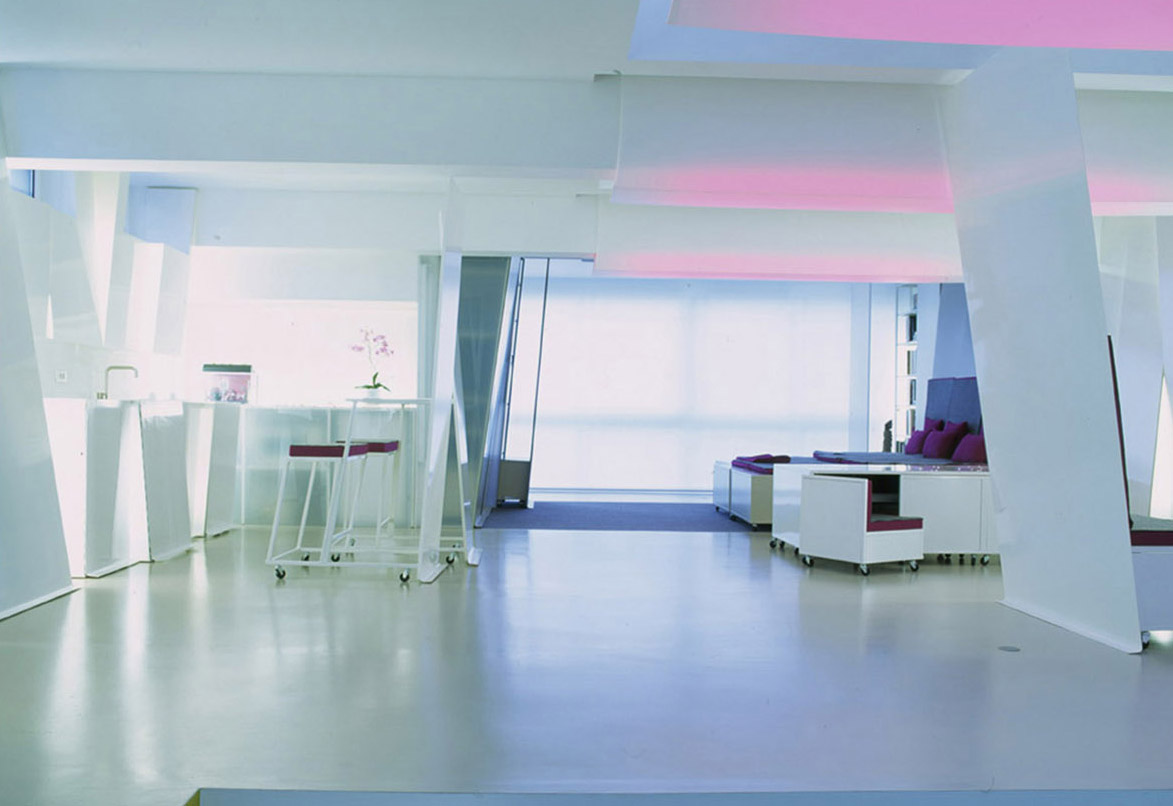
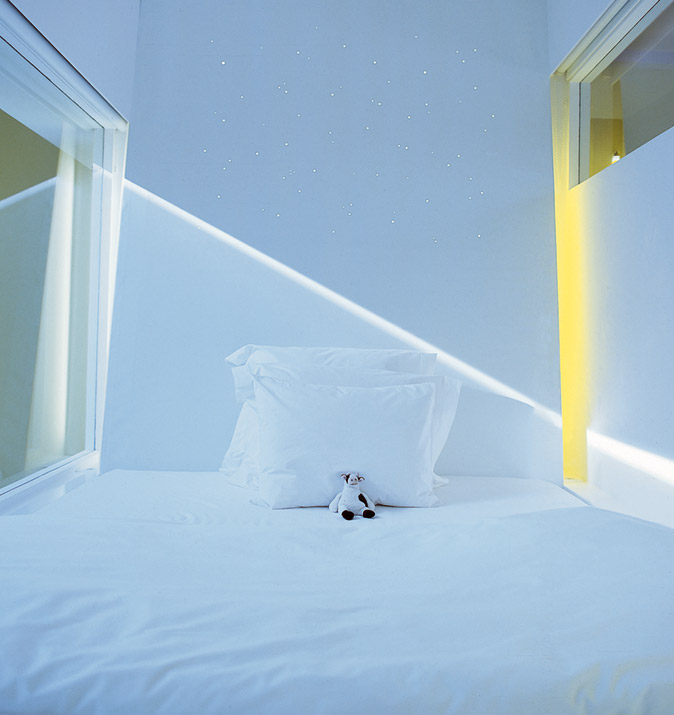
Illumination of the relaxation area
↑ Click image to enlarge
The library area
So, for Maison NW, the architect's own personality - own desires, passions, even pathological deficiencies - lies at the core of the project.
The approach uses the body to define the shapes of space.
A number of suitable principles will be elaborated and adapted over time that will meet the needs of many, even though the project is based on the architect's personal experiences.
↑ Click image to enlarge
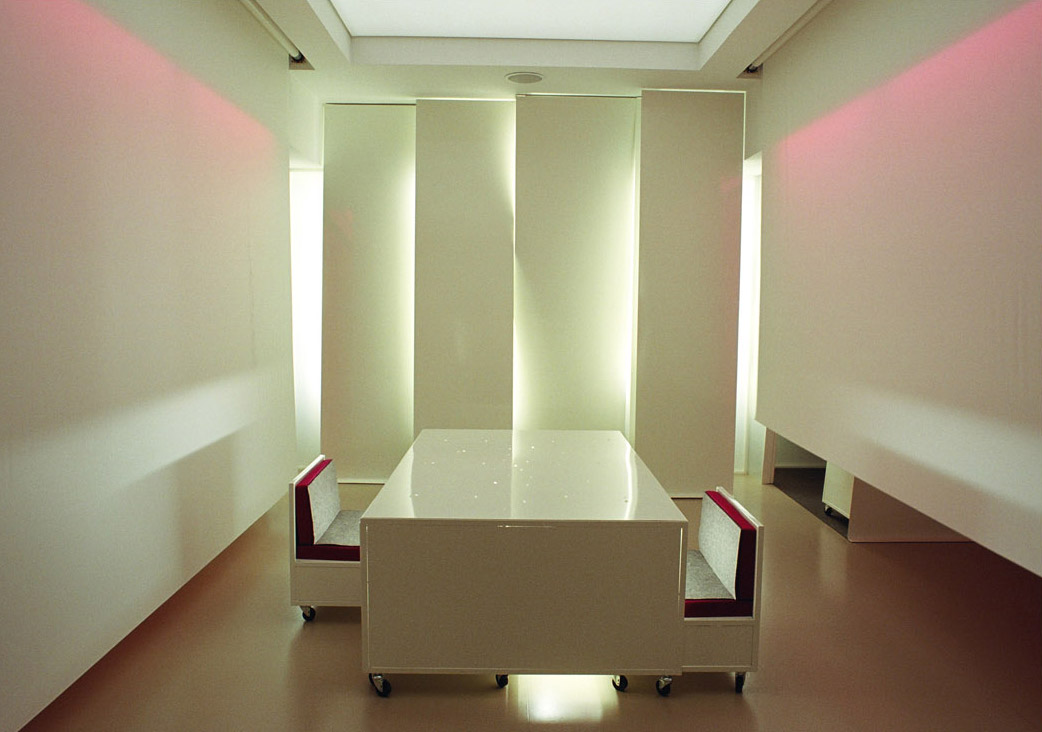
Working in the 'Furniture Room'
An architecture of the senses.
This architectural concept is defined through a linguistic approach: words that qualify our behaviors. The implementation of a system permits the progressive transition from sense to shape, from conception to perception, to concrete representation. It projects symbolism into reality, and reveals the framework in their physical, sensible, and perceptive dimensions. Thus, it becomes possible not only to qualify shapes, colors, and materials, but also to work on a sound-based, visual, kinesthetic, and tactile transcription of words, and chosen notions.
Consequently, the environment is conceived through sensibility to create specific atmospheres. It creates a "wall-free" architecture within which light, sound and matter, according to their inherent qualities define the limits of the space.
↑ Click image to enlarge
Kitchen area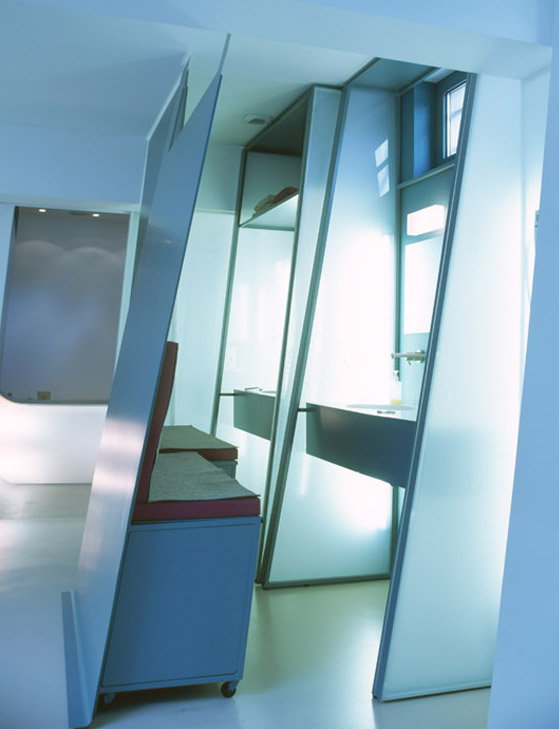
↑ Click image to enlarge
Bathroom area
Various scales of the project modify behaviors and relationships.
The project is based on three scales designed to match needs for intimacy, autonomy and/or sharing. Through similar actions, it will be possible to adopt behaviors, attitudes, various postures and to initiate numerous relationships.
↑ Click image to enlarge
Canape
The scales are :
↑ Click image to enlarge
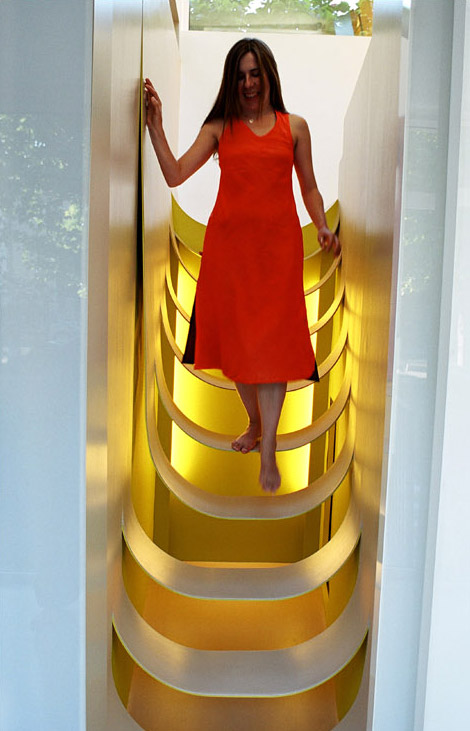
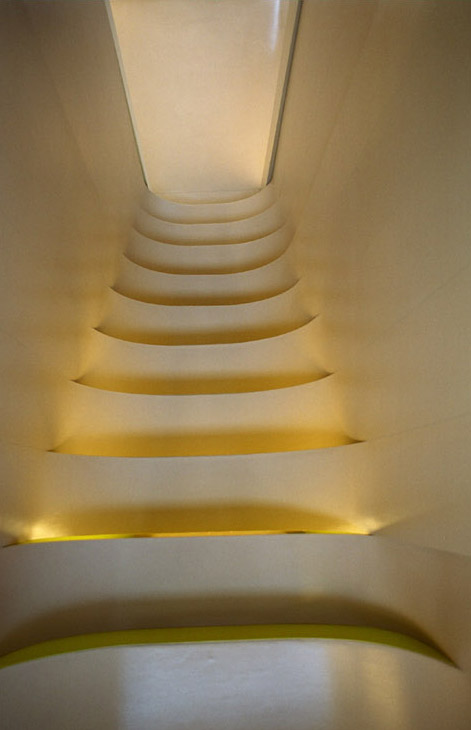
Staircase
↑ Click image to enlarge
Staircase - Detail
Global and Conceptual Approach.
Each space is a framework that has attention to many details. Here, the furniture participates in the architectural setting. It is not the expression of a style, but the very foundation of the architectural project. The items integrate both functions, postures, constitutive elements of the created ambiance (light, sound,...)..., to the point of re-creating the walls of the house.
The space integrates actions linked to work and domestic life. In addition, the domestic functions must disappear when the space is turned into a workshop thus giving way to creativity. Nevertheless the house must regain its original functions when needed.
↑ Click image to enlarge
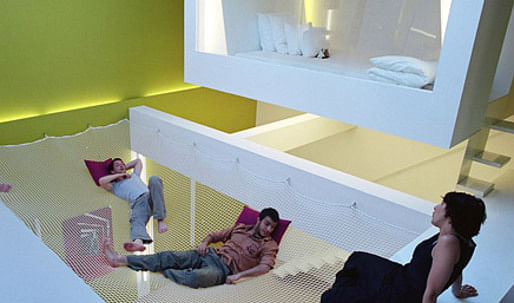
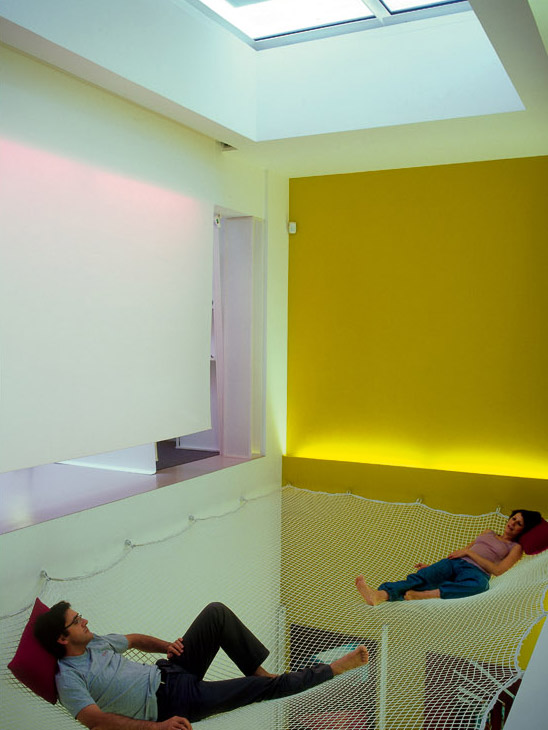
Transition of space towards the net area
"The furniture room" provides the functions that appear and disappear.
Whether a closet or living room space, the furniture room (closed or seen from outside) re-creates the walls of the global or total space, integrating light, matter, dynamic shapes,... When opened or seen from inside, it reveals the various functions of the house and produces intimacy, and/or isolation spaces.
↑ Click image to enlarge
The large hanging net allows the individual to extract himself from the surrounding environment, and makes the body become gravity-conscious.
The rounded angle at the base of the doors of the furniture allows for a continual reading of space from one door to another to the very span of the space. The envelope of spaces reads like a ribbon. The widths, inclines and variable colors of the doors creates a dynamic, an imbalance which eventually breaks the monotony of repetition.
↑ Click image to enlarge
The LIVE IN area situated under the net in the lowest part of the house
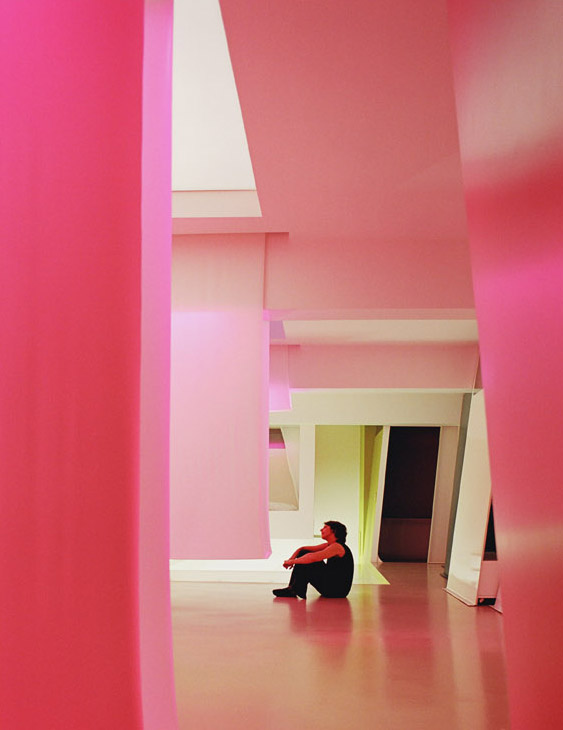
The space is constructed around bands or spans, drawn by the heavy downfall of beams which support the house. Flexible, mobile and bright partitions act as ambiance dividers. Wound up, they give rhythm to the global/total space and can also be drawn as light curtains. Once down, they re-qualify the intangible and colorful environments, revealing an architecture enhanced by sensible transitions.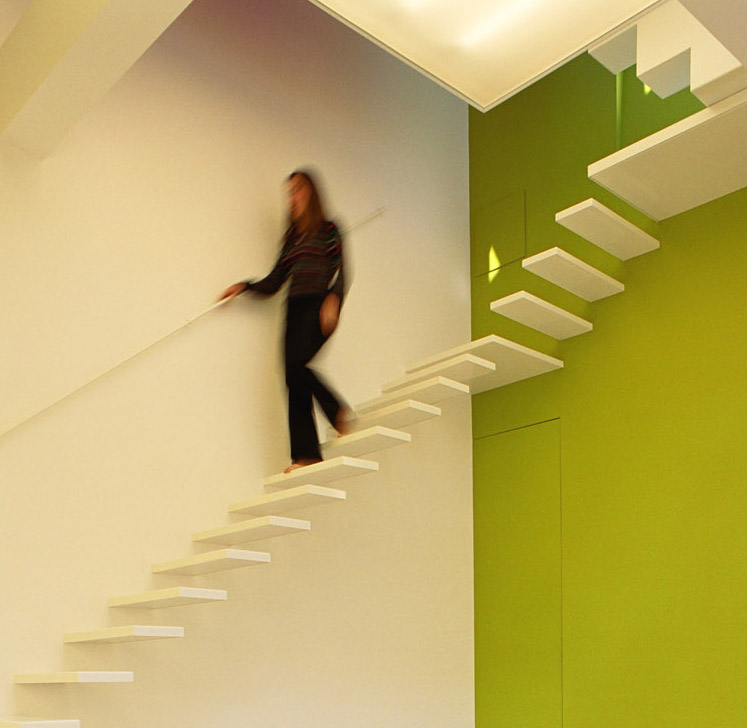
↑ Click image to enlarge
Staircase
↑ Click image to enlarge
Staircase - Detail
The large hanging net is a space conceived for relaxation. It allows the individual to extract himself from the surrounding environment. Thus the body becomes gravity-conscious. Mobility, light variation, multiple postures : the variability of the frameworks guarantees their longevity.
The first phase of the project of the house-studio was completed in 2004.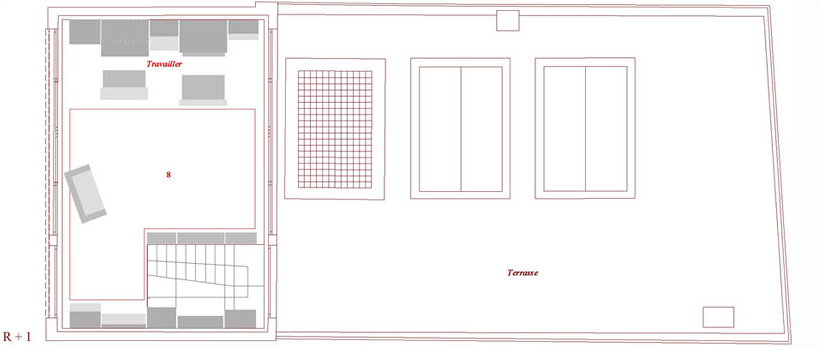
↑ Click image to enlarge
Floor Plan +1 (Roof Terrace)
↑ Click image to enlarge
Floor Plan (Street Level)
↑ Click image to enlarge
Floor Plan -1 (Basement)
↑ Click image to enlarge
Sections
↑ Click image to see 20 more photos of the Maison NW project 
Nathalie Wolberg
Both, in her teaching practice (Ecole d'architecture de Paris Belleville, Atelier National d'Art Textile - ENSCI), as well as a professional, Nathalie Wolberg is interested in the relationship that man has with the built environment. Through reflection on atmospheres, use of the various sensitive materials, and through an analysis of behavior, she attempts to create uniform spaces with those who inhabit them. Her work focuses on the concept of physical and mental comfort and how to enable the individual to "live better" through architecture.
Creative Commons License
This work is licensed under a Creative Commons License .
/Creative Commons License










36 Comments
this project is the sheer essence of cool...
This is like some crazy playhouse. I love all the chairs/furnitutre with wheels and the net/floor/loft thing..
Very stimulating project!
Oh la la!
This place trips me out. Playhouse is a very good description. I don't know that I could "relax" in a net hanging 10' above the ground but I would certainly like to try!
this place makes my sciatica hurt.
Forever young and privileged breed?
Luuuhv it!
It's like where I wanted to live when I was 12 . . . and now, too.
love this one. well thought of, it shows. bringing back my belief in 'word-play' gimmick to help a design process - not an easy feat.
tQ!
"The concept consists of crossing individual personalities with daily actions in order to create a coherent framework that takes on:
* an emotional dimension that meets the needs stemming from the individual’s personality,
* an erotic dimension that satisfies cravings generated by his/her desires and passions
* a prosthetic dimension that meets the needs rooted in deficiencies and pathologies."
I haven't encountered such intellectual dishonesty like this since the Sixties. Or maybe it's simply pompous. Tis a pity, since the project is so very cool, though I would be willing to bet a week's salary, that one couldn't live with it for long.
it's a type of entitlement. the word "needs" is used rather liberally here.
housing projects need grocery stores within walking distance.
teepees in montana need fire for heat.
we don't need "emotional dimensions . . . stemming from individual's personality"
what this translates to me is "we needed a shell to house the individual's ego."
Rogue, I agree largely with what you say, but I'm not sure it's dishonest . . . I thinks it's honestly pretentious.
Big money & bad timing. Inaccessible for humans (those not 22 and model-thin). Natural light and air? Modern-postmodern transition awkwardness. Angles introduced in lieu of architecture. Design quote unquote doesn't need gimmicks.
who cares what narrative they have to weave for themselves to get here? i love it. i wanna live there.
and, possibly more importantly, i expect it's been a very nice laboratory from which they can learn a lot for future projects. lighting, steel fab, custom millwork, use of unusual finishes....
how can you not love it?
Steven, I care; if I have to read through such annoying text just to learn a bit more about the project than you get from photos alone -- over-the-top pretentious 'narrative' helps no one, especially the design professions. That said, there are some some fun (though not particularly unique) details in the project.
I never said I didn't love it!
I stopped reading the text because I was afraid it would ruin it for me. There is so much wonderful whimsey going on in these images. There are some really wonderful material ideas going on. The stair is amazing and simple. It would be so fun to roll around on that net.
I love it, but wouldn't want to live there. It is more of a fantasy space for adults which I like, but I have doubts about much of the rhetoric used to describe or justify it. And the circulation is a bit wonky.
Added the net looks like fun, in theory but I kept looking at the details and thinking it didn't instil confidence or a sense of security.
but again, I love it
I can't understand some reactions in this post that feel like childish jealousy from self-believed serious "grown-ups". "Pompous and pretentious text"?... your comments for sure "didn't help the design professionals" either...
This is her own house, so were is the problem to reflect her own ego? most of us do the same in our own little "castles", with all the objects/pictures/work of arts that we display...
The quality of spaces, natural light, settings, emotions and playfulness in this project is truly inspirational.
Pfff!
Everyone should express themselves, even if wonderfully or grotesque. I admire that she is testing ideas on her own house. I am sure she can taylor a project to different kind of personalities.
It's "tailor," not taylor.
Oh, I apologise for the mistake. Thank you! I hope the message content wasn't so bad that only the spelling was worth noticing.
Everyone should be allowed to express themselves, but not everyone should express themselves. Very few people have something new, or truly interesting to say.
I find comments like this to be of the "everyone is special" variety - unfounded to the point of being nonsense.
It seems you do not have much to express about yourself, only criticise other's writing, going too much into form, but not getting any of the message and content and yet you think you are allowed. Of course you are, this is what writing on the net is about, freedom of speach.
It's "speech", not speach.
:))
Hey Rogue, are you American by any chance?
Did you check my profile? No? Yes, I am an American, but got my architectural education in England.
Did you check my profile? No? Yes, I am an American, but got my architectural education in England.
I was wondering if the cultural difference was maybe the reason for you not appreciating this project (or the way the text describes it)?... French culture is very oriented towards the "me, myself and I"... (although nothing wrong with that)
Nope. I love the French, warts and all. I made it very clear in my first post that I like the work ("...the project is so very cool").
What I object to is the artsy/psychobabble bullshit & intellectually dishonest captions. Perhaps it's a poor translation (I have doubt), but someone bears responsibility. At the very least, ARCHINECT could have done a better job.
Ahaaa, that explains. Without even checking the profile.
It's "ahaa," not "ahaaa".
Yuo are relly funny!
And you really can't spell!
I was sarcastic. You are not funny at all
Block this user
Are you sure you want to block this user and hide all related comments throughout the site?
Archinect
This is your first comment on Archinect. Your comment will be visible once approved.