

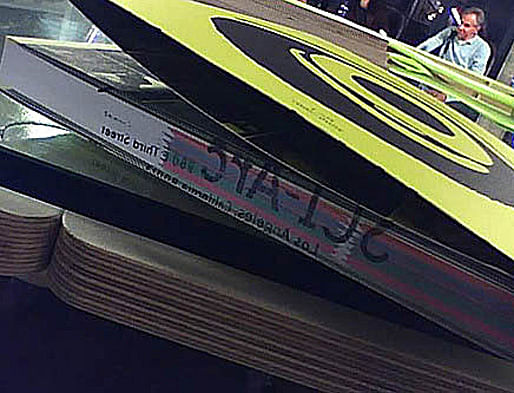
I went to Culver City the day before my interview with Eric Owen Moss. I needed to see what the architect was doing or done, and why it got attention.
EOM Architects’ business campus commissioned by Samitaur Development is easy to write off as architect gone mad.
The place is like the architect's personal laboratory of what I call, ‘gestural architecture,’ perhaps reactively.
This building complex is a provocative form farm.
Whether or not you like EOM's buildings, is not the issue, or, that is all it matters. All for nothing, or all for everything. That is the feeling the place left me with. I didn’t want the cracked stucco and the vibrations of plexiglass railing dictate what I write about the architect. After gazing 360 degrees in the middle of the parking lot surrounded by EOM buildings, I quickly realized I was looking for a bigger picture, literally.
At the end, I liked what I saw.
But not because this or that building shape, or some details, but I liked it that the architect had made no attempt to hide his shortcomings, vulnerability, his will power, courage and his vast imaginative rigor.
The experience is very similar to reading a series of short stories by the same author.
The Interview
The next day, I walked into Mr. Moss' office in Sci Arc, where he welcomed me with his great smile and he immediately asked me about the design studio I am involved with teaching, assisting, agitating, writing about, etc...
I told him, I just convinced a graduating student to finish his project instead of dropping out of school... He then asked me what the project was and lectured me on how important is to keep it clear with the students and concentrate on stuff that I have a clear idea of.
He asked me to notify him for final presentations so he can see the projects.
Before we started with my questions, I showed him the project I did in his class in 1981 and thanked him for encouraging me to write.
Thinking we are running out of time and pressured, I quickly mentioned a lecture by Slavoj Zizek, about future wars taking a place in the city limits, in so called apartheid societies [see #4 'New forms of Apartheid,' in the link]. It was to see if I could provoke Mr. Moss and get him to talk about the future of the cities via crisis detour...
OA- You have been talking about infrastructural planning of the cities which is the norm, but what do you have to say about, let’s say there is a civil war broke out between South and North of Los Angeles?
...I see a little frustration and “What kind of a question is this” kind of dismissive look in his face. That’s good...
EOM- I think that is very unlikely to happen, that is not gonna happen. I think there are parts of the city that tend to be in war amongst themselves. If you divide the city between more affluent areas or poorer areas, or some areas in the middle, you might see crime is usually confined within each community. What you don’t see is the Eighteen Street Gang going to Palos Verdes or Pacific Palisades or Los Feliz in order to do what they do. They tend to do what they do in the areas they recognize and are familiar. You don’t see an area of the city juxtaposed against another, you see one area of the city juxtaposed against itself. Some people call it black on black crime or brown on brown crime and sometime they go at each other. You can talk about these things in terms of racial problems, and they represent social and economic problems. But, I don’t see this turning into an American civil war in Los Angeles. I don’t see the structure for that to happen. There have been incidents of riots in Los Angeles in the past but the Federal government won’t allow that to happen in America, they will send the National Guard and shut it all down.
I don’t know what the motive of a civil war would be. I guess I could understand that happening in Baghdad between Shias and Sunnis or other places in Iraq. Again, there might be situations around the world where people are fighting in a city, Kosovo is a place like that. But, you can’t just pick a city like Los Angeles and start a civil war like that. It just doesn’t have any political, economic or social reason for it. The wars just don’t start like that.
OA- I saw it start during the 1992 riots... It happened. It could get much bigger next time.
EOM- Well, but you don’t see black people going to Sunset strip and burning it down or going to Malibu and burning it down.
I’d like to interject here that an EOM building, the World Savings Bank in MacArthur Park was destroyed during 1992 riots.
OA- But what happened, which took my attention at the time, and reminded me to put my question to you this way was, the afternoon the riots started, they closed Beverly Hills. You couldn’t go through Beverly Hills without a Southward detour which would promptly put you back to the areas where buildings were burning and guns were talking. BH police department closed the neighborhood.
EOM- They probably shot down different zones of the city that time like Culver City, which is adjacent to South Central, where the Riots started. I just don’t see that as a big issue in Los Angeles. I just can’t.
OA- Maybe I am looking as a more abstract way of the division of the cities, looking into the projected ‘civil war’ to understand the speculative development of the cities in relationship to one neighborhood versus the other, and perhaps projecting some consequences as a result of unjust or obtuse way of wealth and investment distribution among the different zones of the cities. If it happens in cities elsewhere, only the strength of country's economy and political structure temporarily guarantees it won’t happen here. If and when those things start to deteriorate in those areas, it will happen.
EOM- I can see a contemporary city like Pristina in Kosovo and there are places like Tibet, where people are oppressed by a government they didn’t select. And that government might be able to keep the lid for a while, but probably sooner or later the thing explodes. Chechnya might be another example of that. Berlin was a divided city at one time... But Los Angeles is not a place like that. I don’t think what you are saying is a relevant urban issue we have to deal with.
...I think it is very relevant but I don't insist.
OA- What are the relevant urban issues we are dealing in Los Angeles?
EOM- I think biggest problem with Los Angeles is the form of government, which is made up of fifteen council districts. The urban policies belong to each district separately, nothing is going to happen without the support of each district’s council person. Let’s say you have a train running from downtown to the University of Southern California, to South Central, to Culver City, to Santa Monica, to the Airport - you have to go through a lot of districts. And, you have to go through some other areas which are under the county supervisors, which is another five people. Then you have to go through municipalities and so on, very peculiar structures. All these different people and places you have to go through really inhibit any large scale decision making. That’s the problem with Los Angeles.
At this point, my semi speculative questioning about violent district wars were countered and more immediate and bureaucratic districting problems were addressed. Perhaps this is not the context to discuss this. My memory of civil unrest fades away without a full blown war within the city. I am now ready to move on to more objective subjects. To different kind of speculative issues...To a place ten hours ahead of Los Angeles according to Greenwich Mean Time...
OA- Let’s go to Istanbul, I know you’ve been there, last year as I recall...
Now, I remember reading a quote you have made in Havana, where you say, “as soon as you try to do something in the city, you have to erase something. In altering anything, there is an immediate conflict. The city moves, and as it moves, the fighting goes on. This doesn’t have to be written down as a kind of urban policy, it can be written aesthetically.”
Perhaps I shouldn’t pull it out of the context, where it was said, but these are the words through which I want to bring Istanbul into the conversation. How do you apply something like that statement to Istanbul?
EOM- Istanbul is the most spectacular, most geographically, physiologically and most historically complicated city in the world... It is an incredibly beautiful city where you have a linage from Eneolithic times, to Phoenicians, to Greeks, to Romans, to Byzantines, to Turks. Everybody who came through there left their very unusual demarcations. It is like a museum without walls, except it is not a museum. It is an exhibition of all different cultures. There are fascinating buildings by Sinan and there are Byzantine Cisterns near each other and so on. These are all very complicated histories. I don’t think there is any other city like that. I’ll give you an example and I think this will be my prototype. You know Gaudi’s Sagrada Familia , and in Barcelona somebody came and wanted to remodel the building and finish the job... And everybody said, “no, you should leave it alone because it is a piece of history and it belongs to a particular time, let it go..," and Catalans said, "no," and now they are finishing the building. In one hand, it is awful, but on the other hand, it is admirable, because it shows that the life of the city continues. The Turks will, and Turks need to figure out a way the areas that can change, areas that can’t, which connections to be removed, and which associations to remain. This is part of a sophisticated planning idea.
Do you know Suha Ozkan?
OA- Yes I met him here and we talked after his lecture in this school. He has got his hands full in Istanbul, trying to change things, I suppose.
EOM- He is an unusual person in figuring out how to do large scale interventions in the areas to add to contemporary times of the city without subtracting from the significant history of the city. You have to do it. You can’t close the city and stop the growth and change, saying, “no metro, no high-rise." You have to do it.
OA- I agree. I think Mr. Ozkan’s problem is not so much the history but some kind of issues around the land claims and the ownership of previously functioning industrial parcels.
He found some critical parcels to develop. Specially the area in Kartal neighborhood, where Zaha Hadid did a master plan as a result of an invitation only competition. I think, a lot of the opposition sprang out from the fact that Turkish architects were left out of this particular site and there are some issues with Ms. Hadid not being familiar with the area and the political issues.
EOM- I don’t know what are they going to do with the master plan but if they build the project, they will open most of the parcels to other architects. This would be a great opportunity for many Turkish architects.
OA- I think that is the best part of Zaha Hadid’s plan. To me, it would be a landmark development and I really think it is the most ambitious and powerful of her late master plan proposals. I have said it before, in one of my previous articles in Turkey that this project would really set a precedent for the shape of things to come, if it was ever built.
EOM- I think so too.
OA- If you were given a chance to design a building in Istanbul, what kind of formulas or strategies you would work with?
EOM- I never use any formulas in my work. I have to see what kind of project it is before I start working on it. But I think in very general terms, you have to, at least ideally, both acknowledge contemporary problems and solutions which have to do with, living, working, entertaining, recreating, and without conceding anything to the unusual history of the city. You have to walk a line between the two areas, which probably means what you make in Istanbul, isn’t the same what you make in Beijing. What you do, has also to do with the scale of the project.
If it is a big area, you have a chance to redefine larger area in more contemporary terms without disrupting something already exists there by working with the small pockets of historically significant buildings or conditions. It is hard to answer your question without asking more specifics of an existing project.
OA- I can’t, because there is no specific area of the city we are talking about except the whole city in general terms.
EOM- We worked with Suha Ozkan on couple of projects in Kazakhstan. Again you are dealing with a country with, either not a lot of history or very particular history and it is now trying to move to a different history but there are some resistance to that.
OA- By the way, regarding your Kazakhstan project, I first thought your own project statement was a little government power friendly. You have said on your presentation boards; “By virtue of its enormous scale and prominent location, the project will become the constructed symbol of this newly affluent Central Asian nation.” Liking or not liking your ‘architectural project’ is not the issue here, but not understanding that statement correctly is.
What do you mean? I am certain it is not what I think it is.
EOM- That doesn’t sound like a support of any power. I wouldn’t do that. It is not a government project anyway. It is a private building that has nothing to do with the government. Except, in a sense in that country, if the government doesn’t approve a project, it won’t happen. It is a private development project and the Turks play a role in it as managers and engineers. I am not interested in promoting governments. What we were interested in Republic Square, which is a main gathering place of Almaty, was to extend the public space adjacent to it.
OA- Thanks for clearing that for me.
I really didn’t want to extend this issue to more recent global arguments about power and architecture discussions, Eric Moss, the oligarchitect not.
OA- You are director of Sci Arc, what kind of a future you are projecting to your students upon graduation?
EOM- Sci Arc is not a trade school. We still have the capacity to satisfy the requirements of accreditation boards. However, our objective has always been to create independent, critical and intellectual students. I think the point is, to teach a group of students to deal with complicated subjects, in a clear coherent way. To speak to the world they are going into, and not to speak to the architects only. The architects as professionals have the problem of only talking the language of their profession. In the process of doing buildings nowadays, especially the bigger projects, architects have to have the capacity to talk and work with many people who are not necessarily architects. This is very important. So, we have many people coming from different areas lecturing on philosophy, science, engineering, fabrication, history. We are bringing in the usual and the unusual voices into the profession to develop that capacity to think, understand and analyze. And after that, the students have to go out into the world and find a way to make their critical and intellectual capacities useful and productive.
OA- I see... You have just described the state of the profession and how it is branching itself to different territories. When I graduated, it was like you got a job in architect’s office and started to draw and make cardboard models.
EOM- There are still a lot of jobs like that. Maybe more than in the past, those people understanding, utilizing and applying new technical skills; milling skills, CNC skills, vacuum forming skills, laser cutting skills, all of the 3D forming skills, parametric drawing and BIM skills, and so on. But what you want, are the students who can combine those tools with conceptual skills. There are a lot of requests for students who can use the new software and the new modeling techniques. Usually those techniques are not required with the broader conceptual understanding. Those are the contemporary drafting jobs... And, what you want, you want students who are not interested in those only, but also interested in conception, idea, fabrication, in addition to latest software and computer tools. I think that is what you want from students.
Okay, I've got to go now...
OA- Thank you for your time.
*A Turkish translation of the article is available via Arkitera.com.
This work is licensed under a Creative Commons License.


A long-time contributor to Archinect as a senior editor and writing about architecture, urbanism, people, politics, arts, and culture. The featured articles, interviews, news posts, activism, and provocations are published here and on other websites and media. A licensed architect in ...




22 Comments
Thank you for profound conversation. You both made many salient points and illuminate our current condition, I will return to this valuable text again. One immediate question regarding the World Savings Bank in MacArthur Park that was destroyed during 1992 riots - would you please point me to an image or any more information about this? Thank you very much.
Orhan...
A triumph again.
Very nice, and also quite political (in a strange American way).
Most architects (like EOM - it looks like) tend to see the world (the cities) only as a site for buildings, and not as a place of social and political reality as well.
@ BLK
Yeah i know what is up with that. I understand people got to make a living but......
Or Eric's total inability to see the possibilities of urban warfare/unrest in LA.
I'd like to think out loud for a second and pose a question...
IF Eric was not recently renewed as Director of SCI-Arc for another five years, who would have been a good candidate? (comments welcome)
moss's point about the 15 council districts IS the biggest problem with LA - NOT the threat of a race riot. Government here works on a neighborhood scale and the City Council rules all. Nothing can happen without the consent of a City Councilment - this often leads to developers making campaign contributions to get project approved and further corruption. If we had a mayor that cared about anything, he could over ride the council.
The economic crisis definitely is making another race riot more likely - but Moss is right - the real problem preventing progress in LA is the fragmented city government.
of course moss' point about fragmented city gov. is not only immediate and real, but also coming from his years of experience with the city in many levels. i certainly would consult to that view, as well put.
however, my purpose of bringing the riot/civil warring issue was, more or less, hinged upon a suggestion that it must be brought into the plate of planning and development discussions within this metropolis just about now. the days of commercial and profitability feasibility studies alone are over.
as we see the gap of social classification widening by the day, it is about high time political tangents must be addressed on drawing boards and in the minds of the architects who are usually the last stop in physical interpretations.
i agree with BLK's observation that cities, specially los angeles, must be discussed not only as building sites but also as socio political hot bed as well.
we have a hot summer ahead of los angeles, mixed with economic decline across the board.
these are the essential fuels of any scale of unrest.
as absurd as it is, and believe it or not...
What if we had more council districts in Los Angeles and embraced "the grid"? (ie, not "the line" of council boundaries, or "the point" of a single mayor / resource director)
http://www.gridbus.org/papers/ecogrid.pdf
Great idea-
I am all for the idea of more council districts and a strong mayor.
or just neighborhood councils and a strong mayor.
Problem with both forms of council is their boundaries often dont make any sense. LA is characterized by change and needs an adaptable government.
It is going to get hot, fuel is expensive and traffic is horrible.
Many of the gridlocked poor are going to be poorer than last summer
Outbreaks of violence definitely are on the menu
We are going to have to feed the government ideas on how to prevent unrest. Then we have to publicize the strategies, gain support and force the issue. Government here works by citizen input. Letter writing is effective - especially if many letters are sent.
We cant just sit back and complain about politicians and the system.
We need to propose solutions, prepare talking points that we email to our friends/post on blogs and then effect a letter writing campaign in support of our issue.
See also "SCI-Arc does Dubai" (and subsequent comments)...
a product of SCI-Arc's SCI-FI program.
http://www.archinect.com/forum/threads.php?id=74247_0_42_0_C
Great interview. Unusual energy.
Must have been a challenge to connect all different areas and still make it a very enjoyable read.
I also think the riots were relevant.
spotted at curbed LA

...Civil war?! In relation to '92 riots? Not to mention the radically different demographics of the city now. If anything, it's an east/West distinction - but both sides have positive value - not some sort of have/have not dichotomy.
Trying to ask such a question is pretty offensive to smart people or even just architects (who are supposed to be smart).
Yeah, focusing on racial tensions to understand an ethnically diverse, economically thriving, cultural epicenter of a city sounds like a great and productive idea...
* Edited for inappropriate language. Please refrain from offensive terminology while displaying opposing views. - Editor
^
i have been living in many parts of this city i love for thirty five years.
in addition to zizek's comments, the question has sprang from an economically and racially unequal development patterns of the city, and provoked consequential discussion based on that.
north-south was a decidedly personal choice for a reduction of more complicated divisions, since i often use columbus hwy.
Qestion was also hypothetical in that scale.
you are arguing for, in my opinion, token praises like; 'ethnically diverse, economically thriving, cultural epicenter of a city...'
this article is not about those.
i see that stuff in group therapy sessions and its newsprinted transcriptions, which are okay by me. i am just not interested with those in this article.
meta,
assuming by 'this,' you mean social, political, economic conditions and possible eruptive manifestations, which are minimally mentioned in relationship to los angeles in the article.
i have been exploring and being aware of 'this' for most of my life. sometimes i teach this to people. sometimes i ask... sometimes live it through, many people do...
this is not an article on fuck form. but it is interesting it got to you that way. i guess i was able to draw multiple responses, denials and further questions via short few questions. that is always good from my point of view as an author...
i really never been a proponent of architecture expressing everything through form. i really think in most cases it is even possible. ie; an architectural work is not a sculpture. but i will leave it at that. it is a personal view of mine and probably is shared by or argued against by many.
there is an integral form making in architecture but only among other makings.
while conceiving buildings as architects, i believe it is very important to develop minds, political positions, relationships on many fronts including the economic and social data, before even any pencil touches the paper or p-line becomes an architectural drawing.
try to see the life surrounding you as a human being and if you find your place, your buildings might be influenced from that. that would be a good place to be as an architect.
that, i point out to students...
meta, those are great questions.
i am not a sci arc faculty member. i was there for one semester this year, thanks to intellectual generosity of a former director.
regarding my sci arc question to its current director; what you read is what he said. what he thought students should have upon graduation, is his goal and they are rounded to multiple ideals. as an educator, who wouldn't want what he 'says'?
what actually happens might be different. there are some other factors in the equation and a whole giant factor called 'the real world.' but this is not unique to sci arc.
i am glad relatively short and dispersed article is slowly unraveling on different fronts...
, via curbed la.
interesting development that is related to what's being mentioned in the interview.
Wow that group suing the MTA is amazing. Lawsuits are a great way to equalize the economically and racially unequal development patterns of the city.
I want the City of Los Angeles to sue Santa Monica for congesting LA's roadways and polluting LA's environment - directly caused by Santa Monica's habit of creating low income jobs at a much greater rate than creating affordable housing. Every morning the roads are clogged from the North, East and South in to Santa Monica, and every afternoon the roads are clogged going back. The majority of the number of people that work there can not afford to live there. Santa Monica continually increases its restriction of new development, lowering height limits and shutting down new construction. By ensuring that the city is a built at some bungalow height, you also ensure that only the richest can afford to live there.
Restricting growth in the "greeenest" areas encourages growth in the "brownest" parts of the world and makes the greenest areas more and more expensive. Santa Monica's draconian land use regulations are contrary to their mission toward a clean environment and equal opportunity for all.
This is a good example of politics and power shaping the physical environment via transportation infrastructure.
It is about which site specific funding gets priority and for which community's interests it serves.
These type of decisions impact related set of end results and they eventually might mean few billions of dollars in property values.
In this case, it is about two adjacent communities, one having an access to fifty million dollars of public money, while the other is denied.
Of course, the issue is not about safety only.
I am not an attorney, but legally, concerns about life and limb always create an objective and winnable argument in the courts and it would be easy to get people's support behind it.
an opinion by Tim Rutten: Los Angeles Times, May 7, 2008
Money talks, this city listens
Who gets heard by local leaders? A traffic project stalled by wealthy westsiders and poor oversight of a South L.A. hospital gives us a clue.
http://www.latimes.com/news/opinion/commentary/la-oe-rutten7-2008may07,0,2275578.column
update on culver city rail;
‘Expo Rail Officials Guilty of Environmental Racism’ via citywatch
Citizens' Campaign to Fix the Expo Rail Line
cyborg
Apr 25, 08 3:36 pm
...Civil war?! In relation to '92 riots? Not to mention the radically different demographics of the city now. If anything, it's an east/West distinction - but both sides have positive value - not some sort of have/have not dichotomy.
Trying to ask such a question is pretty offensive to smart people or even just architects (who are supposed to be smart).
Yeah, focusing on racial tensions to understand an ethnically diverse, economically thriving, cultural epicenter of a city sounds like a great and productive idea...
* Edited for inappropriate language. Please refrain from offensive terminology while displaying opposing views. - Editor
______________
Over four years later, while re-reading the interview, I found that comment above by "cyborg" extremely short sighted, uninformed and basically out of touch, especially after recent 10th year reviews of L.A. Rodney King Riots and in the light of last few years' economic, political and social climate which broke out shortly after the interview was conducted...
Block this user
Are you sure you want to block this user and hide all related comments throughout the site?
Archinect
This is your first comment on Archinect. Your comment will be visible once approved.