

ShowCase is a new feature on Archinect, presenting exciting new work from designers representing all creative fields and all geographies.
We are accepting nominations for upcoming ShowCase features - if you would like to suggest a project, please send us a message.
It's common knowledge that the planet is warming, ice caps are melting, and water levels are rising. The international scientific community predicts that a temperature elevation of 1°C will lead to a water rise of 1 meter, resulting in massive land loss and the displacement of millions of people world wide. Vincent Callebaut, a visionary Belgian architect, is responding to this inevitability with his proposal LILYPAD, A Floating Ecopolis for Ecological Refugees .
Aerial view over Monaco
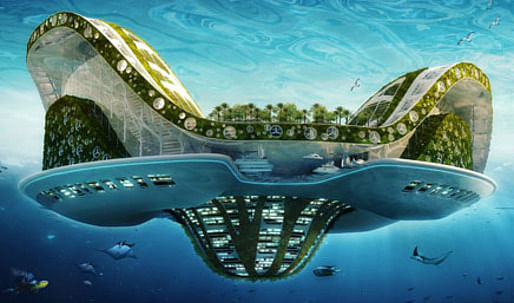
LILYPAD is touted by Callebaut as a prototypical auto-sufficient amphibious city... a tenable solution to the rising water levels. In addition to providing housing for those displaced by the transforming land/water relationships, LILYPAD also produces sustainable energy for developed regions.

Aerial views over the Maldivian Atolls
Entirely autosufficient, Lilypad takes up the four main challenges launched by the OECD in March 2008: climate, biodiversity, water and health.
LILYPAD is a true amphibian - half aquatic and half terrestrial city - able to accommodate 50,000 inhabitants and inviting the biodiversity to develop its fauna and flora around a central lagoon of soft water collecting and purifying the rain waters. This artificial lagoon is entirely immersed, ballasting the city. It enables inhabitants to live in the heart of the sub aquatic depths. The multi functional program is based on three marinas and three mountains dedicated to work, shopping and entertainment. The whole set is covered by a stratum of planted housing in suspended gardens and crossed by a network of streets and alleyways with organic outline. The goal is to create a harmonious coexistence of humans and nature, exploring new modes of cross-cultural aquatic living.
The floating structure is "branches" of the Ecopolis inspired of the highly ribbed leave of the giant lilypad of the Amazonia Victoria Regia
The giant lilypad of the Amazonia Victoria Regia (left: top surface; right: bottom of lilypad)
The floating structure of the Ecopolis is directly inspired of the highly ribbed leave of the great lilypad of Amazonia Victoria Regia. The double skin is made of polyester fibers covered by a layer of titanium dioxide (TiO2) like an anatase which by reacting to the ultraviolet rays enable to absorb the atmospheric pollution by photocatalytic effect.
The three mountains are ecological niches, aquaculture fields and biologic corridors
The main deck with the three marinas, the submarine performing arts center and the gardens of phytopurification.
LILYPAD reaches a positive energetic balance with zero carbon emission by the integration of all the renewable energies (solar, thermal and photovoltaic energies, wind energy, hydraulic, tidal power station, osmotic energies, phytopurification, biomass), producing more energy than it consumes.

To adapt to the changing ocean flows resulting from the hydro climatic factors, LILYPAD makes direct reference to Jules Verne's literature, the alternative possibility of a multicultural floating Ecopolis whose metabolism would be in perfect symbiosis with the cycles of nature.


 Vincent Callebaut
In 2000, Vincent Callebaut, 23 years old, graduated with the Great Architecture Prize René Serrure awarding the best diploma project at the Institute Victor Horta in Brussels for its Parisian project Metamuseum of Arts and Civilisations Quay Branly.
Then, thanks to the bursary Leonardo da Vinci attributed by the European Community, he decided to live in Paris to extend its critical thinking and its spatial inventiveness during two years of internship in agencies that fascinate him (Odile Decq Benoit Cornette Architectes Urbanistes, Massimiliano Fuksas).
In 2001, he competed in box and won the Grand Architecture Prize Napoléon Godecharle of the Académie Royale des Beaux-Arts of Brussels awarding the best hope of the Belgian architecture with its ecological project Elasticity, an aquatic city of 50 000 inhabitants entirely autonomous . The jury appreciated at the same time his dynamism, his expression force and the coherence of his concept, and recognised a personality endowed with a remarkable aptitude giving well-founded expectations of great success and able thus to contribute to the fact that reputation of Belgium becomes a truth.
In 2005, he was the finalist of the RE-New Architecture Pleasures awarding the 12 best figures of the Architecture in the French Community of Belgium. During the same year, the Edition Company Damdi of Seoul dedicated him at the age of 28 its first architecture monograph detailing the story of its awarded and exhibited projects during worldwide spontaneous proposals and international competitions.
Since then, in the framework of his agency and great collaborations (Jakob+MacFarlane, Claude Vasconi, Jacques Rougerie), he militates continuously for the long lasting development of the new Ecopolis via parasitical strategies for an investigation architecture mixing biology to information and communication technologies
From New York to Hong Kong crossing Brussels and Paris, Vincent Callebaut proposes with determination and conviction prospective and ecological projects by insufflating locally dialogs and meetings that try to raise our questionings on the society in which we live as citizen of a global world!


18 Comments
hmm...boring... BIG already did a project like this about a year ago. and much better one i would say.
id say most of the people on here who talk shit like ^^^ usually dont have anything of their own to talk about.
This does look scaringly much like the BIG/PLOT project MER.
http://www.big.dk/projects/mer/mer.html
Conceptually the lillypad and the big/plot emr project are very similar, however Callebaut's concentration of the idea behind the structure is what sets the two projects apart. Moving beyond the structure itself and into what it offers the inhabitants and the environment it would exist in is what makes it so interesting.
Awesomeness. Nice presentation too.
wow similarity. from overall form down to the porthole-ish windows around the perimeter. a bit hard to sustain the benefit of the doubt...
i see more marketing qualities in this idea than architectural quality, which is something that happens incredibly often these days...
Living inside one of these would be just like in the Wall-E movie.
I love these sites until they're polluted by rude asses like Neufert. Dude, smell yourself. You are really offensive. You're not bringing anything positive to the site do you realize that?
Callebaut vs PLOT (JDS+BIG)
Callebaut vs Mass Studies
Callebaut vs MVRDV
Callebaut vs Toyo Ito
Callebaut vs ....
http://vincent.callebaut.org/projets-groupe-tout.html
lol
come on yraq, neuferts criticism is accurate, present a counter-argument instead of whining.
The project as well as the others on his website places Callebaut squarely in the box of fantasy-imagineers, creating utopias that would rely so heavily on technological innovation and investments on a massive scale, that they don't ever have to worry about reality - just hoping secretly that they will be seen in a few years as people who "saw it coming", "were the first with the idea" or just "before their time". With projects like these the hope is slim. The highest hopes and aspirations of the utopianist are evident in the over-heated rhetoric companying the pretty images - the designs themselves present nothing new (as the lilypad shows) but just fantasies without real imaginary force, originality or contact with reality.
I think he just has some good education and ideas, and more will come as the conversation develops. So far, it doesn't sound like many here are supportive. He probably comes up with some interesting "real" solutions creating these projects in his studio or even some "continue the thought" exercises in creating these concepts.
They may not be feasible but as we consider the lilypad, for example, and if anybody sees the beauty in alternate living scenarios, and does not crush them dominant culture style, then at least there is discussion.
I understand not being impressed by the marketing, or concept. Just that there are ideas being worked out is interesting. For example, is there anything currently this massive that could stay afloat? How structural are the lily pad ribs, and how does that translate to a much larger structure?
If they need any volunteers, I'm their person. If man lived in harmony with nature from the beginning, we wouldn't have to find ways to live with our mistakes in the future.
steamboat
Hmm. visions of the future that are grounded in real developments and a bottom-up processes have a chance of success in my opinion, not these top-down utopias. These are just elaborate forms for an image-hungry media and audience, nothing more.
I think that real, interesting, inspiring and beatifull concepts and developments look much more like anything in 'Massive Change' - than this surface candy.
EASY ON THE BASHING, I THINK NO ONE SAW THIS AS A CREDIBLE PROPOSAL FOR A REAL FUTURE, UNLESS I AM MISTAKEN ABOUT THAT. AM I? DO PEOPLE SEE THIS AS A REAL PROPOSAL FOR FUTURE HUMAN INHABITANCE ON EARTH? IT CANT BE, WE ARE NOT ALL THAT EASILY DOUPED ARE WE?
Interesting concept... even if I am a bit bearish on global warming, colonizing the oceans is a fantastic idea.
Just curious, how would it actively avoid hitting other ships, islands, etc ?
And how would it float? It appears as if there is more mass above the water than below.
Interesting project with the natural form.
I also used the same idea about global warming idea and refugee when I did my project in grad school. But I also thought about the ice making system in the building skin to bounce back the sun radiation to space.
http://phuttipan.multiply.com/photos/album/24/UN_Refugee_Future_Iceberg_Camp_Spring_Studio_2008
http://www.youtube.com/watch?v=HpwU6ZHuLXs
Is it ok to post my project to share an idea in here?
Dubai! Dubai!
The city of Dubai in the United Arab Emirates is fast expanding with industrial and economic growth. Many ambitious projects are in development there, the Burj Dubai (tallest tower in the world) and the palm island to name just two but the lilypad project could be the next.
Convincing the investors there of how the lilypad will bring tourism, spectacle, promise of future sustainability and recognition of the middle easts contribution to tackling the world issue of global warming will be the key to realizing the concept fully. the most important thing to note is that nothing will come of this project if the likelihood of profiting from the endeavor is not certain, this is the way Dubai works. a key selling point that overlooks any monetary ideals is the projects symbolism that through sustainable living comes the promise of remaining and lasting through time. solidifying a country's wellbeing for years or century's to come.
Block this user
Are you sure you want to block this user and hide all related comments throughout the site?
Archinect
This is your first comment on Archinect. Your comment will be visible once approved.