


Many times what is most important and valuable to a student's education happens outside required courses, studio, and, for a few, well outside of their own country. In this Student Works feature we will take a look at the process that took a group of committed students outside of their curriculum and into a community in need of design in South Africa. For these students it is not a charitable project, but it is about creating a space for the community to lift itself and create its own opportunities; design as an accomplice to bettering conditions.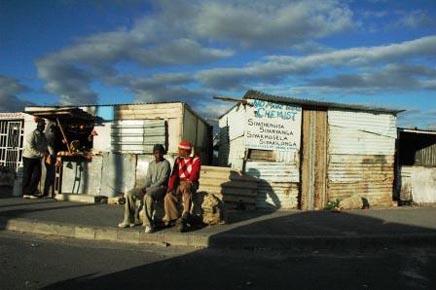 Current conditions in parts of the Khayelitsha township. Courtesy of Steven Lewis
The story of project_KHAYELITSHA (pK) begins, unorthodoxly , with the 50th birthday celebration of California based artist Dorothy Garcia, co-founder of the non-profit organization Art Aids Art
. As her husband and collaborator Tom Harding and her were wondering how to celebrate this passage into full adulthood they came upon a simple plan; an art show in which they would ask each of their friends to purchase a yellow brick for about $10. What they did not know at the time is that the yellow brick road they built that night would deepen their involvement in South Africa's Khayelitsha
township, and bring about an eventual collaboration with the current vice-president and president-elect of the National Organization of Minority Architects (NOMA
) and a group of Harvard's Graduate School of Design (GSD
) students. Shortly after the birthday party Dorothy and Tom bought a plot that community members within the Khayelitsha township had offered them so that they could continue the work they had started with the purchase of a single shipping container for Monkeybiz
, an organization that works with women from Khayelitsha, providing them the resources for a career doing traditional beadwork art.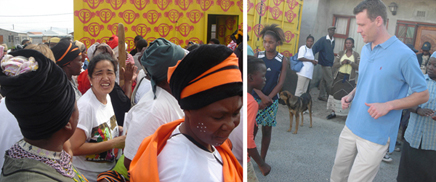 Dorothy Garcia (left) and Tom Harding (right). Courtesy of Art Aids Art
Knowing that they wanted to build something that would be beneficial for the entire community they turned to Tom's basketball buddy Steven Lewis
, an architect with the General Service Administration's Office of the Chief Architect
and president-elect of NOMA. At first, Steven thought that the best way to move forward was to organize a NOMA sponsored competition. However, Steven told me that "after presenting the idea to NOMA's board of directors everyone thought it sounded like a good idea, but soon other priorities arose and the Khayelitsha competition got to be in the bottom of the list of things to do".
A couple of months after the initial contact by Tom, Steven found himself heading for a Loeb fellowship at the GSD and thinking of how to best approach Dorothy and Tom's project. Rejecting the idea of sitting in Cambridge, MA designing the entire project by himself, Steven decided to talk to GSD students about setting up a charrette. On an early 2007 winter morning a group of students gathered to look at the project which they began to call pK. The process that Steven thought would take a couple of days became much longer as the group of students led by members of the GSD's Social Change and Activism (SoCA
) student group, decided that to do the project any justice they had to get as much information and collaboration from the Khayelitsha community as possible. Although the longer process was unexpected it was something that Steven welcomed as an advocate of social projects that engage local communities.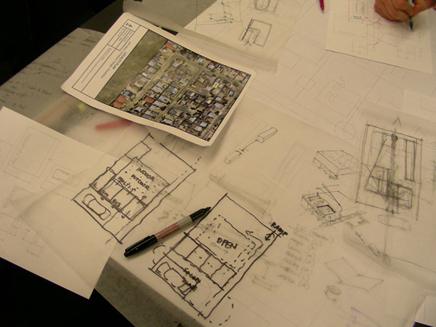
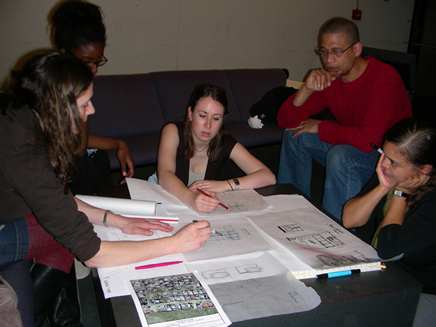 Images from the Winter 2007 Charrette. From left to right: Jessica Lisagor, Angie Thebaud , Ashley Heeren, Steven Lewis, Laura Shipman. Courtesy: pK
pK group:
*Ashley Heeren MArch I
*Patrick Jones MArch I
Jessica Lisagor MArch I
Dk Osseo-Assare MArch I
Vanessa Palmer MLA I
*Laura Shipman MAUD
*Angie Thebaud MUP
*Gena Wirth MLA I
Ulises Diaz Loeb Fellow '07
*Steven Lewis Loeb Fellow '07
*Traveled to Khayelitsha during the summer of 2007
Over the next few months the students took on the extracurricular task of designing the project, talking to Dorothy, Tom and the people at Monkeybiz to get a sense of what the community wanted. Those that attended the spring open house at the GSD may have seen Tom, Dorothy, and Barbara Jackson (director of Monkeybiz), give a public crit of the design work by the pK student group. As the students presented their three schemes the invited guests gave their opinions, not as architects but as concerned friends of the community, using a language and methodology one is not used to hearing in an academic setting. The critics talked about feelings and nuanced every-day spatial qualities of the different schemes. 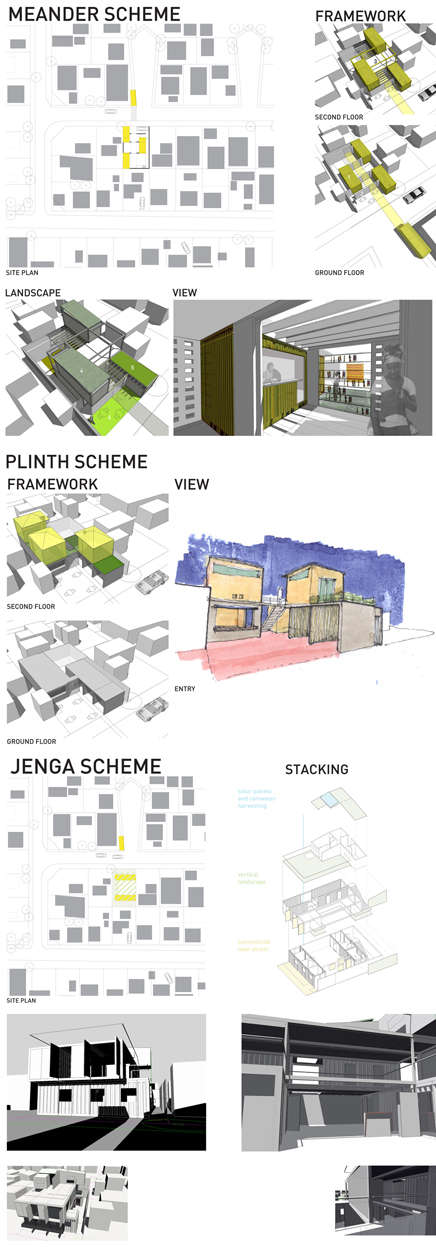 Courtesy: pK
Key Features of the Design:
Program:
The students, in conversations with the community, wanted to create entrepreneurial programs to attract people from outside the township and better the quality of life of the community. The main program for the building consists of a gallery and store for Monkeybiz, a hair styling salon, a bed and breakfast, a community kitchen/snack bar, and space for education and community events.
Shipping Containers:
In Khayelitsha shipping containers are used for everything from offices and shops to homes, this project recognizes their ubiquitous use and intents to use them in new ways. The Shipping containers provide appropriate structural rigidity to most of the building as well as for the roof gardens. The rest of the building is constructed using local materials and techniques.
Vegetation:
Used as part of the passive cooling strategies, as insulation, for water retention, and for a vegetable garden that will supply the community kitchen.
Water Retention:
The project will apply water catchment and reuse strategies on site to help mitigate the severe environmental conditions of Khayeltisha.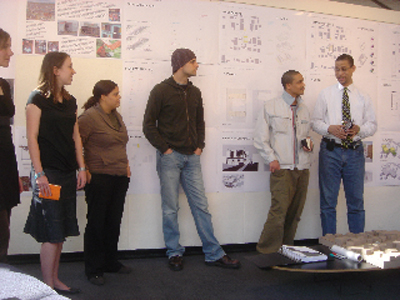 Presenting the work to Tom, Dorothy, and Barbara. From left, Jessica Lisagor, Ashley Heeren, Laura Shipman, Patrick Jones, Dk Osseo-Assare , Steven Lewis. Courtesy: pK
However, as helpful as Dorothy, Tom, and Barbara proved to be, the students wanted a closer conversation with the Khayelitsha community and by their own initiative applied for a series of grants to finance a group trip to Africa. After the successful grant writing effort 5 students and Steven flew to Capetown in the summer of 2007. While there, the group would talk and interact with the local community, create prototypes of some of the more experimental features such as the edible garden roof, and refine their design. This process has brought the group face to face with the people from Khayelitsha, but as African artist and Monkeybiz co-founder Mathapello Ngaka tells me, it is important for the community to see people from outside. For her, this cultural exchange is as important as the final building itself and she hopes that the final built-project will serve to improve the quality of life of the community and to bring people from other countries. 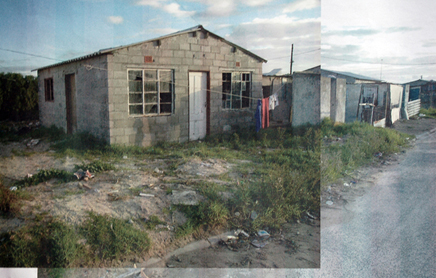
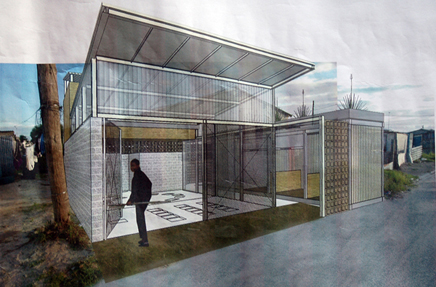 Before and After Renderings that the students prepared right before going to Africa. Courtesy: pK
The lesson the students were to learn while in Africa is that no matter how much you talk to the community and work you put into the plans and perspectives socially responsible work requires a good amount of money. In order to realize their vision for Khayelitsha they are now in the midst of a fundraising campaign. As the students reflect on the role of the designer as the fund raiser they confide that they have become more committed and have taken the project from a more traditional client-designer role to become full partners with a stake on seeing the project come to fruition. Perhaps this is the greatest lesson to be learned from the pK project, the importance of designers taking on larger roles in order to do socially responsible work. Currently, The students continue to fundraise to get their design built and help the community, but as they wait they are already looking at pK as a precedent for future student projects. They plan to take the lessons they learned during the process and while in Africa to apply it to other countries and projects.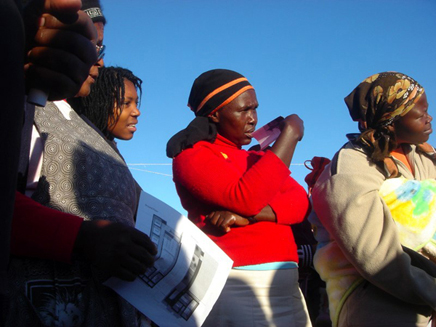
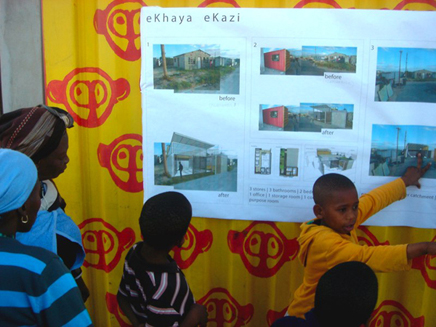
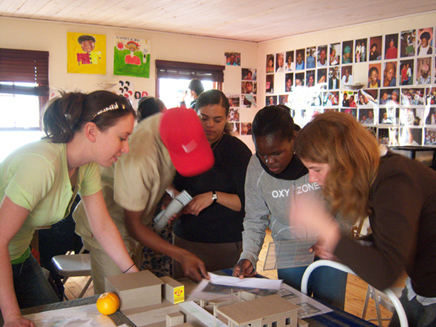 Working with the community. Courtesy: pK
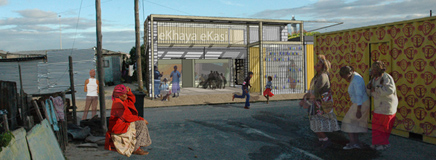 Current Design, Exterior Perspective. Courtesy: pK
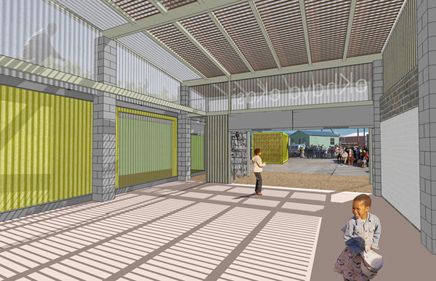 Current Design, Interior Perspective. Courtesy: pK
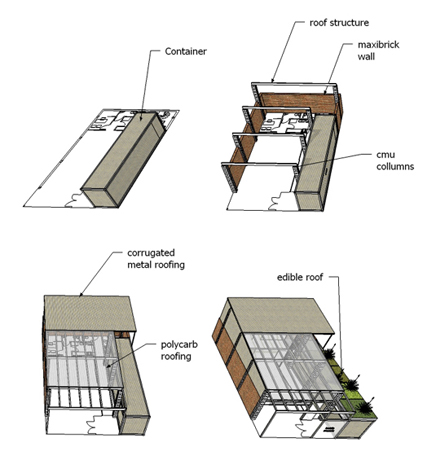 Current Design, Scheme Components. Courtesy: pK
Creative Commons License 
This work is licensed under a Creative Commons License
.
/Creative Commons License
Pratt Institute DeanDSGN AGNC founder Quilian (pronounced: Killian) is the Dean of Pratt Institute’s School of Architecture, working across the school’s architecture, landscape, urban design, planning, and management programs. Quilian also serves as the Vice President for Architecture ...



5 Comments
This is great!! love it.
Very promising approach... Reminding us of architect's role for the community and society... There has been a nearly similar approaches in Egypt, to better the community around concrete bridges by designing cultural centers under the bridges slopes.
http://www.culturewheel.org/English/ElSakia/Location/SakiaLocation_e.htm
You say that like its not usually our role!
Well...i know some architects who forgot their "usual" roles.
Interesting example Dikor - do you know of any photos of that project (or others similar?)
Block this user
Are you sure you want to block this user and hide all related comments throughout the site?
Archinect
This is your first comment on Archinect. Your comment will be visible once approved.