

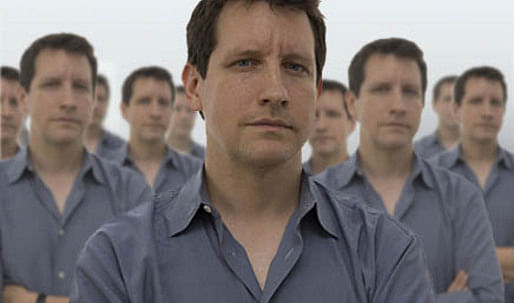
Kazys Varnelis comes pre-caffeinated. You can imagine what he's like when you add a couple shots of espresso to the mix and sit down for a conversation that launches through open source software, social ecologies, the academy, Los Angeles, and even a dash of gossip stirred in with other topics. Founder and director of the Network Architecture Lab at Columbia University, Varnelis is an educator, writer, and thinker currently based out of New York City.
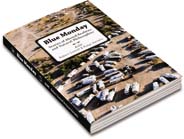 After reading the recently-published Blue Monday ($27, Actar), a book by Varnelis and production designer Robert Sumrell under the umbrella of the Architecture & Urban Design Collective (AUDC), I never should have been surprised to be caught up in such a whirlwind conversation. The book, a self proclaimed documentary-style replacement for the novel, is conceived in three acts. Each opens with a small introductory tale followed by a more in depth essay with stories ranging from the curious to the absurd by way of the unexpected. The authors' ability to introduce these stories to the reader on their own terms before folding them into an understanding of the way our contemporary reality is constructed is one of the greatest feats of the book.
When Sumrell and Varnelis write about Mike the Headless Wonder Chicken you know that a tenacious fowl is not the limit of the discussion. Rather, Mike is used as a vehicle for explicating the relationship between us and the things we own. Along with Mike, readers will find a mix of tales that includes feral camels roaming the American Southwest, Major General George Squier's (a man to whom the book is actually a covert homage) grand plans, RV constellations, and a woman who has erotic feelings for the Berlin Wall. Blue Monday is simultaneously audacious and modest: it reaches impossibly far, covering all scales, things without scale, freedom, slavery, even the question of existence itself but settles for simple revelations and small steps. As the authors themselves claim, "self awareness" always comes first before answering questions you weren't even ready to consider.
Swarming RVs form an Instant City in Quartzite, AZ
Although architecture is at the core of the discussion, Blue Monday is not a book about buildings. In Sumrell and Varnelis' telling, architecture is critical in orchestrating Empire (the eponymous term borrowed from Hardt & Negri's tome) but also provides a way of unpacking it. Blue Monday winds its way through each of Empire's three main protagonists of the Bomb (advanced military power), Money (late capitalism), and Ether (image culture and telecommunications technology) in a way that effortlessly explains the occasionally opaque text of Hardt & Negri. As Reinhold Martin points out in the introduction, Sumrell and Varnelis have provided the reader a field guide for observing Empire.
The architecture one finds using Blue Monday as a guide is often bland to the point of being generic, invisible. It abandons expression in favor of operativity, creates effects instead of affects, and fades into the background of our lives. Beginning with One Wilshire , a generic SOM tower in Los Angeles claiming the highest rental fees per square foot in North America, AUDC sets a trajectory of inquiry that is relentlessly attentive to the way in which realities are constructed through mediums ranging from architecture to music. One Wilshire, this "palace for the empire of Ether," houses the bulk of America's telephone and data connections reaching across the Pacific and as such gives a physical- if unnoticed- face to the virtual. That this building came to occupy such a critical yet unknown position in American society (what are we without Google? ) is the result of Empire's ability to simmer political, cultural, and market forces into a single stew of power. The building itself is the result of a similar mixture of unexpected causes: telecom de-regulation forcing interactions between carriers but not requiring them to make space for each other's equipment, neutral modernist space planning allowing racks and racks of servers to become unexpected inhabitants, and the evacuation of downtown Los Angeles. No one planned One Wilshire to be the way that it is today and yet such a building could scarcely exist anywhere else and its programs could hardly find a more suitable container.
Blue Monday 's images tell their own story
One gets the feeling that Sumrell and Varnelis are using Blue Monday as a field test of their ideas about how to explain architecture and its position within a larger network of forces. In addition to arriving at an architectural discussion through any number of distant avenues (record collections! lemmings! ), the format of the book itself is subtly testing the reader as well. One of the hidden beauties of the volume are the photographs, drawings, and models interspersed with the text which reveal that the authors of Blue Monday benefit from first hand experience of their subjects. Whether between a pair of RVs in Quartzite, on the roof of One Wilshire, or diagramming the internal rhetoric of Muzak, Blue Monday develops alongside a set of images carefully considered but never enslaved to the text by explicit references or labels. The subtle friction that develops between word and image connected in an unseen order of their own affirms Blue Monday as an investigation of the world as a series of projects: internally rigorous and benefiting from an overzealous desire to cover ground, yet loosely bound . It's a format any architect should find familiar.
As Blue Monday brings closure to AUDC's first phase of work based on the west coast, Archinect is anxious to see what's coming next. We asked Varnelis to discuss Network Culture and the other things he has stewing for the future.
Boyer: What does the discipline of architecture give you in examining the subjects you've chosen to look into (Empire, et al)?
Varnelis: Of course we could have written the book from another disciplinary perspective- and indeed both of us wear a few disciplinary hats- but then, it would have been a different book entirely. By training, I am a historian, by profession, Robert is a production designer. Neither of us fit the mold of what an architect is supposed to be.
But we claim Blue Monday as an architectural project, not as a work of architectural theory. Whether it be modernism, postmodernism, or postcriticism, when architects turn to theorists, they do so to get some kind of broad picture of the world and draw from that some kind of design lessons. So the instability of knowledge systems generates a building at a funny angle while a new smooth capitalism generates a building with walls that curve into ceilings . This seems to me to be a bit sad for architects.
Boyer: Yes, there is certainly great sadness in architecture's mimicking (or literalizing) whatever theoretical position is of the moment, but an important question still stands for the architect as builder. Do you have any insights into how the architect as designer-of-buildings may start to understand a networked public as an important new mode of user in the way that the Moderns benefited from the specific aesthetic and cognitive cocktail that was the modern subject (Freud, hygiene, and chrome inclusive)?
As you mention, the position of AMO is seductive but is AMO is possible without its mirror image? AMO certainly benefits from the disciplinary context of architecture, but it's also taking advantage of OMA's connections, presence, and catalog of built works . Would AMO and OMA survive independently if ripped apart by an antitrust suit?
Varnelis: It is entirely plausible to imagine literal building as an activity that produces rather than consumes ideas. The Seattle Public Library would be an example of that. I agree with you about AMO. But as an educator, I am always struck by how many of our students don't go into building per se (around half in many schools). What if the AIA and NCARB disappeared tomorrow and took licensing with them? It'd be fascinating to see what would happen to education. For one, I think we'd have to come to terms with the vast numbers of graduates who do other things besides making buildings. Are they all deviants? And if they are, shouldn't we embrace that deviance?
We'd have to come to terms with the vast numbers of graduates who do other things than make buildings. Are they all deviants? To return to AUDC, we stand in an architectural tradition of using the tools of the profession to investigate conditions and convey ideas. From the Russian revolutionary architects, to the Eames Office, the Smithsons, Constant, Superstudio, OMA, and most important for us, Andrea Branzi and Archizoom, you can see a lineage that inverts the traditional role of architecture and theory. In this model, architecture becomes a form of research and communication. Sometimes this is expressed through buildings, sometimes through media.
Boyer: There is an emerging fashion for creating prototypes instead of images- I am thinking here of people you mentioned like the Eames, but also The Living , IDEO , and the general web ethos . If architectural discourse has typically been steered through printed images what will be the medium of incitement for a networked public? Is the image unbeatable?
Varnelis: First of all, I do think that the era of the image is coming to an end. But I don't think there's going to be any one thing that replaces it's dominance. So many aspects of life since the Enlightenment were based on distinction and specialization. The relentless dominance of the visual thrived in that condition. Today, however, that seems to be at its end. Certainly the network is tending towards media convergence and with that convergence comes a need to understand multiple modalities and sites of investigation. So I'm not so sure that there is going to be a singular media of incitement. New media art failed to be quite as captivating as it was touted precisely because it didn't understand convergence. This is why AUDC consciously operates in multiple media. And the prototype is not going to replace the image but rather is one strategy amongst many considered for experimental work. Just as we need to have a broader definition of what architects do, our definition of how they do it also needs to get more fluid. But Archizoom, Superstudio, and Ant Farm weren't really all that different really. The history books record their images, but prototypes, models, films, and installations were as important as their images, no matter how compelling the latter were.
The history books record [images], but prototypes, models, films, and installations were as important as [the] images Boyer: Speaking of how you do your work... What role does the network play in your collaborations?
Varnelis: The web is a place we work, quite literally. AUDC.org is just the public face of our web work. The first draft of the book came together written on a wiki that we installed on the site in 2004. You can still visit this proto-book material . Later, we turned to writely, now part of google documents, to fine-tune the project.
In the wake of Postopolis , there has been much attention paid to blogs. Of course, blogs are important but structurally speaking, blogs are still very authorial and hence a transitional medium. In a wiki, you start to write something, then someone edits it, then you edit it again, and the process keeps going until everyone is satisfied with the result. At some point, your original voice is subsumed by a new hybrid voice. This sort of practice is accepted in many offices where you think not "what would I do" but "what would the office do," but it's still pretty unusual in writing.
In terms of network culture , there's much more to say about that, but I will say that we're moving rapidly into the era of networked subjectivity and that doesn't just mean being connected by telecommunications, it also means that instead of the individual of modernity who strove to be whole or the destabilized individual of postmodernism, under network culture we are multiple, and the boundaries between ourselves and the world are beginning to dissipate.
In the spirit of networked publics, what better way than to open this discussion to Archinect readers? Join in by posting your questions below.
Creative Commons License
This work is licensed under a Creative Commons License .
/Creative Commons License

6 Comments
I'm curious where Archinect lives within this concept of networked subjectivity. This site isn't a blog, that's for sure, and it's not exactly a wiki either...but in the past people have accussed regular members of becoming victims of groupthink. Perhaps that's the natural progression (from singular/Whole, to destablized individual in an expanded field, to a networked culture, within which a destablized individual can find a stabilizing group to identify with).
yeah...i agree with what ap said.
too, too many Kazys's's's staring back at me from archinect.
Will the entire former staff of SCI-Arc end up peering back at me from my browser window?
How does it feel to treat me like you do?
When you've laid your hands upon me
And told me who you are
I thought I was mistaken
I thought I heard your words
Tell me, how do I feel
Tell me now, How do I feel
Those who came before me
Lived through their vocations
From the past until completion
They'll turn away no more
And I still find it so hard
To say what I need to say
But I'm quite sure that you'll tell me
Just how I should feel today
I see a ship in the harbor
I can and shall obey
But if it wasn't for your misfortune
I'd be a heavenly person today
And I thought I was mistaken
And I thought I heard you speak
Tell me how do I feel
Tell me now, how shall I feel
Now I stand here waiting...
I thought I told you to leave me
While I walked down to the beach
Tell me how does it feel
When your heart grows cold
AP- archinect and the web in general offer a mode of multiple, simultaneous subjectivity. you are an archinector, a googler, a flickr user, etc and in each place your identity is constructed slightly differently. these entities hosting your identity are all asking different things of you, their communities are organized differently, different interactions are possible, and in each situation I argue that one cannot help but slip into different modes of existence. Your identity has been transformed into a browser window full of open tabs flitting between them at will.
but on archinect there is still the presence of the individual since our names are attached to everything we do. In wikiland it's different, identity is even more diffuse, downplayed.
Yes, yes, too many kazyses, no question.
Thanks to Benedict Clouette of c-lab, my colleague here at Studio-X for pointing out that this super-secret discussion is only available to logged in members of the site. I had no idea it was going on. Now I know better. Obviously, however, the real discussions are going on at an architectural version of Pownce .
Bryan, I agree about the difference between wikis and archinect although this site is a lot less identity-centered than sites like boing boing—with its very limited number of posters, all with distinct personas or corante in which posters produce much longer pieces, more articles than blog posts. In this respect, archinect seems to be the product of a virtual tribe, in which individual identity is displayed but a collective identity—not based on any particular position but rather on the continued existence and growth of the group—is dominant.
Speaking of such sites… here is a very different one, a gift for those of you who read archinect logged in…
the blue monday owner's club
Block this user
Are you sure you want to block this user and hide all related comments throughout the site?
Archinect
This is your first comment on Archinect. Your comment will be visible once approved.