

Follow this tag to curate your own personalized Activity Stream and email alerts.

Even the smallest architectural design proposes to make an intervention in the known world, it dares to change things as they are, and to venture how they might be. It envisions a possible future, sometimes a fantastic one, and then sets out to make it manifest. If that’s not a rich subject for children’s books, I don’t know what is. But such books should also make us question what we want architecture and architects to be. Not just in fairy tales, but in real life. — Places Journal
For generations children's books have told fanciful stories about the creation of houses and the comforts of domesticity. "When you go looking," writes Naomi Stead on Places, "you realize that there is a huge, even dominant genre in children’s literature: stories about houses, about the... View full entry
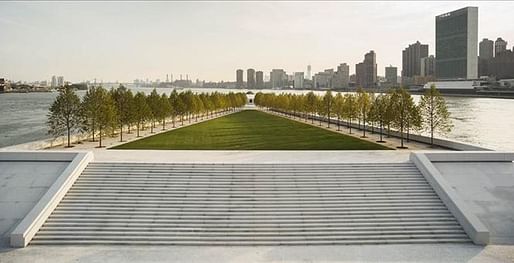
The creation of a public monument is a fraught business these days. That the pristine work of an architect nearly 40 years dead should rise intact, in today’s contentious political, legal and aesthetic climate, is a wonder. And how timely it is that the legacy of Franklin D. Roosevelt should be honored in such eloquent fashion at a moment when powerful political forces in this country seek to dismantle it. — Places Journal
Why is the design of memorials so fraught? Belmont Freeman reviews the design and politics of diverse memorials to American presidents, with a focus on Four Freedoms Park in New York City, the memorial to Franklin Roosevelt designed by Louis Kahn that opened last month. View full entry

In the terms of the story, we wanted to distill experience to a shape, a volume, instead of a literal space-type (“castle” or “gingerbread house,” etc.) We chose this path in part because the structure of the story wasn’t accessible, the events were scattered, random and untethered to a place. So we had to find the rope, make the place, invent a story-space outside the tale itself. — Places Journal
In the Halloween installment of Places' ongoing series of architectural fairy tales, fabulist Kate Bernheimer and her architect brother, Andrew, investigate the shape of fear itself. Re-imagining a Brothers Grimm fairy tale at the site of a World War II bombing, Andrew Bernheimer and Vera Leung... View full entry
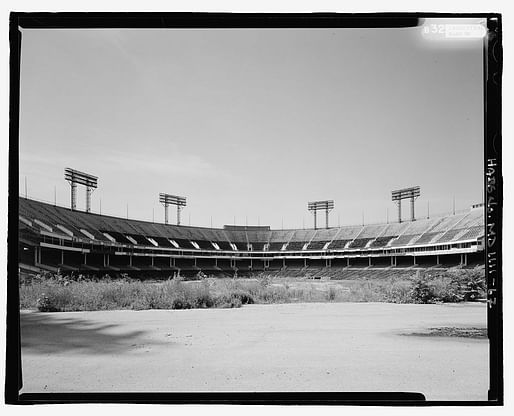
We tend to think of architecture as solid, stable, enduring, something that at its best will outlast us and possibly say something about us to future generations. Demolition makes powerfully evident the vulnerability, the mortality, of all things standing. — Places Journal
"When does architecture, once started, stop?" asks Keith Eggener. "Does it end when human occupation or attention terminates, when function or fabric are removed?" What is the connection between civic buildings and collective memory? Just in time for the World Series, Eggener recounts the saga of... View full entry

Conditions of scarcity demand new ways of thinking, an expansion of the role of the architect and designer outwards in order to function more broadly and imaginatively as spatial agents. In contrast to the regimes of austerity ... the territory of processes and networks opened up by scarcity is far more conducive to creative intervention. It is here that scarcity — which can seem at first a bleak prospect — can become the inspiration and context for constructive and transformative action. — Places Journal
What is the difference between scarcity and austerity? On Places, Jeremy Till contrasts the political ideology of austerity — imposed reductions of public services and social benefits — with the physical condition of scarcity — the measureable dwindling of finite resources... View full entry
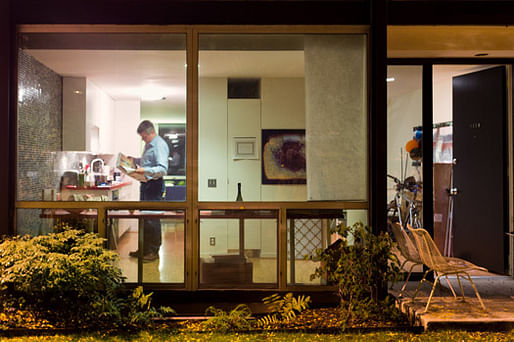
The ability to observe the private lives of strangers from the windows of my home is one reason why I’ve chosen to reside within a dense urban fabric. I am not a voyeur: I do not receive sexual satisfaction from watching the daily lives of others. But I do like to imagine the many meaningful “relationships” I have created with people that I will never meet or even recognize on the street. — Places Journal
When architect Melissa Dittmer moved from New York City to Detroit, her reaction was a "year-long panic attack." Where, she wondered, were the people? "Where was the density, the sense of connection with strangers?" But then Dittmer and her family bought a townhouse in Lafayette Park, the... View full entry
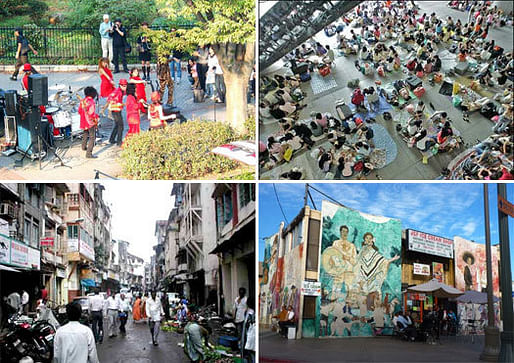
The root cause of diminishing public resources and the privatization of urban public space today is precisely the privatization of our political system — a crisis that cannot be addressed simply by creating more public spaces or by making these public spaces more inclusive and accessible. This deeper crisis requires the attention and intervention of a much more active and engaged public, a public willing and capable of speaking up and mobilizing politically to change the system. — Places Journal
The recent wave of citizen protests — from Tahrir Square to Zuccotti Park to the streets of Athens — has brought renewed attention to the role of public space in democratic society. In an essay on Places (excerpted from the new book Beyond Zuccotti Park, by New Village... View full entry
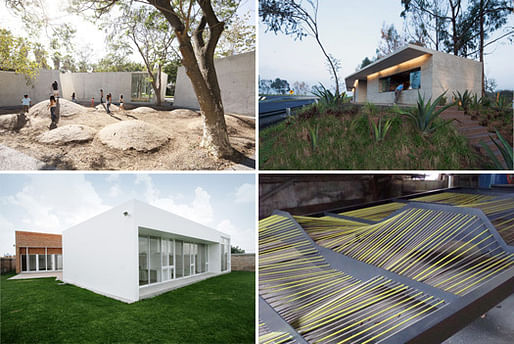
Yet women architects in Latin America — as in North America — continue to confront gender-based inequities. Partly this seems due to entrenched cultural attitudes, and partly to the traditional connections between architecture, engineering and capital, which can make it difficult to progress to a less patriarchal culture of building and design. — Places Journal
Places presents highlights from the exhibition Spaces Through Gender, now on view in San Francisco, with exemplary work by Latin American designers Tatiana Bilbao, Fernanda Canales, Frida Escobedo Lopez, Rozana Montiel, Nora Enriquez, Rocio Romero, Galia Solomonoff, Catalina Patiño and... View full entry
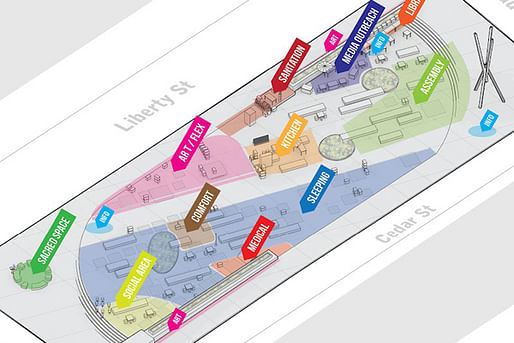
As Occupiers posted links, updates, photos and videos on social media sites; as they deliberated in chat rooms and collaborated on crowdmaps; as they took to the streets with smartphones, they tested the parameters of this multiply mediated world. What is the layout of this place? What are its codes and protocols? Who owns it? How does its design condition opportunities for individual and collective action? — Places Journal
On the anniversary of Occupy Wall Street, architects Jonathan Massey and Brett Snyder investigate the spatial dimensions of political action in two related features on Places, including axonometric drawings that follow the transformation of Zuccotti Park into Liberty Plaza. See the trailer below. View full entry
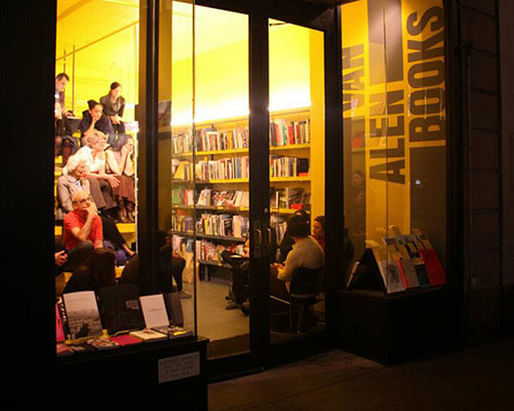
For those of us who have long fought for greater diversity in architecture, the slow pace of change is less alarming than the emergence of cynical voices that dismiss the viability of architecture as a profession. At the final Van Alen roundtable, Dagmar Richter relayed the opinion, expressed by some in the field, that the declining status of the discipline is reflected in the growing presence of women in architecture schools — in other words, women are making headway because men are bailing. — Places Journal
Are we really ready to be post-feminist? Inspired by a series of Van Alen Institute roundtables held this spring — and by the alarming attrition rate of women practitioners — Despina Stratigakos advocates for an expanded role for next-wave feminism in architecture and design... View full entry
![Left: Ms. Magazine, inaugural issue, summer 1972. Right: Faculty and students of the Women's School of Architecture and Planning Summer Program, 1975. [Images courtesy of Gabrielle Esperdy]](https://archinect.gumlet.io/uploads/a6/a6e4976girowvrur.jpg?fit=crop&auto=compress%2Cformat&enlarge=true&w=514 "Left: Ms. Magazine, inaugural issue, summer 1972. Right: Faculty and students of the Women's School of Architecture and Planning Summer Program, 1975. [Images courtesy of Gabrielle Esperdy]")
Let’s mentor a new generation of architects who are as proud to be women as they are proud to be designers. And let’s start by taking back the “architectress,” by infusing that cringe-inducing, condescending, mid-century term of opprobrium with some born-this-way, kick-ass, grrrl-power, retro cool. Imagine Architectress t-shirts and Architectress tattoos, Architectress blogs and Architectress fansites, Architectress flash mobs and Architectress meetups. Imagine Architectress going viral. — Places Journal
Back in the '70s, second-wave feminists were organizing and agitating, forming alternative communities, creating new spatial practices and attempting to pry open what a contemporary reporter called the "exclusively male preserve" of the American architecture profession. Gabrielle Esperdy revisits... View full entry
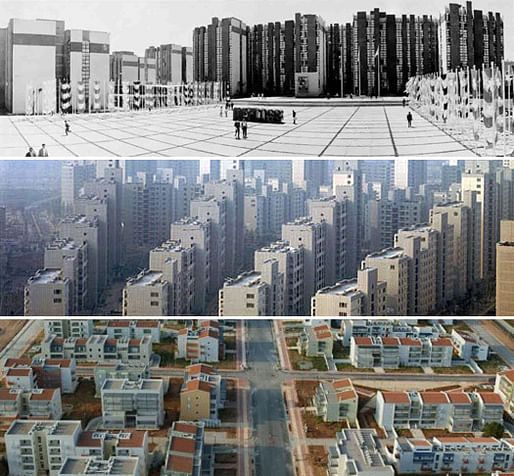
At the 1928 Amsterdam games, athletes were accommodated in spare rooms in boarding houses and aboard ships. The first Olympic Village was built in 1932, in the Baldwin Hills neighborhood of Los Angeles, but it was dismantled after the games and virtually no trace survives today. Not until the 1952 Olympics in Helsinki did host cities began to plan and develop permanent structures for housing athletes. — Places Journal
When the Olympic Games open next week in London, showpiece venues like Zaha Hadid’s Aquatics Centre and Populous’s Olympic Stadium will be the center of the world’s attention. But when the games are over, the greatest impact on London urbanism will be from the 2,800 new... View full entry

Revolutionary guards who are denied entry to an apartment have been known to scale a building’s walls with grappling hooks to dismantle receivers. It may seem like something out of a spy novel, but this cat-and-mouse game tells the deeper story of a complex exchange between the Islamic Republic and citizens of Tehran. In the absence of legitimate public space for discourse or demonstration, the satellite receiver opens a space for political dissent and cultural protest. — Places Journal
In contemporary Tehran, where the city's parks and plazas have been delegitimized by censorship and surveillance, the true public realm is inside the home. On Places, architect Rudabeh Pakravan examines the spatial politics of satellite television in Iran, with a close look at "the satellite man"... View full entry

Foreclosed is controversial because it suggests that the state, or the public sector — conceived along with civil society in terms of multiple, overlapping, virtual and actual publics — might play a more active, direct and enlightened role in the provision of housing and, by extension, of education, health care and other infrastructures of daily life in the United States.... Simply put, can we no longer imagine architecture without developers? — Places Journal
Earlier this year Foreclosed: Rehousing the American Dream opened at MoMA in New York. The exhibition quickly became controversial, with some decrying it as elitist and paternalistic, others defending it as powerful and ambitious. On Places, Reinhold Martin, co-organizer of Foreclosed, and... View full entry
But despite the many and varied predictions of the death of criticism — of architecture as well as other forms of culture — it seems to me that a radical rethinking of critical practice might be prompted by the potentials of writing for online media, and that this rethinking might result in a new belle-lettrism. — Places Journal
How will the accelerating transition from print to digital publishing affect the practice of architecture criticism? On Places, Naomi Stead surveys the scene and is optimistic about the possibilities. View full entry
