

Follow this tag to curate your own personalized Activity Stream and email alerts.

Shaun Donovan, the former Secretary for the United States Department of Housing and Urban Development under President Barack Obama, has filed papers to run for mayor of New York City in the upcoming 2021 election. Donovan is vying to succeed current New York City Mayor Bill de Blasio, who... View full entry

President Trump is preparing to divert an additional $7.2 billion in Pentagon funding for border wall construction this year, five times what Congress authorized him to spend on the project in the 2020 budget. — The Washington Post
According to The Washington Post, the funding would give the government enough money to complete about 885 miles of new fencing by spring 2022, far more than the 509 miles the administration has slated for the U.S. border with Mexico. So far the Trump administration has completed... View full entry

In light of the recent Democratic debates, many candidates have shared their goals and intentions towards sustainability, housing, and infrastructure plans. Last year presidential candidate hopefuls like Andrew Yang shared his sustainability plan back in August 2019. Candidates... View full entry

Sanders railed against Trump’s housing policies and explained his own, which calls for federal investment of $2.5 trillion over the next decade and a national rent control standard. He said he will pay for the policy by establishing a wealth tax on the top tenth of one percent — or, according to his estimate, the wealthiest 175,000 families. — The Washington Post
Major points of the $2.5 trillion plan include: Establishing a national rent control standard that would cap rent increases at no more than 1½ times the rate of inflation or 3 percent, whichever is higher.Promoting legal protections for fair housing and taking steps to eliminate racial... View full entry

In a recent news article from MIT News, architectural historian Timothy Hyde explains why "every building is ultimately a compromise.” Hyde shares, “It’s a compromise between the intentions of architects, the capacities of builders, economics, politics, the people who use the building... View full entry

The city recently enacted stricter zoning regulations to curb excessive mechanical spaces in residential buildings, the first in a series of steps geared toward eliminating zoning ambiguities exploited by developers.
[...]
Now, elected officials and preservationists are pushing the city to enact stern oversight on additional types of voids and other perceived zoning loopholes.
— Curbed NY
"Many neighborhood advocates felt the void amendment did not go far enough, and called for the change to recognize unenclosed voids—such as Rafael Viñoly Architects’ disputed 'condo on stilts' on the Upper East Side—as mechanical," writes Caroline Spivack for Curbed NY. "They charge... View full entry

Technology that would connect the cities of Cleveland and Chicago via a 30-minute commute inched closer to reality this month as a national transportation and housing appropriations bill passed one federal hurdle.
Five million dollars in initial funding for the Great Lakes Hyperloop System, an experimental high-speed transportation project, was included in legislation voted on by the U.S. House of Representatives in late June.
— Crain's Cleveland Business
Kim Palmer reports for Crain's Cleveland: "The passage of the 2020 Transportation, Housing and Urban Development Appropriation bill by the House provides the funds for the U.S. Department of Transportation to create a regulatory framework for development of a hyperloop system." Prototype of the... View full entry

The City Council voted to close a zoning loophole that has allowed developers to boost building heights with excessive mechanical spaces—but it’s only the first step in addressing the issue, say lawmakers. — Curbed NY
The zoning amendment will limit the city's notoriously over-sized mechanical spaces to 25-feet in height before additional space begins to eat into a project's allowable buildable area. New York City lawmakers are pushing to close other loopholes, as well, including rules impacting the use... View full entry

The news of British Prime Minister Theresa May announcing today that she would move out of 10 Downing Street on June 7, following a lengthy period of political disarray over the UK's post-Brexit future as well as criticism over her handling of the Grenfell Tower fire tragedy, did not come as an... View full entry

All told, there are at least seventy border walls in the world today. Their construction has inspired an entire field of research dedicated to studying their effects. Psychologists, economists, geographers, and other specialists regularly publish reports in outlets such as the Journal of Borderland Studies, and much of their research suggests that border walls may be affecting the people who live near them in unforeseen ways. — The New Yorker
As the discussions about producing and enforcing geopolitical borders become more commonplace in global news, the studies of the psychological effects of those of previous eras have become painfully relevant. Berlin Wall, photographer unknownDietfried Müller, a German psychiatrist, had noticed... View full entry

A state lawmaker is gunning for more aggressive restrictions on the vast mechanical voids developers often abuse to boost their buildings’ heights as a “more robust” solution to the de Blasio administration’s recent zoning amendment. [...]
Current zoning exempts mechanical voids from a building’s floor-area ratio (FAR)—a given property’s square footage—and puts no height limits on those spaces.
— Curbed NY
"Luxury developers often exploit this loophole in residential towers to hike up the price for apartments on higher floors," explains Curbed NY one reasoning behind the newly introduced bill by New York State Assembly member Linda Rosenthal. View full entry

The UK government thinks it has got to the heart of the housing crisis: the problem is, new homes just aren’t beautiful enough. “Build beautifully and get permission,” says the housing minister, Kit Malthouse. “Build beautifully and communities will actually welcome developers, rather than drive them out of town at the tip of a pitchfork.” — The Guardian
According to housing minister, Kit Malthouse, the key to solving the housing crisis in the UK is “putting beauty at the heart of our housing and communities policy.” On November 3, 2018, the initiative to champion beauty when building better homes was announced through the "Building Better... View full entry

On this week's episode of Archinect Sessions, Ken, Donna, and I share our conversation with Rusty Long, an architect based in Cary, North Carolina. Rusty’s private practice focuses on sustainability and community engagement with a style that bridges modernism and the history of the the American... View full entry

In a big win for architects, the US House of Representatives passed the Senate version of H.R.2353, the Carl D. Perkins Career and Technical Education (CTE) Act on Tuesday. Architects across the country led the charge to pass this bill, highlighting its promise in discussions with their representatives. — AIA
The academic grouping known as STEM (Science, Technology, Engineering, and Mathematics) has long been regarded as the antithesis to the creative fields of art, music, and architecture. But the bill recently passed by the US House of Representatives allows states to use federal money to modernize... View full entry
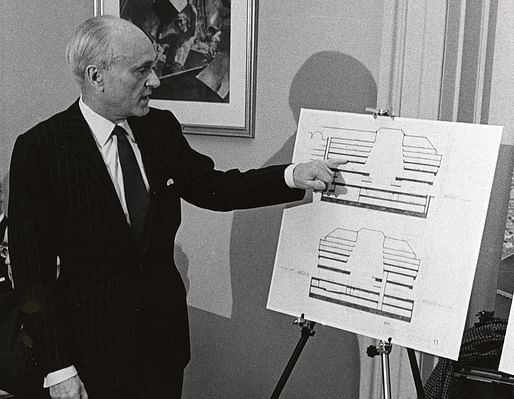
In “The Man in the Glass House,” Mark Lamster’s brisk, clear-eyed new biography of Johnson, we are asked to contemplate why the impresario of twentieth-century architecture descended into such a morass of far-right politics—and how, given the depths to which he fell, he managed to clamber his way not just out of it, but to the top. [...] Johnson managed to abjure his past and, on the march toward an exceptionally successful career, leave it behind. — The New Yorker
The New Yorker reviews the new Philip Johnson biography, The Man in the Glass House by architecture critic and professor Mark Lamster, and examines how Johnson eagerly embraced Fascism before WWII and still rose to great fame as America's iconic 20th-century architect. "Indeed, it is... View full entry


