

Jun '10 - Aug '10
Finally made it to Miguel Fisac's Iglesia de Santa Ana (1965) today. There will be more Fisac to come, but I wanted to put this up. Of the major figures of post-war Spanish architecture, he is perhaps the most clearly related to the Scandinavians, whose work he'd seen in person. Asplund is mentioned, as well as Jacobsen, but surely Aalto must have been an influence as well. The Asplund relation can be more clearly seen in a couple of buildings I'll post later.
In the late 1950s, Fisac developed a highly specific language of pre-stressed concrete elements, or bones, here combined with both sculptural and generic cast-in-place forms. At Santa Ana, the interior is given great attention, while the exterior (the church sits in the middle of a post-war housing development) appears to be the largely unadulterated result of the interior manipulations. 
The sanctuary 


The stained glass on the rear walls 
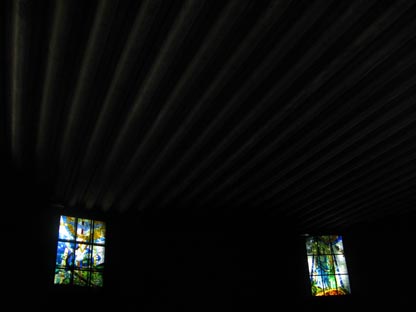
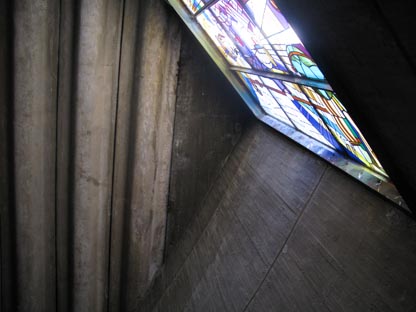

The quite delicate pews 
Inside the baptistry and confessional 

The parish offices 
The little cloister 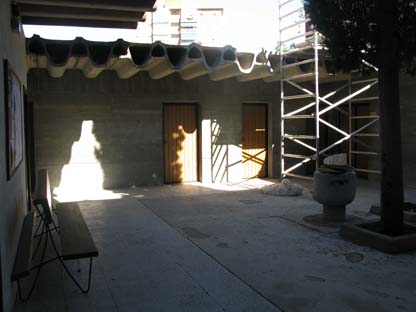
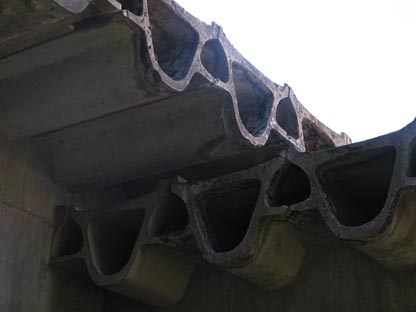
The exterior form is clearly driven by the interior 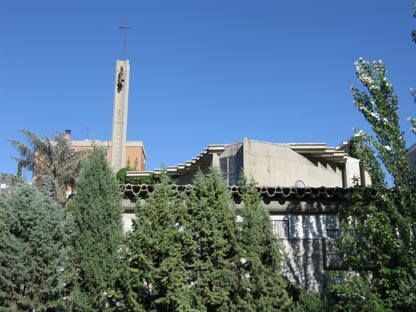

Santa Ana, like everything else, is being restored this summer. Plans and sections were conveniently posted 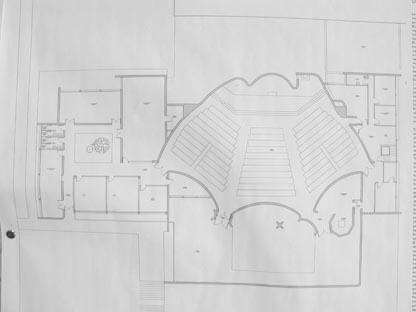
When I walked into the church a few people were inside testing its presumably new Bose soundsystem. It was the first time I'd been asked to be absolutely quiet in a church. I heard the noise you will hear in the video at least forty times. Bose has got to be making a killing on churches.
Santa Ana from Emmett Zeifman on Vimeo.
His research is focused on the diverse and shifting positions of architecture within Francoist Spain (1939-1975). It pursues a number of related questions, examining the relations between institutions of architecture and the regime, the function of architecture at the intersection of totalitarianism and an increasingly free market, and the evolution of architecture in Spain in the void left by the post-Civil War rejection of international modernism.



1 Comment
holy cow.. really really fantastic church!! love the pews
Block this user
Are you sure you want to block this user and hide all related comments throughout the site?
Archinect
This is your first comment on Archinect. Your comment will be visible once approved.